


Seeking a balance that would calm the streets and not cost him more political capital, Volodymyr Zelenskyy dismissed the commander-in-chief of the Ukrainian Armed Forces, veteran Oleksandr Syrskyi, on Tuesday night, and appointed General Mykhailo Drapatyi, a reformist who had been leading the Joint Forces, in his place. The change culminates a week of political and military crisis triggered by the dismissal of Defense Minister Mykhailo Fedorov, which led to the largest protests recorded in Ukraine since the beginning of the Russian invasion.
Read more It’s no country for children: “More and more people only see them as a nuisance”
With this move, which implies a generational change, the president responds to one of the main demands of the protesters, but keeps out of the government the minister whose dismissal triggered the crisis and leaves open questions about the future of the deep reform of the Army. For now, more faces are changing: he has also replaced the Chief of the General Staff of Ukraine, as part of a new military reorganization that might only be about names.
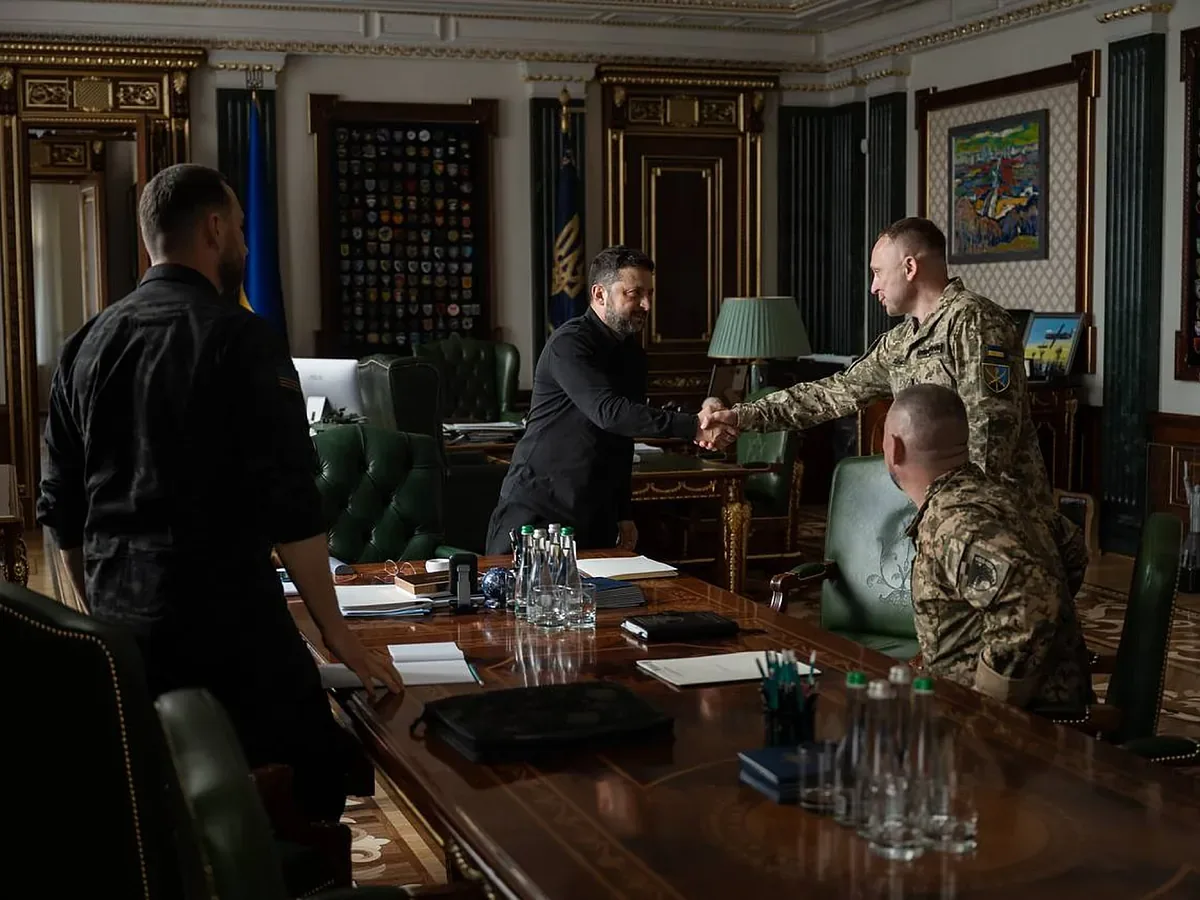
In his message announcing the change, Zelenskyy assured that, together with Drapatyi, acting Defense Minister Yevhen Khmara, and Deputy Head of the Presidential Office Pavlo Palisa, he has already defined “how the General Staff structure should be renewed,” while thanking Syrskyi for his historic role in “the Defense of Kyiv, the Kharkiv counteroffensive, and the Kursk operation.” Drapatyi, 42, belongs to a generation of officers whose careers have developed during the war against Russia and had appeared in recent days among the main candidates to replace the outgoing commander. Drapatyi’s new right-hand man, Ihor Skybiuk, fought “shoulder to shoulder” with Drapatyi, the Ukrainian president recalled.
The replacement at the head of the army is the biggest change in the military structure in force since the winter of 2024, when Syrskyi replaced the —too— popular Valerii Zaluzhny. The decision modifies the tone of the crisis, but does not guarantee its end: on Friday, demonstrations will return to Kyiv and other cities demanding the return of the reformist Fedorov to the head of the ministry. But Zelenskyy, who tries to neutralize accusations of inflexibility, also does not want to appear as a softie who backs down. Fedorov’s popularity has soared in recent hours and now surpasses Zelenskyy.
WHAT IS AT THE HEART OF THIS DISPUTE?
If former minister Fedorov believes in algorithms and efficiency, the dismissed Syrskyi always revered courage and sacrifice. Without bravery, it would not have been possible to defend Kyiv and Kharkiv in the early days of the war, when Ukraine seemed doomed. But then came almost suicidal missions like the incursion into Kursk, from which they did not withdraw in time, paying a high price in soldiers with questionable results. The digital tool and its stream of cold data clash with the Soviet school, which combines blind obedience with cunning when embellishing reports or perverting supply contracts for profit. The two currents have support in the army and the private sector, are intertwined and have nuances: in 2022, Ukraine resisted with a mix of the courage of the grandparents who fought against Hitler and the decentralized scheme learned from NATO by the grandchildren who now wield weapons against Russia.
The old Syrskyi and the energetic Fedorov had been trying to eliminate each other for months and both have ended up in the ditch of Ukrainian politics. During these days, the president’s team has tried to square the circle. Fedorov rejected several proposals from Zelenskyy over the weekend to return to the government with other responsibilities and maintained that he would only accept returning to the Ministry of Defense, convinced that the transformation of the Army cannot be carried out without control over the budget, procurement, and relations with the General Staff. Syrskyi left office claiming that he was handing over to his successor “an Army that not only maintains defense but is also on the offensive,” and assured that the Armed Forces have recovered about 700 square kilometers of territory this year. Fedorov is popular, but Syrskyi had connections and a certain influence over Zelenskyy, who, although he yearns for an effective army, appreciates military personnel capable of sometimes obeying political orders with less military value.
“The Kyiv regime is tottering,” boasted the Kremlin spokesman about Syrskyi’s departure. In Moscow, where they have not yet managed to put together a plan for the growing wave of enemy drones, every chapter of these days’ Ukrainian turbulence has been viewed with some satisfaction. Especially the departure of the ousted Defense Minister, a man of numbers who had changed the tide of the war against Russia. Ukrainians no longer retreat heroically, but advance. They continue to search for their dead among the rubble every week, but they are disarming Russian logistics in the rear, which is now also a death zone, while melting down Russian refineries causing gasoline crises. Now they are also short-circuiting Russian commercial normality by razing the warehouses of Russian internet shopping giants. The war in Ukraine is felt more in Russia than ever, and the credit is no longer only due to Western sanctions but to the Ukrainian army. Ukrainians now like to call their missiles and drones “long-range sanctions.” With this open crisis in the army, Zelenskyy risks losing the initiative.
A LEGACY AWAITING
Ukrainians have taken to the streets because they know that a reform is pending to achieve an army that does more with less without demanding so much sacrifice of lives and suffering. One of the priorities of the dynamic Fedorov was to reduce troop exhaustion. Analyst Jack Watling, from the Royal United Services Institute (RUSI), explains that Ukrainian military inspectors themselves considered that a soldier should not remain on the front line for more than 40 consecutive days. However, many fought for up to 200 days because the Ukrainian Army did not have enough units to relieve them or the necessary firepower to do so safely. To correct this problem, Fedorov wanted to reorganize army corps and facilitate the rotation of brigades. The current system, Watling writes in a report for RUSI, “greatly complicated command.”
The second reform consisted of reorganizing the front. When Fedorov arrived at the Ministry, many brigades of the same corps were deployed in sectors separated by hundreds of kilometers. This made it difficult to share resources, coordinate operations, and replace exhausted units. His idea was to group brigades fighting in the same sector under a single command to gain flexibility and improve front management. He also wanted to change the way of fighting: Fedorov was convinced that technology should serve to reduce casualties. His intention was to identify commanders who achieved better results through the use of drones and other unmanned systems and give them more personnel and resources. As Watling summarizes, he sought to reinforce those who “best leveraged technology to accomplish missions at a lower cost.”
Fedorov wanted to transform the functioning of the Army to make it more sustainable in a long war: less infantry attrition, more frequent rotations, and a model in which innovation replaced part of human sacrifice.