


The change in stance that the Prime Minister dictated regarding the Western Sahara in 2022 – assuming Moroccan sovereignty – already sparked some insinuations at the time, from the right, about the relationship this could have with the espionage using the Pegasus software on the mobiles of Pedro Sánchez and other members of the Government, committed in 2021. “I have no problem with my mobile,” the president limited himself to saying in response to one of those questions, although, as the PP reproached him then, he did not clarify which files had been taken from him.
Read more The socialists’ veto to shield Morocco sabotages a resolution supporting Ceuta in Europe
Four years later, the thesis presented by Sánchez regarding the role Rabat played in the massive entry into Ceuta at the end of July has revived the questioning, but now it is not only the right who raises it, but also some of his partners. The Government’s opacity regarding what was taken in Pegasus and the dialogue established with Morocco in the face of this Ceuta crisis has not helped to quell the insinuations of blackmail coming from across the political spectrum.
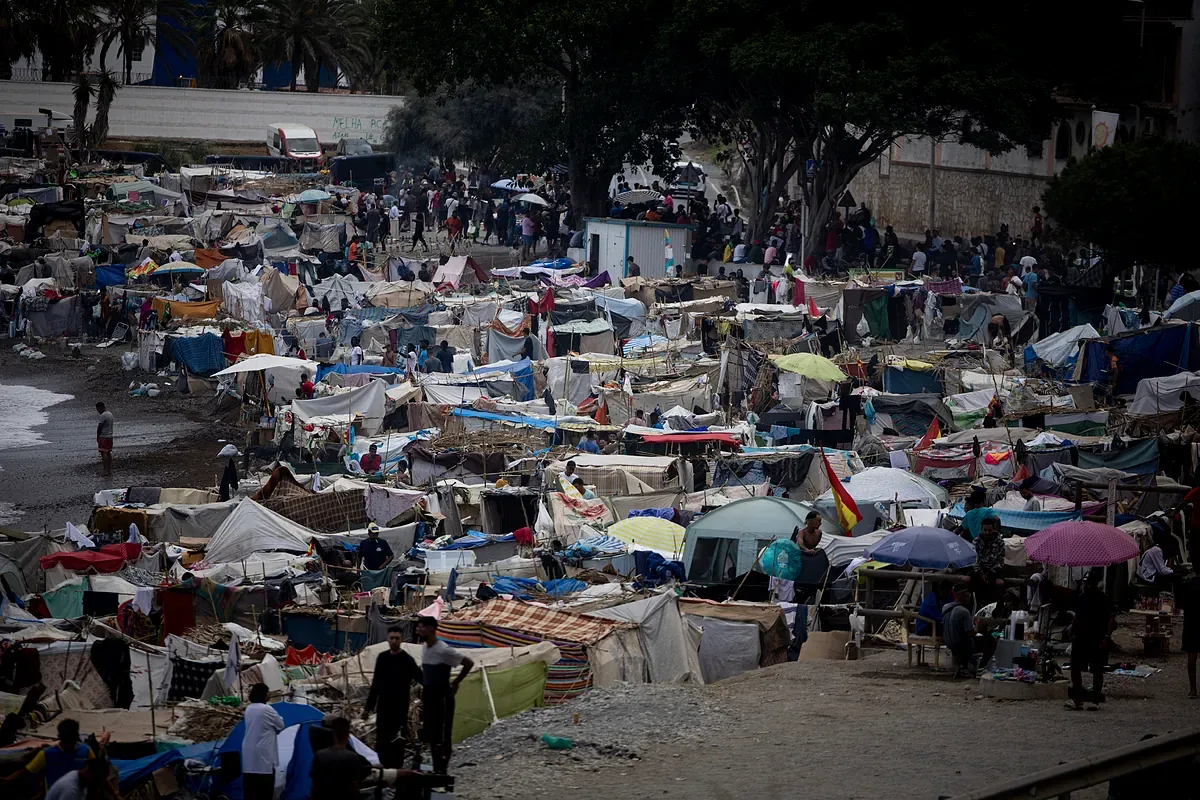
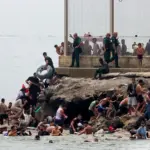
Popular Party and Vox were the first to stir the thesis, framing it in their reproach to Sánchez for not holding Rabat responsible for the irregular entry of 72,000 people. “What was on your phone? Why are you afraid of Morocco? What does Morocco know about you?” Alberto Núñez Feijóo addressed him two weeks ago today, in the same session in Congress in which Santiago Abascal threw at him: “What do you owe the attackers that you do not dare to point them out? What do they know about you?”.
But the approach did not stop there, as some parliamentary supporters of the Government made it their own in the following days. “Perhaps [Morocco] has too much information about the president,” suggested Ione Belarra (Podemos) and, this weekend, the president of the PNV, Aitor Esteban, stated in an interview in El Correo: “That Morocco may have something we do not know that makes the pressure on the Spanish Government even greater, I would not rule it out.” Earlier, asked if he believes Sánchez might be being blackmailed, he hinted: “The issue of Pegasus espionage occurs and a few months later we have the shift in the Spanish position on the Sahara. It was an earthquake about which no explanation was ever given.”
Although other partners of the president, such as Sumar or ERC, have distanced themselves from that blackmail thesis, all have questioned the stance Sánchez is maintaining regarding Morocco in relation to the Ceuta crisis, demanding a greater response that, for now, has not arrived. And that, for those who do support the insinuations, gives them wings to reaffirm their doubts.
It is also due to the persistent lack of clarifications about what material was obtained from Government members in the intrusion with Pegasus. In Monday’s interview on El Intermedio, when asked if he could assure “that the Pegasus espionage on [him] and his Government is not conditioning his stance with Morocco,” Sánchez replied: “Absolutely not.” He did not provide further details about the data that might have been seized. And, almost a week earlier, in an interview on La 1, when asked if he feels blackmailed by Rabat, he limited himself to assuring that his Government “never accepts any blackmail.” “Because it is not in our nature and because we have nothing to hide,” he added, then referring to the declassification of documents about the massive entry into Ceuta that was being launched that same day.
In any case, Sánchez’s answers to questions about the alleged blackmail and Pegasus have always been focused on the Government as a whole, not on himself as an individual, which is where the right directs its suspicions.
On El Intermedio, Sánchez wanted to clarify that he has “never” said that Spain “will not make a strong response to Morocco if it is proven that Morocco, the regime, is behind what happened on July 30 and 31.” But so far he has not explained what dialogue he has maintained, as president, with Rabat after what happened, something Feijóo asked him to clarify yesterday.
Meanwhile, in the six appearances he has made this September, between interviews and interventions in Congress, the “attack” or “violation of Spain’s territorial integrity” that Sánchez defined on July 31 has given way to other terms such as “hybrid attack” and, in its current state, “humanitarian crisis.”