





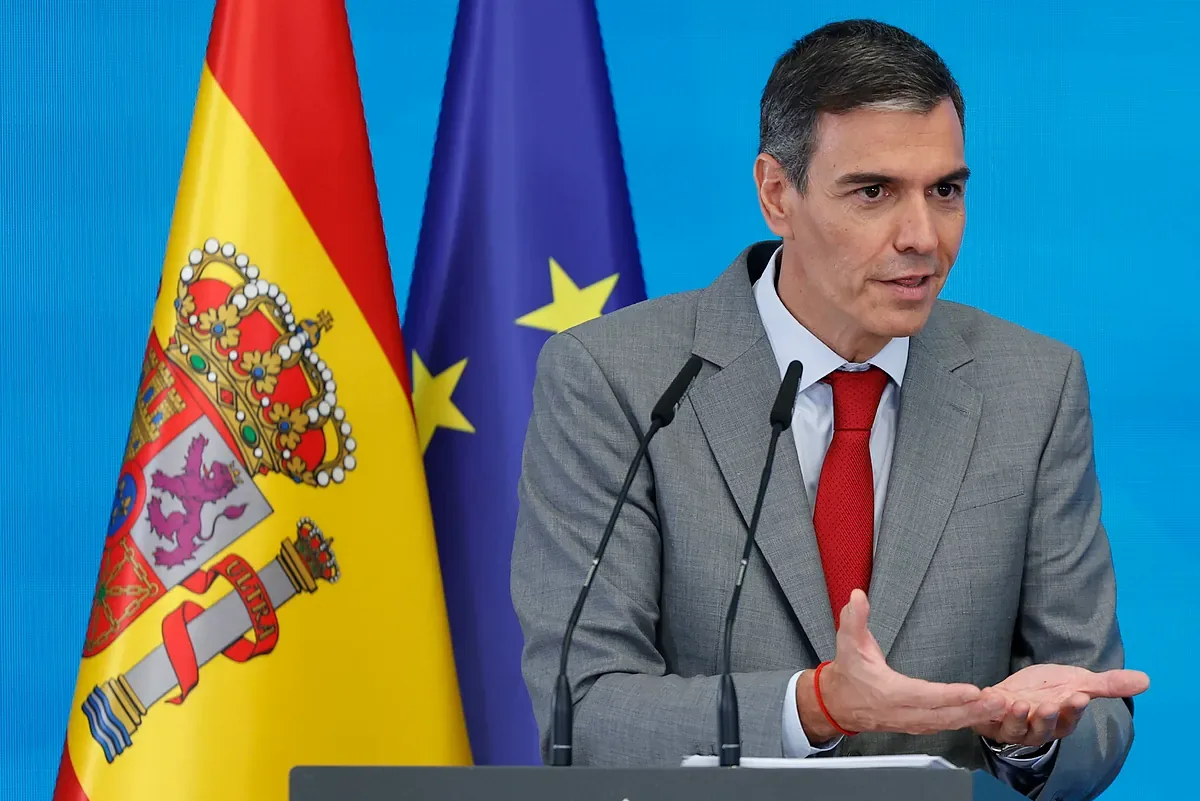
The close of the political term has been marked by the uncontrolled fires ravaging Spain, burning thousands of hectares and causing an unprecedented number of evacuations. “Serious situation.” This is how Pedro Sánchez described it in a statement to review the term. The fire has led the Prime Minister to call on political parties these days to join the State Pact against the Climate Emergency that the Government presented in September 2025. But the position is that the parties should unite, because the head of the Government does not plan to call the opposition leader, Alberto Núñez Feijóo, to meet and reach a common stance that allows this purpose. “If they are willing to join this pact, they are welcome. The doors are open,” Sánchez said.
This State Pact, which Sánchez proclaims as a necessity, serves, however, to contrast against the PP and Vox. For an agreement of this magnitude, the participation of the two major political parties, PSOE and PP, is essential, but the socialists understand that the popular parties’ pacts with Vox in the autonomous communities—a party that questions climate change—make an agreement with the main opposition party impossible. So, in addition to advocating the need for this agreement, Sánchez’s insistence also aims to expose that the PP is tied to Vox and cannot.
“The Government is always open to talking with the entire opposition. Hopefully, it would be a constructive and not destructive opposition and would not deny scientific evidence,” Sánchez said. “There are issues that make me cautious. In the government agreements being formed (in the communities), there is no clear and firm will to fight the climate emergency. The denialism that, unfortunately, is gaining ground in some communities is the worst fuel to fight the climate emergency.”
What does this pact consist of? The Government’s proposal is structured in 10 points: advancing towards a forest management model adapted to the social, economic, and climatic realities of the 21st century; increasing resilience to floods and droughts; protecting citizens from heat waves; boosting the rural world and favoring its adaptation to climate change; enhancing the contribution of the forestry and agricultural sectors against extreme climatic events.
It also proposes creating funds with national and regional resources; permanently maintaining technical and human means to combat extreme climatic events; improving coordination and decision-making of public administrations; promoting a civic culture of prevention and reaction; accelerating the ecological transition in Spain and the European Union.
The PP, for its part, focuses on the anti-fire plan it also presented a year ago that contains 50 measures and that the popular party considers still “valid.” Each puts their proposal on the table, but the chairs do not turn to start the dialogue. Each looks toward their own wall. For Sánchez, what the popular party proposes is included in his plan.
“The PP wants a pact against fires, but does not want it on one of the main causes that provoke fires. Is that the issue?” the Prime Minister wanted to ironize. “That unity we already have.”


