






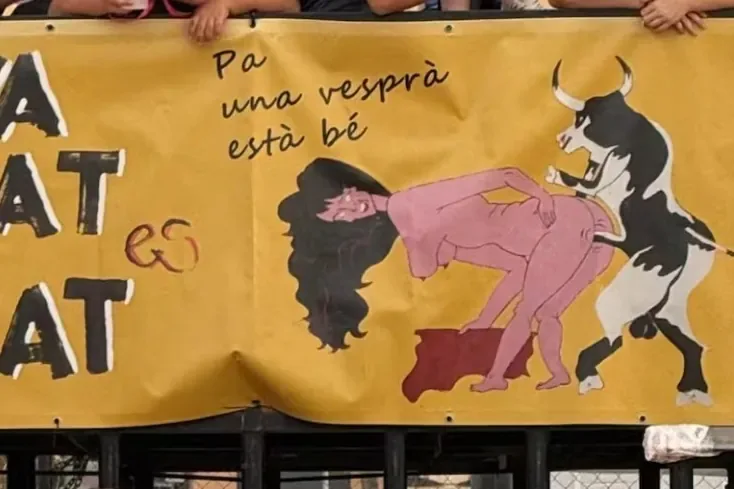
The First Vice Presidency of the Generalitat Valenciana and the Ministry of Housing, Employment, Youth and Equality have expressed their rejection of the poster of a peña at the Sagunto (Valencia) festivities that displays the image of “a bull sexually subjugating a naked woman”.
The Generalitat has shown its opposition “to any representation that contributes to denigrating, objectifying or ridiculing women (…) In the 21st century, and after the significant advances achieved in terms of equality between women and men thanks to the effort of the whole society, we cannot normalize or justify images that reproduce sexist stereotypes or that present women from a perspective of subordination or humiliation”.
“These types of manifestations – they add from the Directorate General of Equality through a statement – have no place in a society that aspires to be more egalitarian, respectful and free of discrimination”.
Popular festivities, it indicates, must be spaces of coexistence, respect and shared celebration, where all people can feel represented and respected, and freedom of expression cannot become an argument to perpetuate messages that attack the dignity of women or that contribute to trivializing discriminatory attitudes.
Equality urges the responsible peña to “reflect” on the impact of the chosen image and proceed to its removal or correction as a sign of responsibility and commitment to the values of equality and respect that must govern coexistence.
It adds that it will continue working to promote a culture based on respect, equal opportunities and the eradication of any manifestation of sexism.
The Feminist Coordinator of Camp de Morvedre, which was the first to denounce the message of the poster of a peña at the Sagunto festivities, states in a statement provided to EFE that this “is not a shared fantasy, it is a scene of subjugation disguised as a village joke. And the difference is simple, although some find it hard to understand”.
“It is a woman’s body placed there for people to laugh at her expense. There is no enjoyment in that image. There is humiliation in the form of a t-shirt”, it states, and adds: “a degrading image that sneaks into the party with the usual excuse: ‘it’s a joke’, ‘don’t be exaggerated’, ‘this is tradition’. The same old refrain so that women remain silent and applaud our own caricature”, the statement adds.
Read more Abelardo de la Espriella initiates the turn to the right in Colombia
This poster, as has now been learned and previewed by eldiario.es, was publicly displayed on the stage of a peña called “Un forat és un forat” (a hole is a hole) – with the phrase ‘pa una vesprà està bé’ (for an afternoon it’s fine) – in the fairgrounds during the patron saint festivities of Sagunto, which were held from July 15 to 30.
The statement concludes: “And since we are talking about holes, we also say it here: in ours there is no room for the right or the far right, nor any discourse that treats women’s bodies as a territory open to mockery or subjugation”.
The City Council requested its removal
The City Council of Sagunto (Valencia) warned that the image of a poster should be removed for being contrary “to the principles of equality and citizen coexistence”.
This demand was channeled through the Department of Festivities, which passed it on to the involved peña, called “Un forat és un forat” (a hole is a hole), according to sources from the town hall, who add that they became aware of the situation on July 23.
The peña explained that the image was on multiple elements and they needed time to find a solution, and it was agreed to establish a working group with that collective to prevent these images from recurring in future editions, with the purpose that the image presented at the festivities complies with the principles of equality, respect for the dignity of people and coexistence, they add.
The City Council adds that the poster is not currently displayed, and that it is the logo of the peña, also visible on t-shirts and other elements.
Read more The Adamuz crisis punishes high speed, which loses travelers seven months after the accident