





“The first thing I want is for this not to be taken as a joke because it was nothing like a joke, I didn’t do it for fun. The press took it as if I were the son of Count Dracula and I have nothing to do with Dracula, I’m a normal, ordinary guy. I saw that I was worth more dead than alive and I died.”
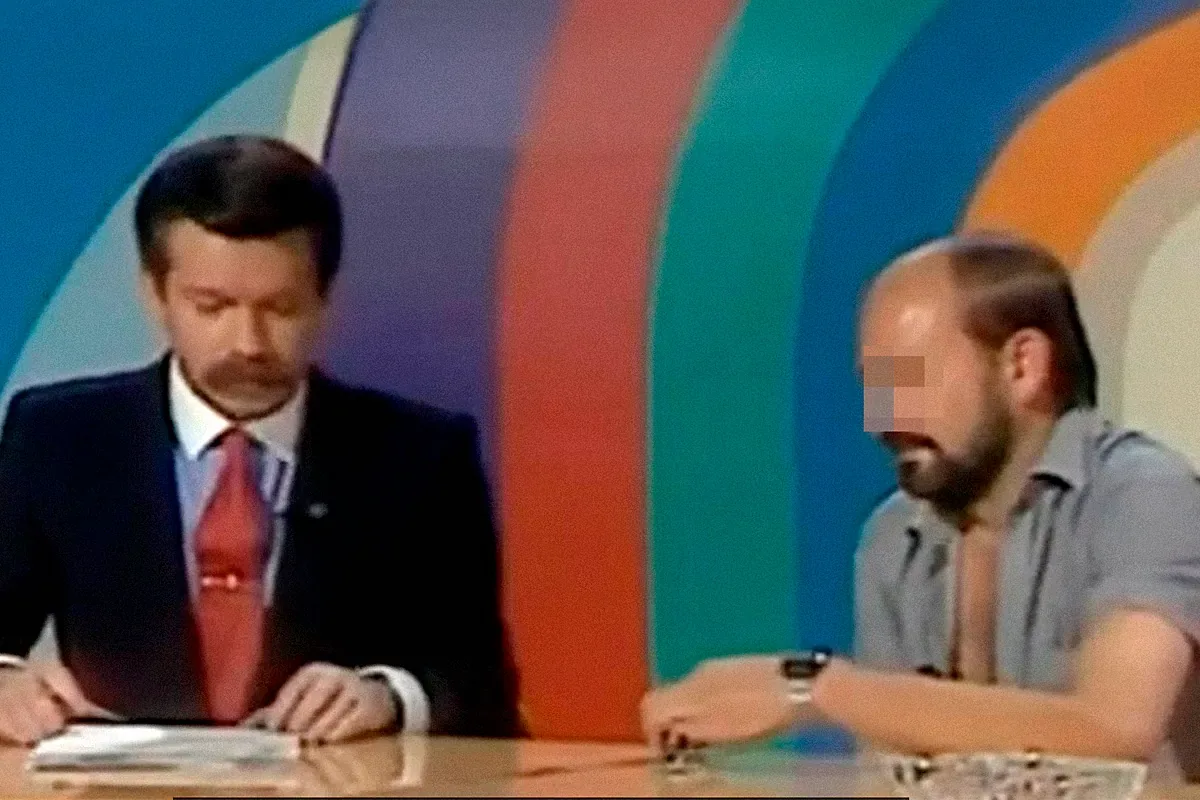
The man had just been released from prison after four and a half months in preventive detention and was sitting on the set of Estudio Abierto to answer questions from journalist José María Íñigo. It was June 1982, Spain was hosting the Football World Cup and he was still awaiting trial for grave robbing and attempted fraud.
Overwhelmed by debts, so that his family could collect his life insurance, he had taken a corpse from the cemetery of his town – Abarán (Murcia) – put it in his car and simulated a traffic accident. The body in the driver’s seat was burned, and since DNA tests to confirm the identity of the deceased did not yet exist, his fake death passed. “The ‘deceased’ was a ‘living person’,” the incident was titled in the newsroom of El Caso when the switch was uncovered.
“For me, it is really complicated, difficult, to put a label on the story I am going to tell you. I don’t know whether to call it chilling, macabre, curious, or simply a crazy story,” Íñigo began presenting the case to the more than two million viewers – at that time there were only two channels, TVE 1 and 2 – that the program had. At one point in the interview, Íñigo asked the guest where he had gotten the crazy idea, whether it was his own or inspired by a novel or movie.
He replied that he had seen the film Death of a Salesman, based on the play of the same name by Arthur Miller, in which Willy Loman, a debt-ridden traveling salesman, commits suicide by crashing his car so that his family receives the $20,000 from his life insurance. “He was a man who realized that he was worth more dead than alive and killed himself. But I didn’t want to die, that’s the truth,” he summarized the plot with a strong Murcian accent.
“I thought about it at eleven-thirty in the morning and by eleven at night I was dead,” he said. “I went to the bank to ask for half a million pesetas [3,000 euros at current exchange] and they told me I had to wait three months. That day I had to pay what I owed, I did the math and I was worth more dead than alive,” he insisted on emphasizing how profitable his death was.
A., who was then 36 years old, had a wife and four children and ran a fish shop, claimed he had improvised, but the truth is that only two months before faking his death, on November 10, 1981, he had taken out a life insurance policy with the company Mudespa.
He thought he had signed for five million pesetas [30,000 euros] in case of death, six million [36,000 euros] in case of accident, and seven [42,000] if the incident was traffic-related, but according to the sentence that convicted him, the amounts were much lower: one million pesetas (6,000 euros) was what his widow would receive for his death on the road.
At eleven in the morning on January 11, 1981 he thought about it and at six-thirty in the afternoon he entered the Abarán cemetery, which was under construction at the time due to an expansion. “I found out that there had been a motorcycle accident and I went and asked where the person buried that day was,” he explained to Íñigo.
The recently buried was nicknamed Querubín in the town, had died six days earlier, on January 5, and had been buried on Epiphany morning in a niche in his family’s pantheon. Juan the gravedigger later said he had not locked the pantheon because the family asked him to leave the door open for a couple of days at the express wish of the deceased.
-You didn’t know him, I suppose, or did you? – Íñigo asked.
-Yes, in my town we all know each other and I knew he was an acquaintance.
-Ah, so you also knew who he was?
-I didn’t know who he was. Later, I opened the coffin and saw it was him and, man, it gave me quite a shock [he probably meant a faint].
-Had you talked to him on any occasion, perhaps?
-Yes, we had drunk beers together and everything.
-And what did you think when you saw he was someone you knew?
-I told him to excuse me a little for what I was going to do.
-Who did you say that to?
-To him.
-To the dead man?
-Of course.
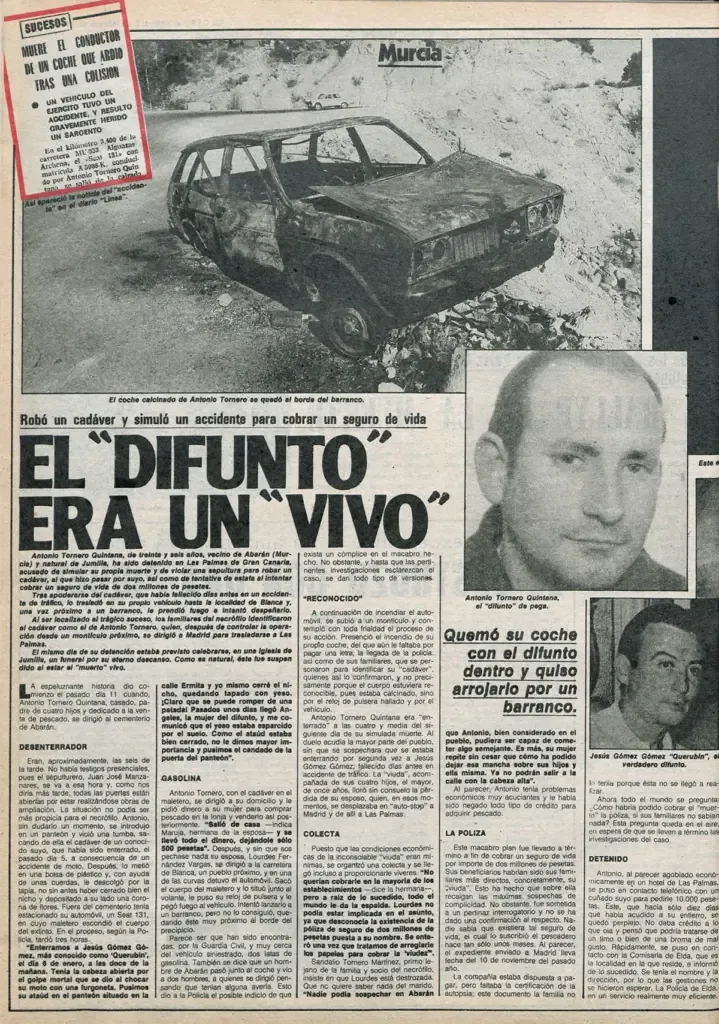
The sentence from the Provincial Court of Murcia that on November 20, 1982 sentenced him to four years for the crime of grave robbing in the degree of consummation and another year for attempted fraud, described the facts as follows: “Using his own Seat 131 station wagon, license plate xxxx, he went to the mentioned cemetery and after removing the slab covering the niche where the referred was buried, with absolute disregard for the respect due to the memory of the deceased, he managed to take out the coffin where the remains of his fellow townsman rested and using a large plastic sheet and a mattress cover, he placed them in the back of his vehicle, which he drove with such an unusual and macabre companion along the local road MU-553 from Blanca to National 301, but upon reaching kilometer 3.400 of said route, around one the next day, he stopped the car and after putting his own shoes and wristwatch on the corpse so that it would be identified as himself, he placed it in the driver’s seat with the seatbelt fastened and then threw the car down a slope of the road towards a ravine. But the vehicle stopped due to terrain accident, began to burn until it was practically unusable, a combustion that also affected the corpse, which was completely charred; after which the defendant, from nearby hills, watched the arrival of several people to the supposed accident site…”.
Afterwards, he said, he walked to a service area called Venta del Olivo, hitchhiked to Albacete, took a bus to Madrid and headed to Barajas airport. His plan was to travel to Caracas, but he didn’t have enough money for the ticket and ended up taking a plane to the Canary Islands.
While his family cried at his coffin on the way to the Abarán cemetery, he was in Las Palmas figuring out how to get the 7,000 pesetas – 42 euros at current exchange – he needed for a boat ticket to Venezuela. How could anyone suspect they were holding A.’s fake funeral, when in reality they were burying Querubín for the second time. It was January 12, 1982. “They buried him and put him there next to it. I mean, not in his pantheon, but in my family’s pantheon. And dead, what does it matter here or a little further,” he said on Estudio Abierto.
Two weeks later – January 26 – the economic situation of the presumed dead man who had fled to the Canary Islands was desperate. He didn’t even have money to shave. He then decided to ask a brother-in-law living in Elda (Alicante) for money. He called him on the phone: “What, do you know me?”. “Yes, yes, I want to know you but I can’t place you right now.” “Hold on, you’re going to fall. I’m your brother-in-law“.
The brother-in-law thought they were trying to fool him. A. was dead. He had attended his funeral. Someone was impersonating the deceased and trying to defraud him. There was no other explanation. He went to report the facts to the police.
One day later, on January 27, A. was arrested at the hostel where he was staying in Las Palmas. Two days later, on the 28th, Querubín’s grave was opened in the presence of some of his relatives. The coffin was found to be empty. His relatives had to be given sedatives.
Let’s now focus on the closest family of the resurrected man. His supposed widow. Was she aware of the farce? After the scandal was uncovered, the woman spoke to the media in these terms: “I never want to see him, for me he is dead, I already mourned him and went to his funeral. If he ever came, I would reject him.”
She did not allow photographs to be taken but probably spoke to silence the mouths of some neighbors, who had gone from being moved by the delicate situation she was left in – widow with four children – to looking at her with suspicion in case she had been an accomplice.
After several days locked in the house digesting the grief, she said, she was convinced to take over the fish shop. “I went out for the first time last Tuesday. Everyone helped me, that’s why I sold the 150 kilos that Sandaño brought me. I sold everything,” she told the magazine Diez Minutos.
It became known that A. had resurrected in the Canary Islands and everyone passed by his stall in the town market. “Today it hasn’t opened, why if no one wants to buy; if almost everyone rejects me? I haven’t sent the children to school either. Poor things, I want to spare them all comments. Lord, what madness! I didn’t expect this. What a shame, what a stain for life!”
She also said she had not detected anything in her husband’s behavior that would make her suspect he was plotting something. The afternoon of his death he was joking, as always. “We were laughing. It must have been nine-thirty or ten at night, the TV was on and the movie on the second channel My Favorite Terrors was about to start. He said goodbye to us, took the money from the cash register and left me only 500 pesetas [three euros]. He was going to Alcantarilla to buy fish. I never saw him again, they brought him to me dead in a box they said was sealed.”
A.’s wife felt betrayed and broke all his photographs, an act she perhaps later regretted, since she forgave him.
-What did your wife say to you? – Íñigo asked.
-The woman didn’t say anything to me until St. Joseph’s Day [Father’s Day], when she came to my house and I almost died. She arrived there and we argued, and then we argued more. My wife is a bit stubborn.
There are no statements in the archives from the great victims of this story: Querubín’s relatives. A. said he wrote them two letters asking for forgiveness and also expressed his regret through the press, but he received no response.
Legally, the case reached the Supreme Court. A.’s defense argued that the crime of grave robbing did not apply since his intention was not to profane the memory of his fellow townsman’s corpse but to defraud the insurance company. The High Court rejected the appeal and upheld the four years for this crime and another for attempted fraud, which was not consummated.
After leaving prison, the fake resurrected man of Abarán, as he was dubbed by the media, left the town and settled in another locality with his family. Now deceased, his children, who have contacted this newspaper, prefer not to remember what happened.
-If you had known what could happen afterwards, would you have attempted that operation or thought twice? – José María Íñigo asked him.
-Well, I would have thought twice. I really thought no one would find out and I was very careful to close the niche so no one would notice – he replied.
