


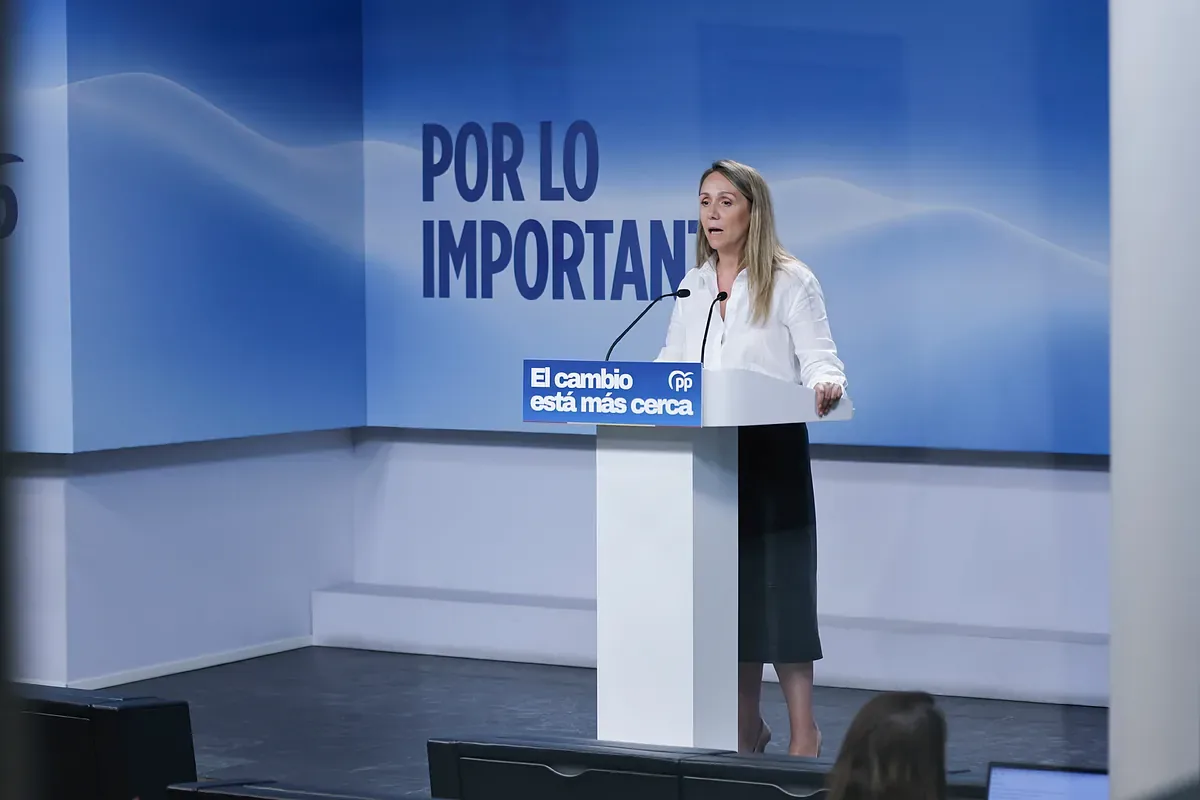
For the Popular Party, the details about the Leire Díez case that became known yesterday through its summary should provoke the resignation of the director general of the Civil Guard, Mercedes González, and her highest superior, the Minister of the Interior, Fernando Grande-Marlaska. The report from the Central Operative Unit (UCO) of the Civil Guard indicated that González would have been a key piece in the maneuvers to, allegedly, pressure those investigating judicial cases affecting the PSOE. “Not all of the Civil Guard is like its director general,” the PP’s deputy secretary Alma Ezcurra reproached this Thursday, to argue her request for resignation: “She is taking too long to leave for trying to undermine her own colleagues.”
In Génova, they extend responsibility for what is known to Minister Marlaska, who, however, this morning defended the “full honesty” of the body’s director and claimed to be unaware of these maneuvers revealed by the UCO. But the popular party members maintain that he must also assume responsibility. “The Minister of the Interior also has to leave, because he has turned his department into the epicenter of a cesspool,” Ezcurra claimed, who also criticized Marlaska for “endorsing such brutal attacks against judicial investigations” given that he himself is a judge: “I find it very sad.”
For the popular leader, the political responsibilities for what was revealed in the summary should extend to Marlaska – and, ultimately, also to Pedro Sánchez – because, in her opinion, “what we have learned is state crime.” “It is using the State that we all pay for with our taxes to attack all democratic counter-powers and to prevent the investigation of crimes in the personal circle of the Prime Minister,” Ezcurra argued, who again insisted that what is known within the framework of the Leire Díez case points to maneuvers to “destroy the Civil Guard from within the Civil Guard itself.” “When power corrupts, and corrupts other state powers, no one, no citizen, no one, is safe,” Ezcurra assessed.
In Génova, they believe that the PSOE “is going through its worst moment” and for this reason they keep all channels of opposition to the Government open, including the option of a motion of no confidence. “The PP does not rule out any constitutional instrument,” Ezcurra repeated this Thursday, who also addressed Sánchez’s partners again in search of support for Alberto Núñez Feijóo‘s party to “call elections.” The leader, however, has not clarified whether there have been – or will be – contacts with the PNV or Junts to sound out their possible support for this parliamentary initiative, although she stressed that the PP will not “ask for favors.”
The popular party members keep alive the option of a motion of no confidence because they do not see an early election happening in the other possible way: for Sánchez to dissolve the Cortes. They insist, in any case, that the Prime Minister is the person to whom “all the corruption plots” surrounding his party point, and that he should step aside whether he knew about them – “as a criminal” – or not – “as incompetent.” Ezcurra did not spare Sánchez her reproaches: “He started in some saunas and will end up in a cesspool,” she told him.