









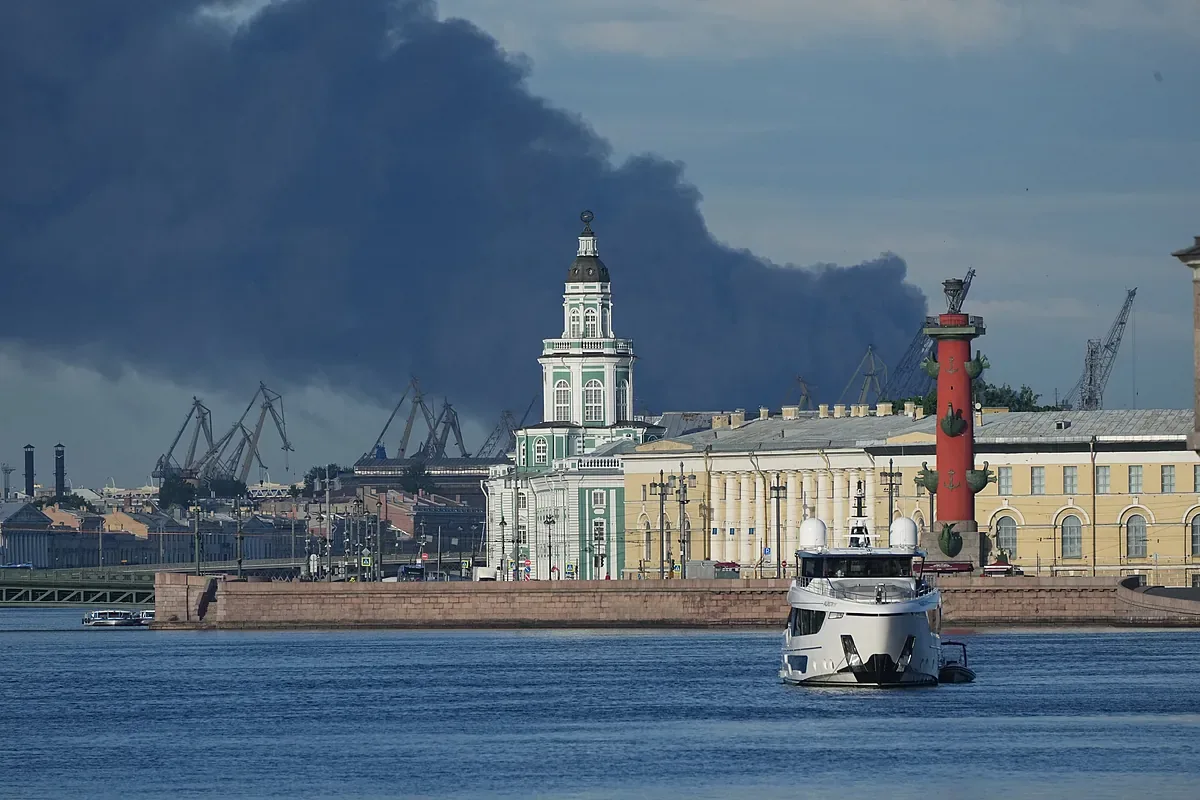
Ukraine launched a drone attack on St. Petersburg, the second in four days. From Kyiv, President Volodymyr Zelenskyy described it as a response to Vladimir Putin’s refusal to negotiate. Russian authorities claim to have shot down 144 drones in the Leningrad region and 376 across the country. Kyiv states that its drones hit naval arsenals and also the Kronstadt base, about 1,000 kilometers from the Ukrainian border
St. Petersburg, Putin’s hometown, woke up again this Saturday to the sound of drones. Ukraine launched one of its longest-range attacks against Russian territory during the night and early morning, targeting areas around the former imperial capital and the Leningrad region. The strike, acknowledged by Kyiv and partly confirmed by Russian authorities themselves, reached the Kronstadt area, the historic home of the Baltic Fleet, and forced the temporary closure of Pulkovo airport, several transport routes, and access to the naval city.
Zelenskyy stated that the attacks are a response to Russian President Vladimir Putin’s reluctance to end the war and initiate peace talks: “It is time to end this war. But the Russian leader wants to continue fighting. That is why Ukraine has imposed sanctions for this aggression.” “Our long-range sanctions covered approximately 500 kilometers, Russia must end its war and stop attacking lives. Any injustice against Ukraine will receive a fair response,” he added on Telegram.
The attack also had a strong media impact. It occurred on the last day of the St. Petersburg International Economic Forum, the Kremlin’s major annual economic showcase, where Putin had spoken just hours earlier. Moscow tries to present the forum as proof of normality and resilience against Western sanctions. But the presence of Ukrainian drones in the sky over St. Petersburg, about 1,000 kilometers from the border with Ukraine, once again demonstrates that the war is no longer confined to the front or to bordering Russian regions.
The governor of St. Petersburg, Alexander Beglov, acknowledged in the morning that the city had suffered a “massive attack by unmanned aerial vehicles for military use.” Air defenses operated for hours, and authorities asked residents to remain in their homes. They also warned of possible mobile internet disruptions, a measure Russia applies with increasing frequency during drone attacks to hinder their navigation.
There were no deaths, but there were injuries. In St. Petersburg, three people sustained minor injuries and were discharged, according to local authorities. In the Leningrad region, there was minor damage to building facades and windows, as well as transport restrictions. Pulkovo, the city’s airport, was closed for about five hours. Dozens of flights were delayed, and several planes had to be diverted to alternative airfields. Kronstadt, located on Kotlin Island, was temporarily closed to vehicle entry and exit.
This is not the first attack this week against St. Petersburg. On Wednesday, at the start of the economic forum, Ukrainian drones hit the St. Petersburg Oil Terminal and military targets in Kronstadt. A column of black smoke was then visible from different parts of the city.
Kronstadt has special military and historical value for Russia. It is one of the country’s oldest naval bases and a key point for the Baltic Fleet. There are ships, naval repair facilities, training centers, and logistical capabilities there. For Ukraine, which has managed to reduce the freedom of movement of the Russian Black Sea Fleet during the war, striking Kronstadt means sending the message that the Russian Baltic is also within reach of its drones.
The new wave confirms a change in aerial warfare. Ukraine, subjected nightly to Russian drone and missile attacks, has increased its long-range operations against refineries, fuel depots, military factories, airfields, and naval bases in Russian territory. The goal is to punish Moscow’s logistics, make the war more expensive, and force Russia to disperse air defenses away from the front.
For the Kremlin, the problem is not just military. St. Petersburg is Putin’s political and sentimental city, the showcase where he tries each year to show that Russia remains open to global business despite the war. The fact that drones reach there during the economic forum erodes that image of control. Moscow insists that its defenses repelled most of the attack.