






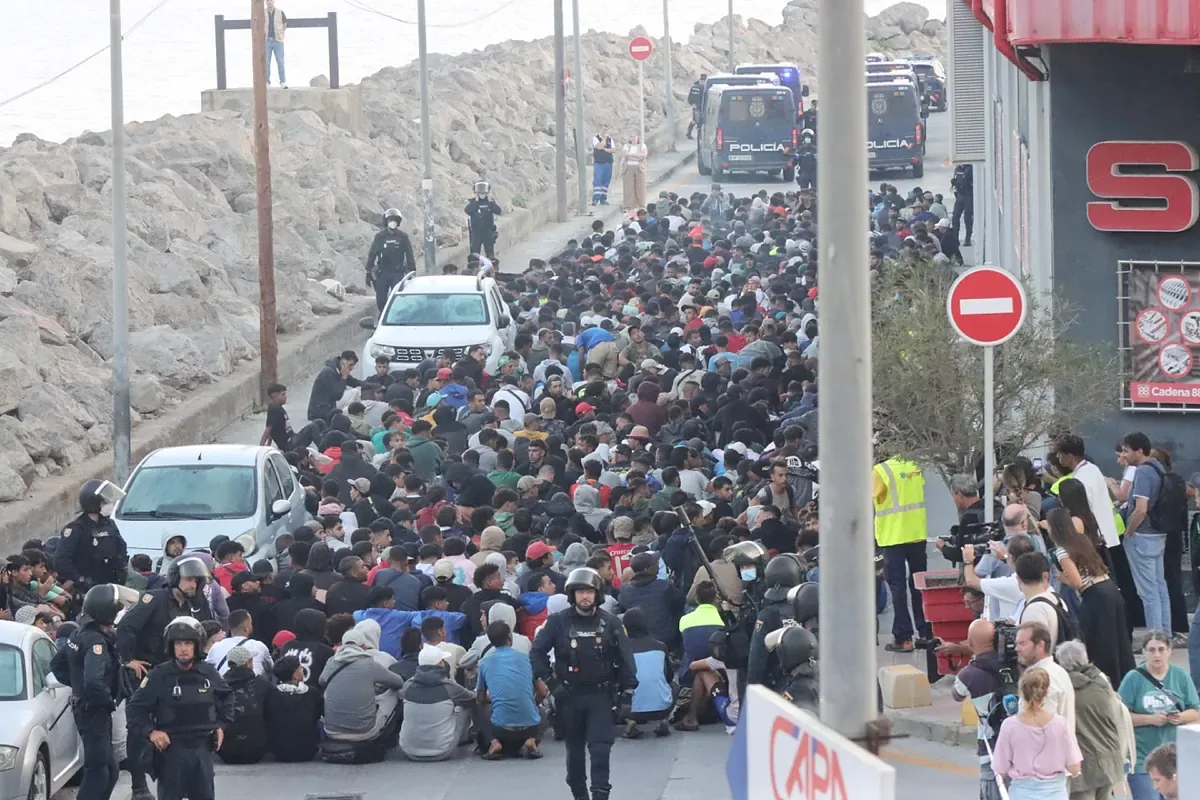
The great operation ended in fiasco. Or, if looked at positively, it brought reality to light. Because the attempt to clear the beaches of Trampolín and Benítez only revealed a situation that had been denied for 50 days: in Ceuta there are many more irregular immigrants than the Government had admitted.
When Moncloa decided to set up tents in mid-August, faced with the evidence that many of those who had entered on July 30-31 would not return to Morocco, they spoke of 6,000 places. They are already occupied and yet there are still thousands of irregulars in the streets, beaches, hidden in hills, crowded on terraces, concealed in basements… The Operation Dock, intended to finally relieve Trampolín, the symbol of the crisis, was about to be more than a partial failure. “In front of our uniforms they know they can do nothing, that if they touch us it’s all over for them,” describes a riot police officer (UIP). They stopped, but the tension could have escalated into something serious.
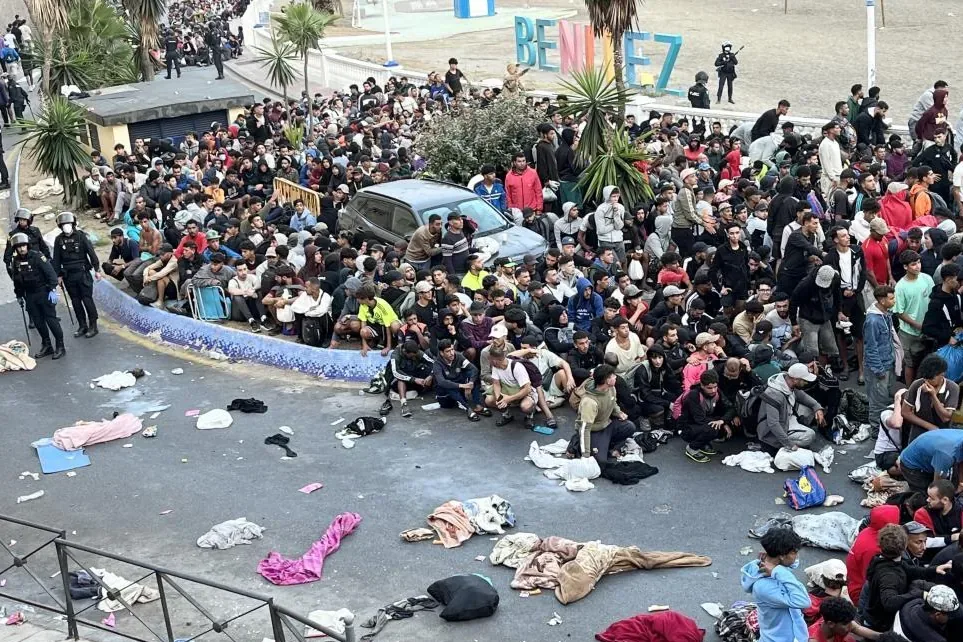
A colleague from the GRS of the Civil Guard provides the key to the minutes when the operation could have completely failed: “The spotlights turned on the call.” That overwhelmed the Security Forces just as the transfer of immigrants began, around 6:30 a.m. When the GRS, with the spotlights on, and supporting the UIP, positioned themselves at the entrance of the industrial estate where those sleeping at Trampolín and Benítez were to be sheltered, they saw a tide coming at them. There were barely 10 guards against 800 immigrants rushing. And they were alone, without the UIP. Opposite them were not those to be encapsulated for a controlled transfer, but other new irregulars who, at the first movements of the security forces, launched themselves from the hills, where they have been waiting for an opportunity for 50 days, to try to be the first to reach the facility set up at the West Dock of the port. And they are the ones who have been housed, while most of those sleeping on the Trampolín beach and near Benítez remain where they were. The plan to clear those areas and be able to show some normality in Ceuta for the first time failed.
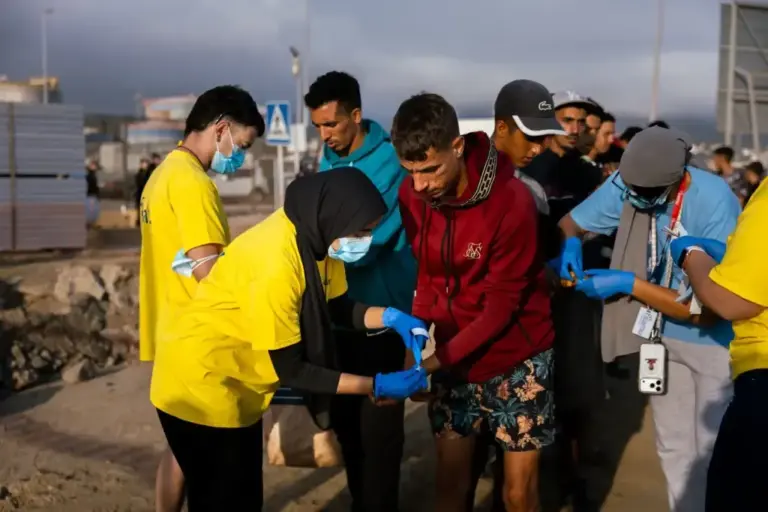
Sources involved in the operation acknowledge “some lack of coordination between Police and Civil Guard,” although what shook the strategy was the appearance of 2,000 ambushers from the hills. “Seeing cars and lights, they panicked and said: ‘It’s time’.” The civil guards were still positioning themselves at the entrance of the industrial estate. The avalanche was numerous but contained. “They were quite obedient at the start. We were a platoon and a half to control 2,000 people. We felt no danger. The immigrants did not show aggressive behavior. We raised our hands and they stopped. Then the UIP arrived and took the lead of the mass. When making the funnel, the mass collapsed, there was distress, but they handled it well. They know there is a limited number of places,” recounts a GRS.
And the immigrants also know that any excess leads to their expulsion. “There was a scuffle among them so that no one would sneak in. The people on the beach didn’t have time to enter the new camp, because there were already 2,000 guys ahead [for 1,700 places]. Desperation is growing because with the opening of each facility people are left without a place and every day that passes is worse.”
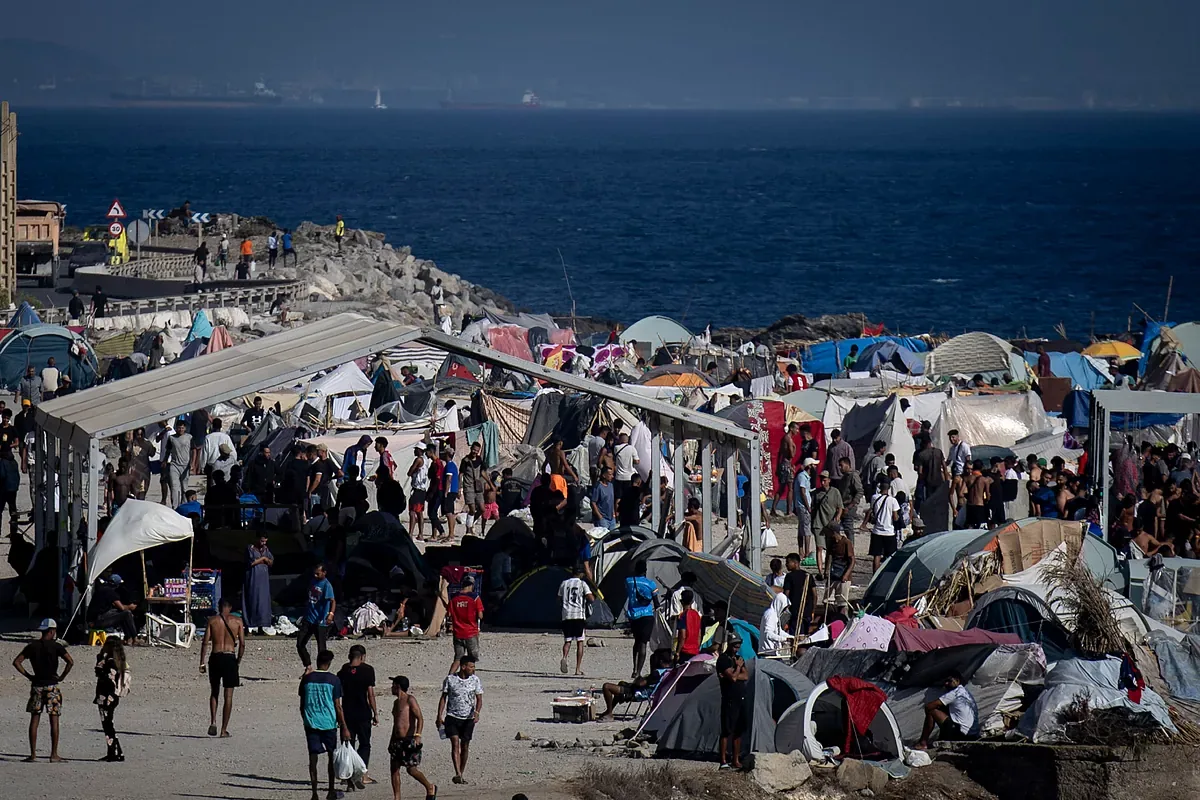
Past noon this Friday, a child just under three years old was kicking a ball through the makeshift alleys formed between the substandard dwellings of immigrants settled on the Trampolín beach. Around him, thousands of people continued to occupy a space that the authorities intended to clear towards the port enclosure, activated after an administrative battle between the autonomous city and the Government; after dodging the halt ordered by the National Court following a complaint from the Unified Police Union. Now, the Government, which yesterday admitted that at least another 3,000 immigrants need housing, will have to look for new locations, which forecasts new jurisdictional conflicts or court cases.
Already last Monday, Pedro Sánchez, against his government’s thesis that 6,000 places would be enough, anticipated that they intended to reach 10,000. And that is the new horizon in a continuum that never closes. Because the authorities of Ceuta do not accept the figure of 10,000 as true, but raise it to 13,000, as a “conservative” forecast. Privately, in circles ranging from the Bar Association to Security officials, it is estimated that there could be “between 15,000 and 20,000” irregulars remaining in a city at the limit, in a city that does not reach 85,000 inhabitants and has 10-15-20 thousand new neighbors, a mathematical and civic absurdity.
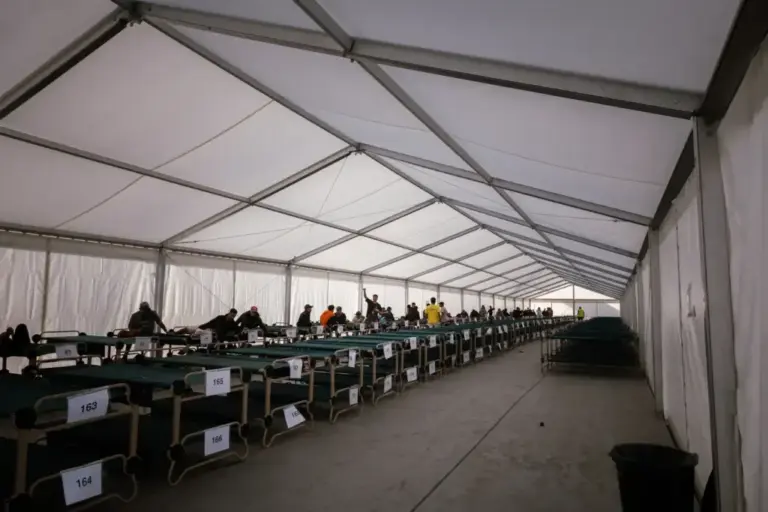
Friday’s operation, which adds to last weekend’s, leaves the frustration of whether the process has an end. Because, as a UIP member explained to this newspaper, those who anticipated the rest yesterday “came out of nowhere.” An eternal nowhere. The idea of the operation was to clear the western part of Benítez beach, occupied by more than a thousand people, whose makeshift tents continue along the breakwater to the desalination plant that separates it from Trampolín. But, for example, Ahmed, one of the occasional residents in a tent in Benítez, didn’t even try to go to the camp. When he saw the mass, he decided to stay in his space. Although he understood some Spanish, he wanted to speak through ChatGPT to understand well. He smiled nonstop despite also having been living in subhuman conditions for a long time.
The West Dock camp was the opportunity for 1,700 immigrants who see there the door to urgently improve their conditions, after 50 days exposed to the elements, and in the medium term, legalize their situation. However, the Government sees there, urgently, a place “indispensable” for them to be “well attended in a confined space”; urgently, a place to register them, but with the hope of later returning them to their countries of origin, mainly Morocco.
Friday’s operation leaves another worry for the Government: many of those who emerged yesterday from “nowhere” were minors and with them expulsion becomes prohibitively expensive.