




The main suspect in the terrorist attack perpetrated this Saturday during the Christopher Street Day (CSD) celebrations, Berlin’s Pride Day, in which one person died and 29 others were injured, has been shot dead by German police. According to the spokeswoman for the Berlin Senate Department for Interior, Abdul B. died during a police operation carried out in an allotment garden colony (Kleingartenanlage) in the Spandau district, in the west of the German capital. The 21-year-old had been known to security services for years due to his Islamist radicalization.
Read more Senior cohousing expands in the city: seniors design their own way of living accompanied
The main unknown remains the reconstruction of the events. The Police and the Public Prosecutor’s Office have not yet been able to determine whether Abdul B. acted alone or with the collaboration of another person. Nor is it established how the sequence between the hit-and-run and the knife attacks unfolded, or whether the driver exited the vehicle after ramming the crowd.
This hypothesis remains open due to several indications. According to information from Berlin television RBB and the regional newspaper Tagesspiegel, when the van crashed into a tree after the hit-and-run, not only the driver’s airbag was activated, but also the passenger’s. This information does not yet constitute conclusive proof, as in some models both airbags deploy automatically in the event of an impact, and in others only when the seat is occupied.
But a new element has now been added to this indication. According to RBB, the police arrested an Iranian citizen overnight whom investigators consider to be the alleged passenger of the van used in the attack. The authorities have not officially confirmed his degree of involvement in the events or whether he will be considered a second perpetrator, so the investigation keeps all hypotheses open regarding the possible participation of more than one person.
Added to this are the testimonies of several witnesses who claim to have seen a man dressed in black with a machete and who maintain that some victims had stab wounds. Others claimed to have observed a possible second assailant. The police are verifying all this information and are keeping all hypotheses open.
Later, the police confirmed that they had arrested several people. However, the force’s spokesman, Florian Nath, did not refer to them as suspects. “We continue to assume that it is possible that there is not a single suspect,” he merely said.
The spokesman continued: “We have several people whom we have naturally questioned in connection with this whole incident, some of whom we have also held and others whom we are still holding at the moment,” he stated. “However, we must attribute concrete indications of suspicion to these people. If we cannot do so, these people must be released after 48 hours.”
In their official statement, the Berlin Police and Public Prosecutor’s Office explicitly speak of an “attack in the vicinity of Christopher Street Day” and specify that the suspect injured several people with a moving vehicle around ten o’clock at night in the Tiergarten area. The statement itself adds that “one or more people subsequently left the vehicle” and that several people were injured with bladed weapons, a wording that reflects that the investigation has not yet fully reconstructed what happened. It is also the first time that the authorities officially acknowledge that they cannot affirm that there was a single attacker.
In parallel, a joint investigation by several Berlin media outlets has allowed for a more detailed reconstruction of the history of the deceased suspect. According to this information, Abdul B. had rented the van used in the attack through private contacts. Inside the vehicle, investigators reportedly also found a mobile phone attributed to the young man, an element that would reinforce his connection to the van.
According to the Berlin Juvenile Court ruling, Abdul B. disseminated Islamic State propaganda and twice attempted to join its ranks. The first of these attempts occurred in May 2025, when he tried to travel to Mauritania via Turkey, a journey that authorities considered part of his purpose to join the jihadist group. Two months later, in July 2025, he was arrested in Lebanon while trying to travel to Syria. After being returned to Germany in November 2025, he was arrested at Berlin-Brandenburg Airport (BER) and remained in pre-trial detention until being convicted by the Tiergarten Juvenile Court. The sentence was suspended after he confessed to the facts during the trial, declared his disassociation from the Islamic State, and cooperated with the investigation, as reported this Sunday by the spokeswoman for the Berlin criminal courts.
Read more Norris dominates Mercedes at Hungaroring and Aston Martin feels competitive again
As part of the conditions imposed by the court to suspend the sentence, Abdul B. was required to participate in a deradicalization program. According to information from Süddeutsche Zeitung, NDR, and WDR, the young man was still in an evaluation process (Clearingprozess), in which specialists had to decide whether to formally take on his case. Until then, only two interviews had been held, and a third was scheduled for the following week. The sessions were still voluntary, and according to this information, those responsible for the program considered it an especially complex case due to persistent doubts about his ideological evolution.
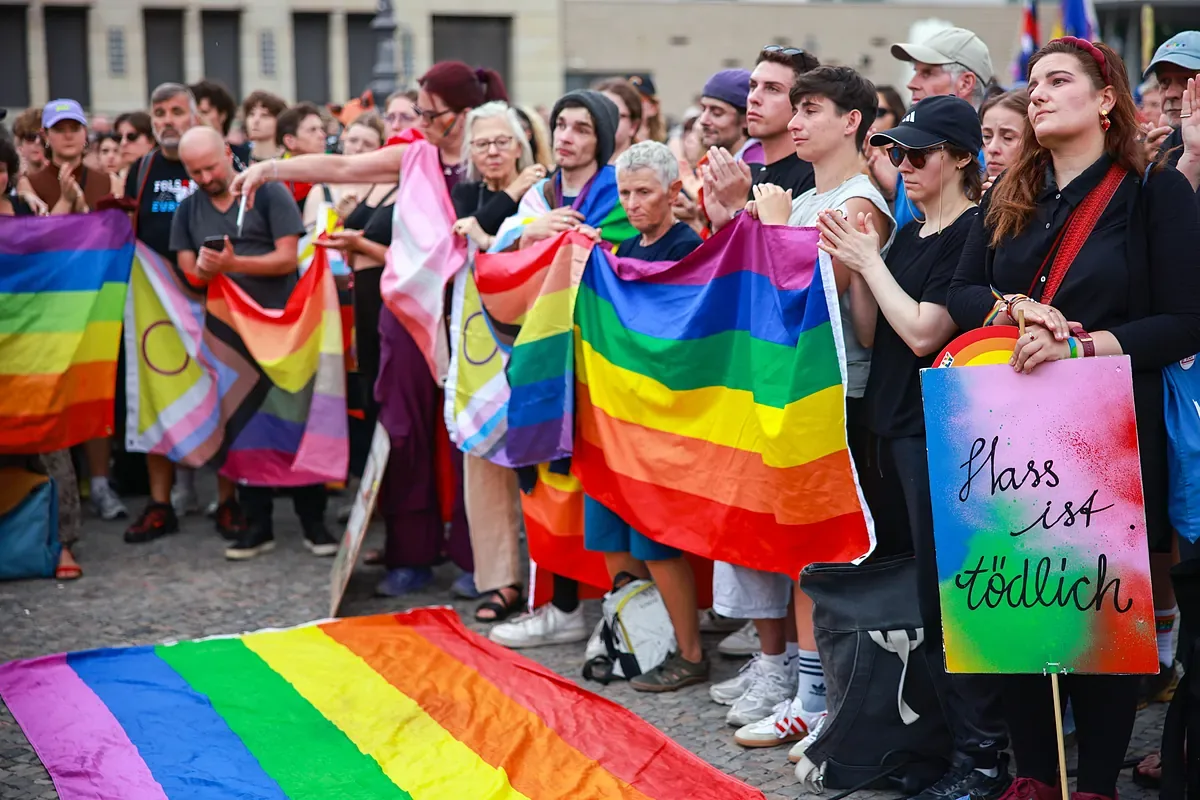
The attack forced the cancellation of the Pride closing event, which brought together hundreds of thousands of people near the Brandenburg Gate. Emergency services deployed a large medical and police operation while the search for the main suspect continued.
Berlin’s Governing Mayor, Kai Wegner, described what happened as “an attack against our free and open society,” while Federal Chancellor Friedrich Merz called on Germans not to be intimidated by such acts. “These acts have only one goal: they want to divide our society, they want to take away what is most important to us, namely our openness and our freedom,” the CDU politician declared in Berlin shortly before a commemorative religious service. “I want to tell the CSD participants here in Berlin and throughout Germany: do not be intimidated, let us not be intimidated.”
The Chancellor also referred to an Islamist attack. He said that “this poison of terrorism and this poison against our freedom” would not be allowed to spread further. “We will defend the freedom of our society. Everyone can count on that,” the Chancellor emphasized. “We are more, we are stronger, and we stand united in our country.”
Merz announced measures after what happened this Saturday. “These criminals, these extremists, have no place in our society,” he continued. “We will reflect on the measures to be taken and decide wisely, but also with determination,” the German added.
The Berlin attack has particularly shocked the LGTBI community, which faces the upcoming Pride celebrations with concern. In Hamburg, where one of Germany’s largest CSD parades will be held next Saturday and some 250,000 people are expected to attend, organizers called a solidarity rally this Sunday, attended by about 800 people, according to the police. “It is important that violence does not make us invisible. What we need now is the support of all society,” said Manuel Opitz, spokesman for Hamburg Pride, who explained that the organization maintains permanent contact with the police and called on citizens to participate in the march as a show of support for the LGTBI community and rejection of violence.
The case once again highlights the threat of radical Islamism in the German capital. According to the latest report from Berlin’s Verfassungsschutz, authorities are monitoring some 2,400 people linked to the Islamist environment; of these, more than 900 are considered prone to violence. The report also estimates the number of members of the Salafist scene at around 1,100, of whom about 350 are classified as violent, and warns of the growing role of propaganda and radicalization processes through the internet.
The attack also brings back to the forefront the debate about the ability of German authorities to control individuals already identified as potentially dangerous and about the effectiveness of deradicalization programs once they regain their freedom.