





Three years and a few days ago, 7,821,718 Spaniards cast a ballot with the PSOE logo in its upper right corner. If voting centers were to reopen today and the same number of people came to exercise their democratic right, only 6,443,590 citizens would repeat that pattern.
Read more Van der Poel crushes Pogacar with a grueling exhibition on the Champs-Élysées
In three years of government, Pedro Sánchez has lost more than 1.37 million supporters along the way. Three years in which the Prime Minister has boasted about the macroeconomic prosperity the country is experiencing, which nevertheless contrasts with many realities on the ground: from a gradual loss of purchasing power due to inflation to a worsening housing crisis. And three years in which Sánchez has accumulated legal cases around him, several already with conviction sentences, which determine the public trust he now inspires. The Prime Minister today reaches his lowest point in polls, while an election call, whose final date is in his hands, is already looming on the horizon.
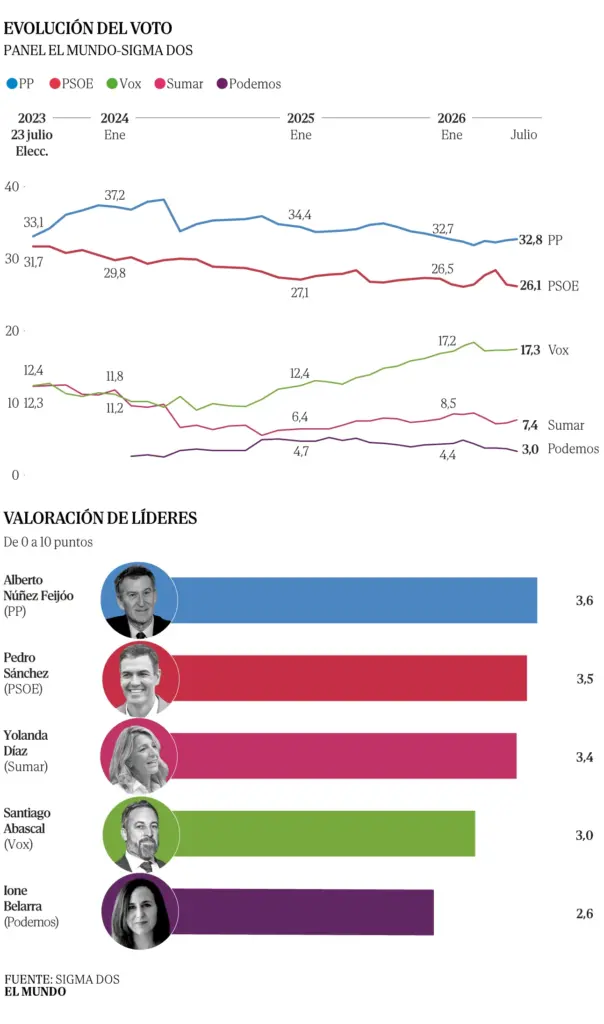
26.1% of Spaniards would choose the PSOE ballot if polls were opened now, according to the latest Sigma Dos barometer for EL MUNDO. This is three tenths less than the support Sánchez garnered in June, and 5.6 points below the percentage of votes he obtained in the July 2023 elections. Thus, the socialists return to their worst mark in this term, which they had only reached once before, in February. And they fall back to that minimum after a few bleak weeks, marked by a constant drip of information about the judicial cases surrounding the Government which, in light of the poll, has eroded the confidence of socialist supporters in Sánchez.
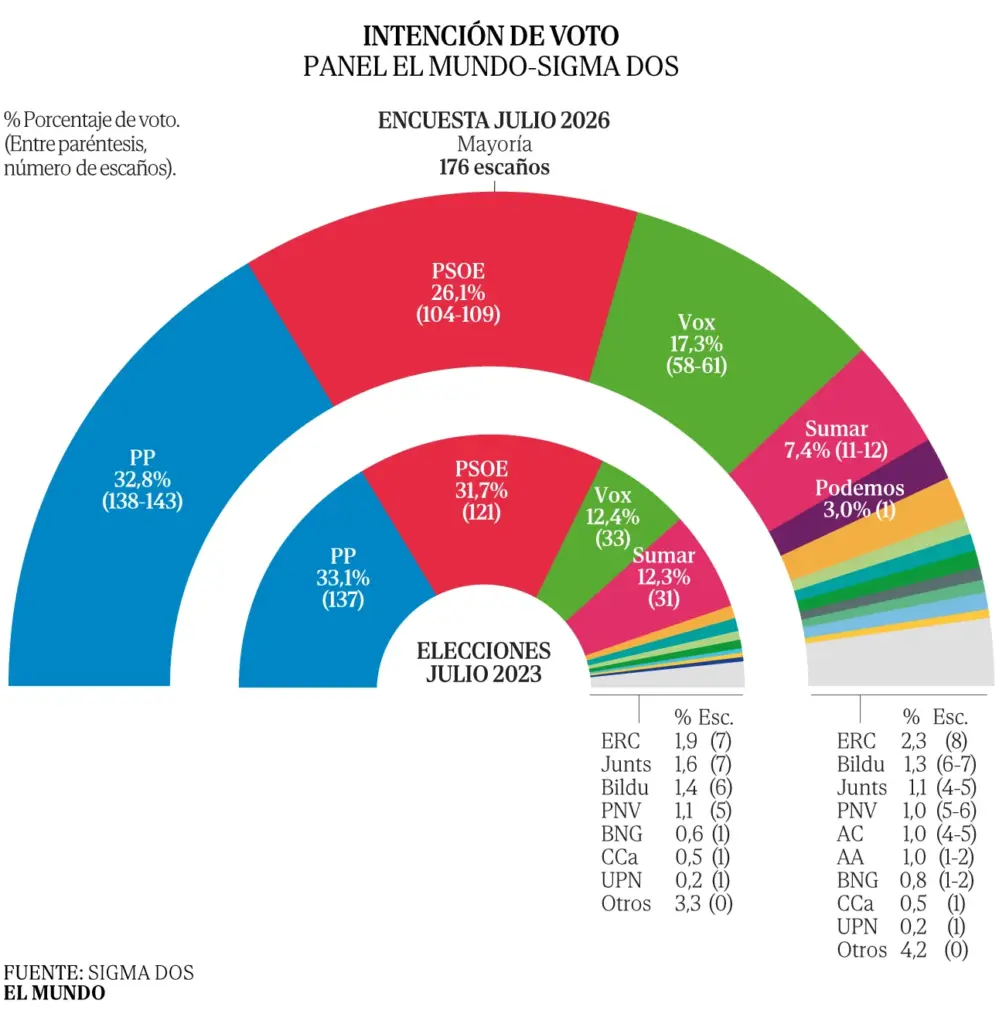
If from May to June the PSOE lost two points in voting intention, dragged down by the indictment of José Luis Rodríguez Zapatero and the outbreak of the ‘sewer case’, from June to July the decline continues, attenuated in terms of percentage of support, but bringing Sánchez to an unprecedented low when looking at the count of deputies. Of the 121 parliamentarians that the socialists currently hold in Congress, today only between 104 and 109 would be re-elected -in June it was 108-. The range, in its most unfavorable scenario for the PSOE, would leave the party with its worst representation mark in this term, losing 17 seats in three years.
Opposite this socialist low, the right-wing bloc maximizes its position at the gates of the final stretch of the legislature. Although it does so, primarily driven by Vox. Alberto Núñez Feijóo’s party would today gather 32.8% of the ballots cast, two tenths more than a month ago, but still below the mark it obtained in 2023, 33.1% of the votes -it has not managed to surpass that figure so far this year-. However, if that 33.1% of citizen support was insufficient for Feijóo to reach La Moncloa three years ago, this scenario seems closer today, as a Vox that has surged since last summer overturns any left-wing equation to revalidate power.
In July, Santiago Abascal garners the trust of 17.3% of Spaniards, one tenth more than in June and almost five points above his mark from the last general elections. This propels the right-wing sum above 50% -compared to 45.5% in 2023- and, above all, raises their combined seat count to cross the 200-parliamentarian barrier, and even surpass it in the best-case scenario. The Popular Party would today hold between 138 and 143 deputies in Congress -compared to the 137 they achieved three years ago- and Vox would multiply its representation: from 33 seats in 2023 to between 58 and 61 now.
Between 196 and 204 seats would thus be occupied by the right in Congress if polls were opened today, comfortably surpassing the main goal: the 176 seats that mark an absolute majority in the Lower House and that, therefore, grant the key to govern. PP and Vox thus maximize their space -the poll had never before in this term predicted that the sum between the two could climb to 204 deputies- and they do so at a time of reconfiguration of their relationship, with constant struggle now replaced by a path of understanding that originates in the communities they co-govern and extends to national leaderships. All with an eye on elections in less than a year where, in light of the polls, only by combining forces could PP and Vox come to power.
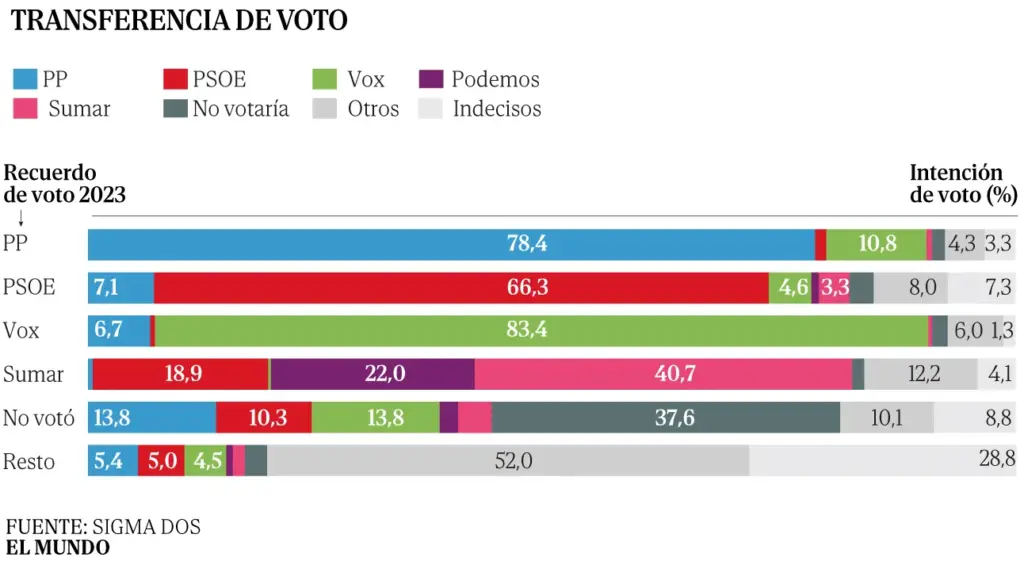
In fact, this truce between the right-wing parties also seems to extend to the shifting of voters between them. Six months ago, almost one in five Feijóo voters was prepared to switch their ballot for Abascal’s, whereas now that percentage is 10.8%. Conversely, 6.7% of those who voted for Vox in 2023 are moving in the opposite direction -it was 4.5% half a year ago-, leaving the balance somewhat more even: Abascal stole 1.4 million net voters from Feijóo in February; now, half that, 678,000.
While the intra-bloc flow between PP and Vox loses momentum, the movement of voters from one side to the other, from left to right, has grown in recent months. This is mainly because the exodus of socialist voters is increasing. If half a year ago the PSOE ceded 6.8% of its voters to the PP and 4.5% to Vox, now 7.1% and 4.6% of its supporters are moving in that direction. And, conversely, it attracts fewer right-wing sympathizers, so its negative balance increases: if in February PP and Vox shared 743,000 socialist voters -in net terms-, now this exchange is 802,000. Although Sumar does obtain a positive balance in the transfer of voters with the right, this is insufficient to reverse the imbalance caused by the PSOE, meaning the left-wing bloc would today cede, in net terms, 763,900 voters to the conservative bench -six months ago it was 728,500-.
This leaves the left, at this hour, with no margin to revalidate the coalition government. Added to the fall of the socialists in votes and deputies is the fact that the space of alternative progressivism, still lacking a brand or leader with whom to start the path to the polls, moves three years later in figures far from that 12.3% of the votes obtained by Yolanda Díaz which, with 31 deputies, served Sánchez to remain in La Moncloa. Sumar, which will no longer present itself under that nomenclature, now gathers 7.4% of support -four tenths more than in June-, but this only translates into 11 or 12 seats -it suffers from fragmentation with Podemos, which only scrapes one seat with 3% of support-.
In any case, insufficient to rival the right-wing bloc, even counting on the rest of the parties that invested Sánchez in 2023. Among these, few novelties: ERC, Bildu, and PNV could revalidate their representation, while Junts, which has been the most uncomfortable partner for the Government in this legislature, loses half a point in vote percentage and could lose up to three seats. These would hypothetically be taken by Aliança Catalana -up to five seats-, although the anti-immigration independence party does not plan to run in the general elections.
Beyond the distribution of votes and deputies by party acronyms, the Sigma Dos poll for EL MUNDO reveals a striking detail, especially considering the current point of the legislature. The percentage of undecided voters among the electorate of all parties is at a minimum: only 3.3% of those who voted for the PP, 7.3% for the PSOE, 1.3% for Vox, and 4.1% for Sumar are unsure what to vote. This means that, with elections already looming on the horizon, the outlook is now less uncertain than ever. Even the figure for the socialists, the highest of the four, is among the lowest the PSOE has registered throughout the entire term. As is, at the same time, their voter loyalty: only 66.3% intend to repeat their vote.
Technical sheet
Reference population and geographical scope: Persons aged 18 and over residing in Spain with the right to vote.
Information collection technique: Through the Sigma Dos by Trust Survey Panel. Mixed telephone (CATI) / online (CAWI) methodology.
Sample sizes: 3,690 interviews.
Selection of sample units: In the telephone interview, by random household selection and application of sex and age quotas in the selection of the ultimate unit. In the case of the panel, proportional allocation by sex and age group was applied. The sample distribution was proportional by autonomous community in both samples.
Margin of error: The absolute sampling error can be bounded by ±2.3% for a confidence level of 95.5%, and assuming variables with two equally distributed categories.
Analysis data and representation estimation by constituency: The results of 30,400 interviews conducted from May 4, 2026, to July 21, 2026, have been analyzed. Distributed non-proportionally in each autonomous community to achieve a necessary minimum for the estimation of seats at the constituency level.
Read more The Cuban regime celebrates Rebellion Day without Raúl Castro and with citizen protests
Fieldwork date: From July 6 to 20, 2026.
Carried out by: SIGMA DOS SL. Calle Velázquez 50, 2ª Planta (28001-Madrid).
Technical direction: José Luis Rojo Gil / Ignacio Javier Clemente Sierro.