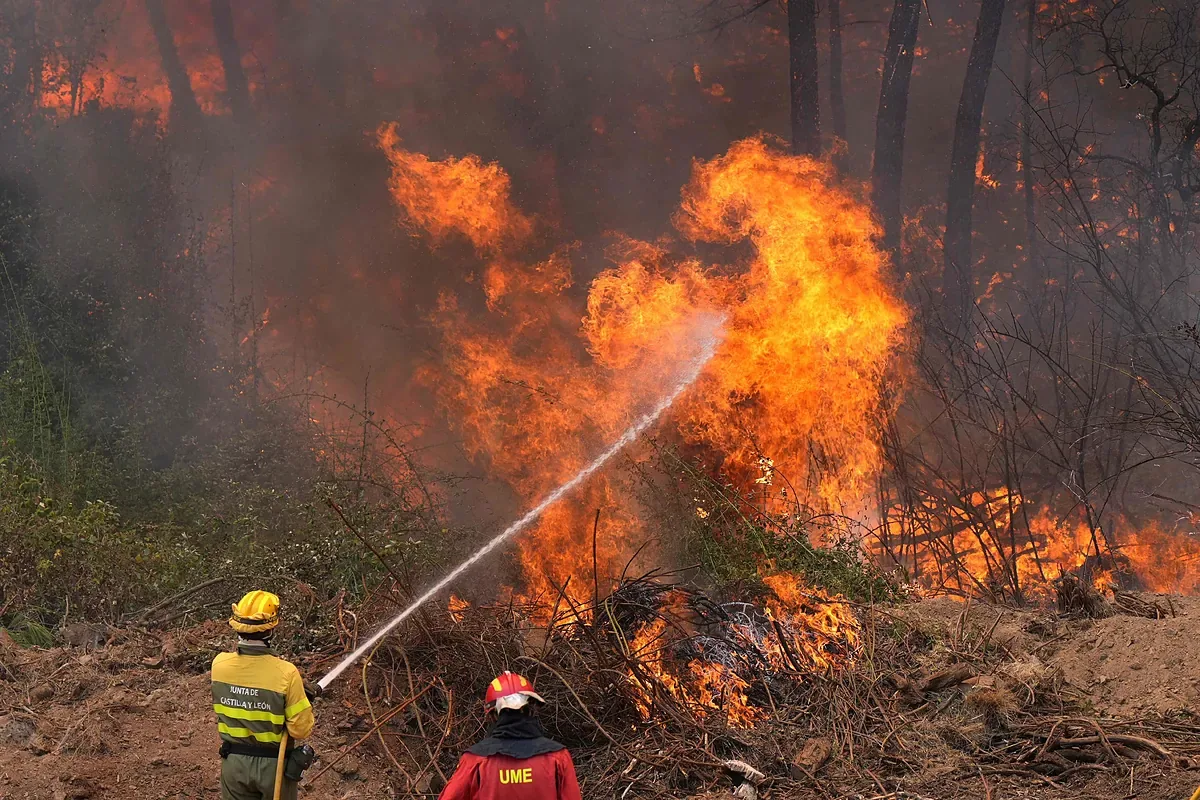
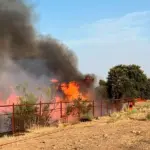
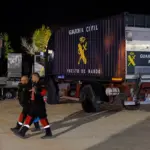


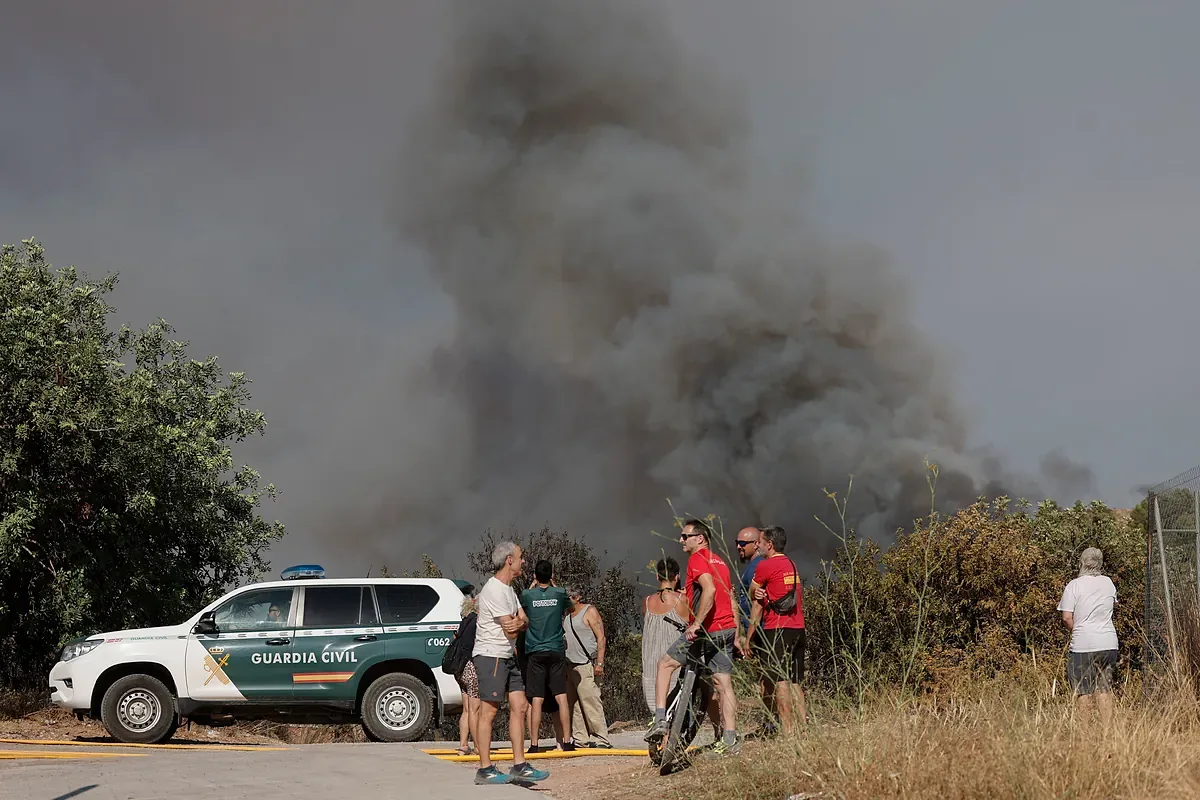
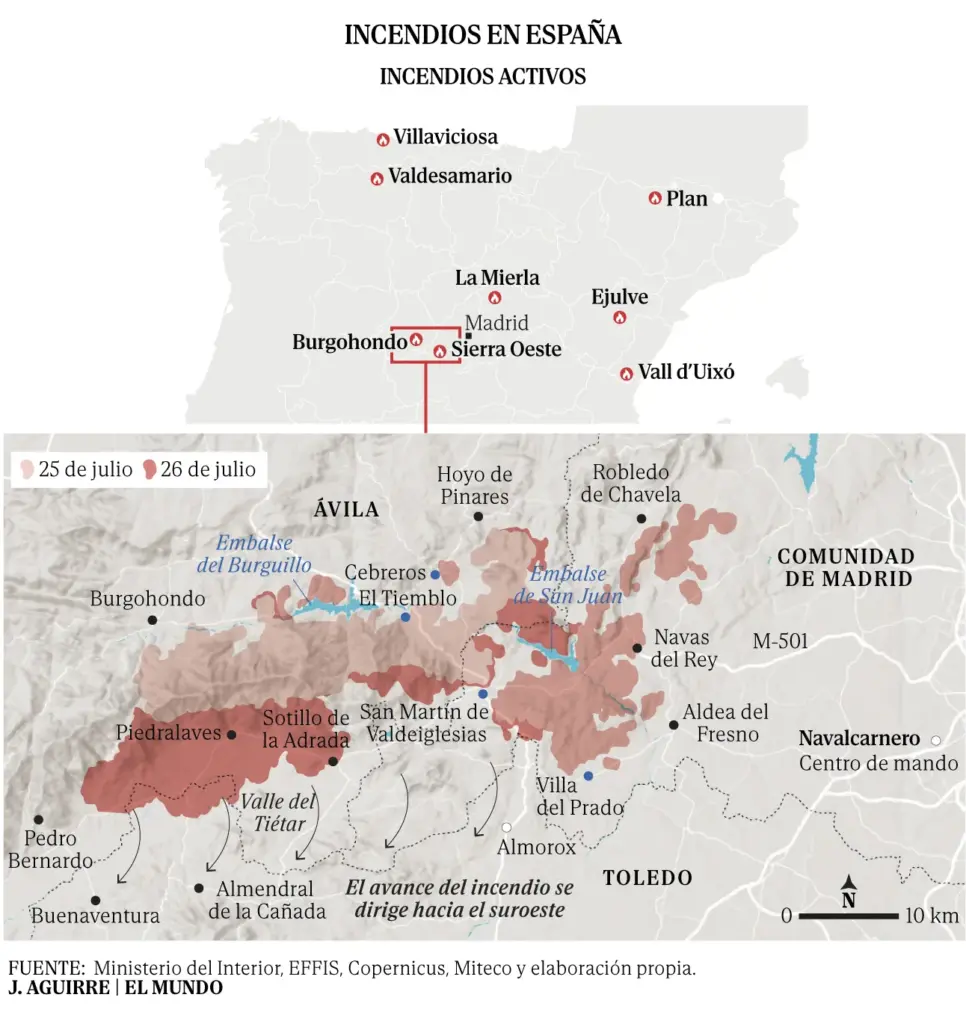
The extraordinary dimension of the fire affecting Ávila and Madrid has forced the Civil Guard to resort to one of its most exceptional resources. The Reserve and Security Group (ARS) -the Armed Institute’s itinerant elite corps- has deployed 108 agents in the face of an emergency of unprecedented complexity due to the confluence of factors that go beyond the violence of the fire.
Read more Sánchez hits rock bottom before the final stretch of the legislature with the right-wing above 50%
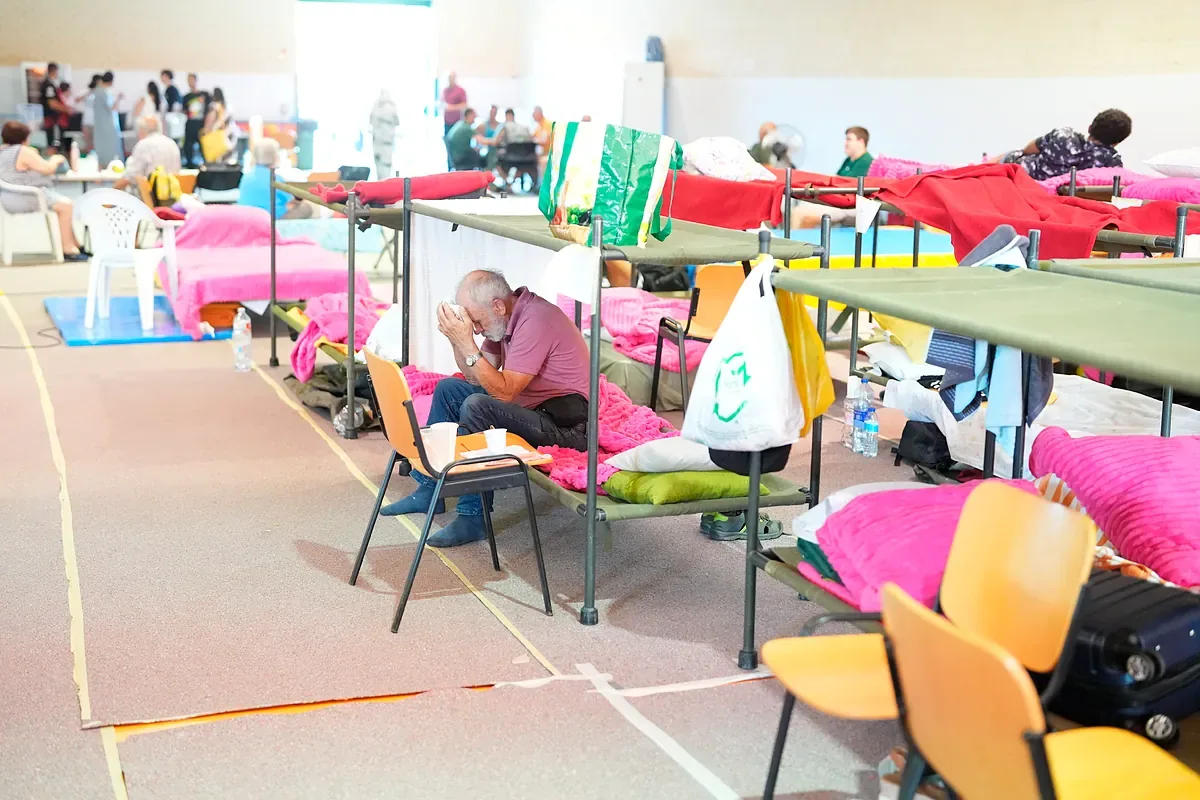
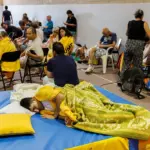
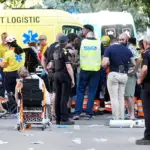
The uniqueness of this fire lies not only in its extent, but in the combination of an extremely virulent spread with an unusual volume of evacuations. In fact, this latter circumstance is, as team sources reveal to EL MUNDO, the differential element of the operation. Dozens of towns have been affected by evacuations in Madrid, Ávila and Toledo, but also in Castellón these days, which has increased the need for security, logistical support and protection of the evacuated areas.
The work on the ground is proving particularly demanding because, being subject to the constant evolution of the fire, evacuations are occurring almost uninterruptedly. A kind of exodus caused by the flames. “We had never faced this number of evacuations.” “They are entire towns and villages; some, moreover, of a considerable size. We are in an extreme situation,” warn people on the ground.
Sources from the operation admit “concern” about the evolution of the flames and point to the deterioration of the forest mass as one of the factors explaining its behavior. “There was a lot of undergrowth and this high load of plant fuel may have favored the rapid spread of the flames.”
The Ministry of Interior mobilized the Civil Guard’s elite field corps in the early stages of the fire, aware of the magnitude of the emergency. A total of 108 agents belonging to eight platoons have arrived in the area. The ARS organically groups the Reserve and Security Groups (GRS), which are the rapid intervention operational teams on the ground.
The feeling of the agents of this unit coincides with that of the Civil Guard commanders on the ground, who admit that the evolution of the fire and its intensity have pushed the agents to their limit: “We have never experienced anything like this; it’s a disaster. We are overwhelmed,” as this newspaper reported.
“This has never been seen before, we are completely overwhelmed,” they insist. The commanders of the Armed Institute agree that the “only” effective solution to contain the flames is the arrival of aerial resources from other countries. Spain has activated the European Civil Protection Mechanism to reinforce the fight against fires, under which two planes from Italy and two from Greece have arrived. In addition, Turkey announced the dispatch of two additional aircraft.
Late at night, the country’s situation was as follows: 170,000 people affected and 83,500 hectares devastated. In Ávila alone, 50,000 hectares have burned, making it the largest fire in Spain’s history. But among the affected territories are also Toledo and Vall d’Uixó (Castellón), the latter being one of the most worrying hotspots because the fire is “out of control,” according to the Military Emergency Unit (UME). Among the four provinces, 75,896 people have been evacuated, and 93,867 remain confined. However, the UME highlighted yesterday that the fires in Madrid and Ávila are “contained,” although “some active fronts” still remain, said Lieutenant Colonel Alfonso Arribas to RTVE.
Faced with this desolation, on the political board, the pieces have begun to move. Both the State Administration and regional governments are already placing the reconstruction of the affected areas at the center of the agenda, even before the flames are extinguished.
Read more Van der Poel crushes Pogacar with a grueling exhibition on the Champs-Élysées
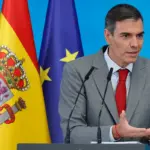
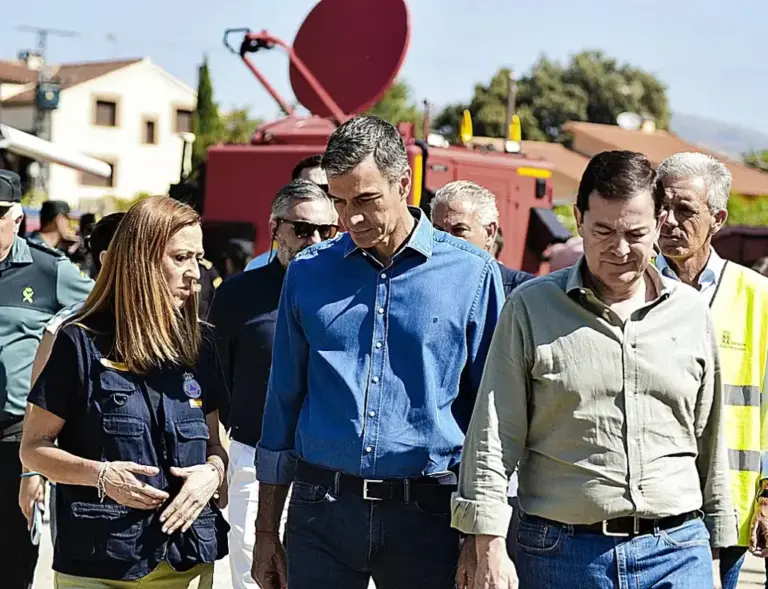
“In the next Council of Ministers, we will approve the Royal Decree-Law to classify the areas devastated by the fires as seriously affected by civil protection emergencies,” announced yesterday the President of the Government, Pedro Sánchez. This implies the mobilization of state economic resources to compensate for the consequences of the fires.
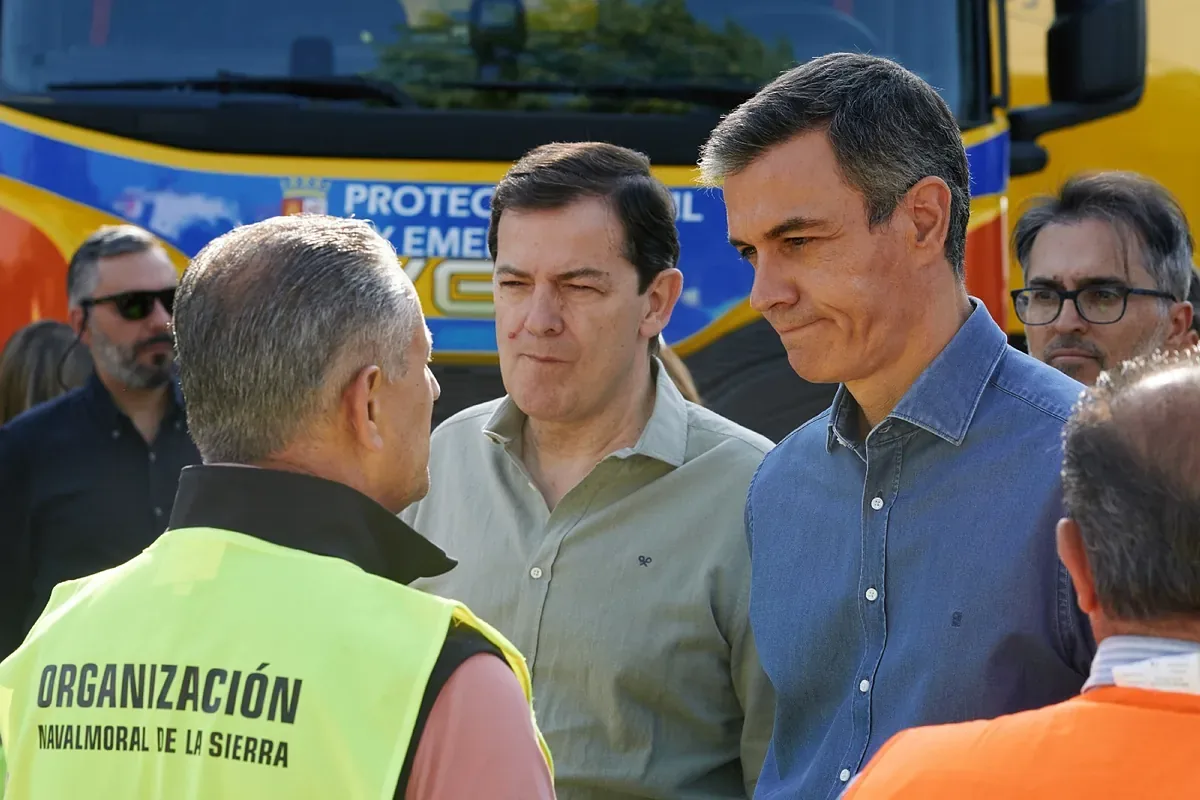
Sánchez made this announcement from the Advanced Command Post in Navaluenga (Ávila). He was accompanied by the Minister of Interior, Fernando Grande-Marlaska, and met with the mayor of the municipality, Armando García Cuenca, as well as with the president of the Junta de Castilla y León, Alfonso Fernández-Mañueco, who announced that his government would request the declaration of a disaster zone before Sánchez made his announcement. In addition, he communicated that recovery tasks in his Community would begin this week: from “affected homes and facilities” to “tourism promotion of this environment,” including “environmental recovery.”
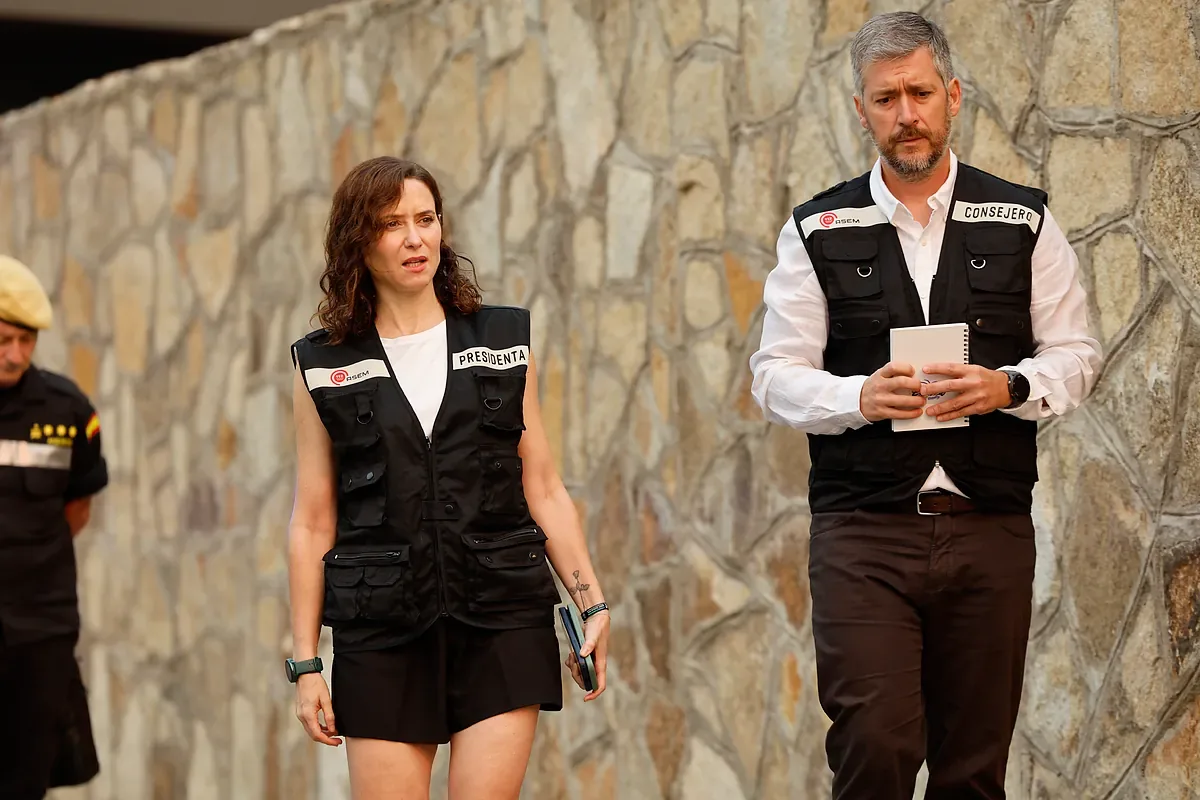
Her Madrid counterpart, Isabel Díaz Ayuso, followed the same path, stating that her “obligation is to already think about that scenario, about recovery.” The PP leader announced that her government is “starting the evaluation of the losses that thousands of Madrid families are suffering to help them immediately and in this way help them rebuild their lives.” “We are already working for the fastest possible recovery before the fire is extinguished. We are not going to wait,” she emphasized.
In addition to boasting “experience in these difficulties” -Ayuso’s government faced the DANA of 2023 that devastated 10 towns, storm Filomena, and the pandemic, among others-, the president acknowledged that “people’s patience will run out” given the heat, the ongoing fires, and the uncertainty.
These announcements by the populars occurred simultaneously with the deployment of government members to the burned areas, which seeks to convey a message of executive presence and action in the face of the emergency. Apart from Ávila, Sánchez visited the Advanced Command Post in Cenicientos on Saturday -later moved to Navalcarnero (Madrid)- and today he will visit the one in Vall d’Uixó to evaluate the fire situation in Castellón.
But it is that, in addition to the president, Grande-Marlaska and the Minister for Ecological Transition, Sara Aagesen -who is part of the emergency monitoring committees-, ministers such as Margarita Robles (Defense) or Óscar López (Digital Transformation), who are not part of the bodies that manage this emergency, also traveled to the Command Posts to project the image of an Executive committed to the situation.
The Popular Party joined the political gestures. The president of the party, Alberto Núñez Feijóo, traveled yesterday afternoon to Navalcarnero, where he offered his “solidarity” to the affected residents and thanked the operation, which “affects all public administrations,” for its “enormous coordination work,” carried out with the “sole objective of succeeding.”
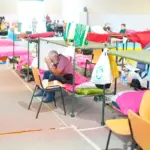
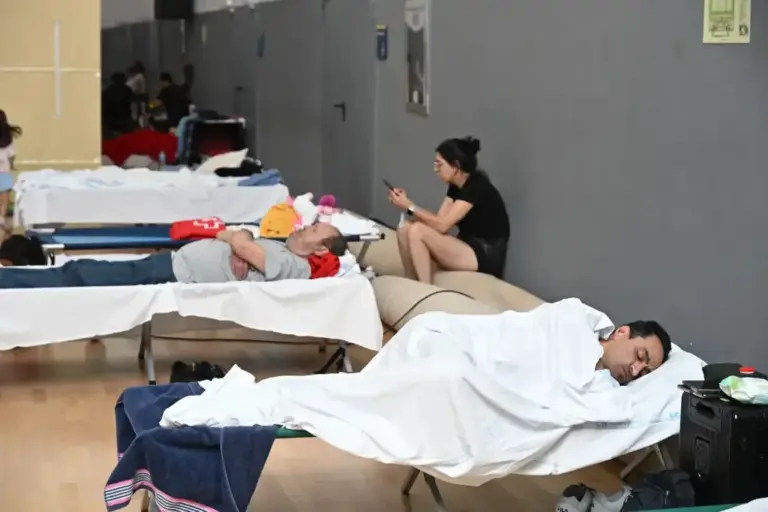
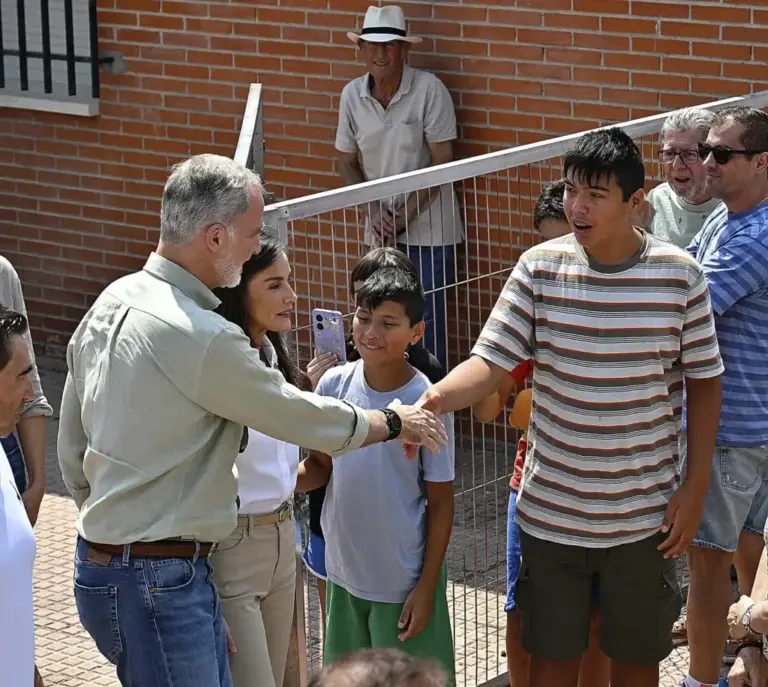
And the tone of yesterday was the emphasis on the “exemplary coordination” of the operation. These were the words used by King Felipe VI during his visit with Queen Letizia to the La Chopera sports center in Villamanta, where approximately 200 affected people are housed, to whom they showed their “affection, understanding, and support.” “All resources are doing a spectacular, dedicated, and arduous job that must be thanked and praised,” he highlighted. The monarch called on all political leaders to “provide certainty that all possible means are being used” and valued the “unity” in the face of the fire emergency.