





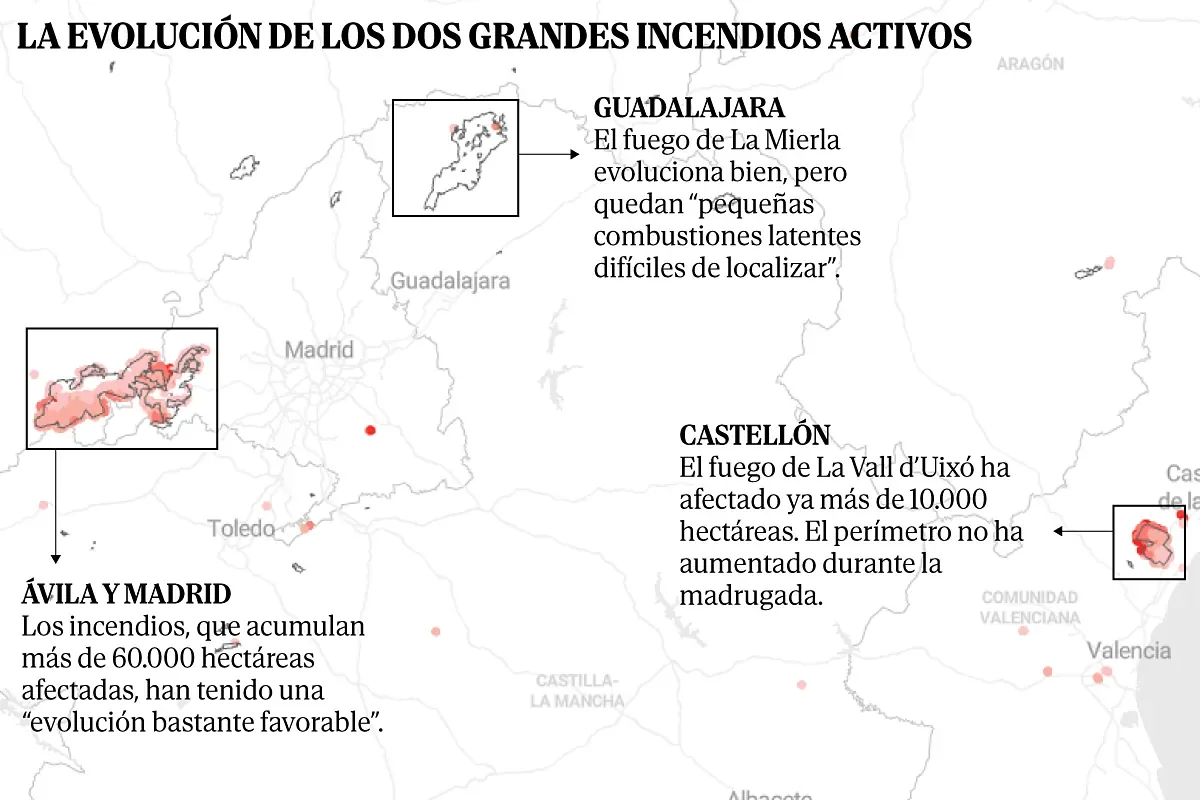
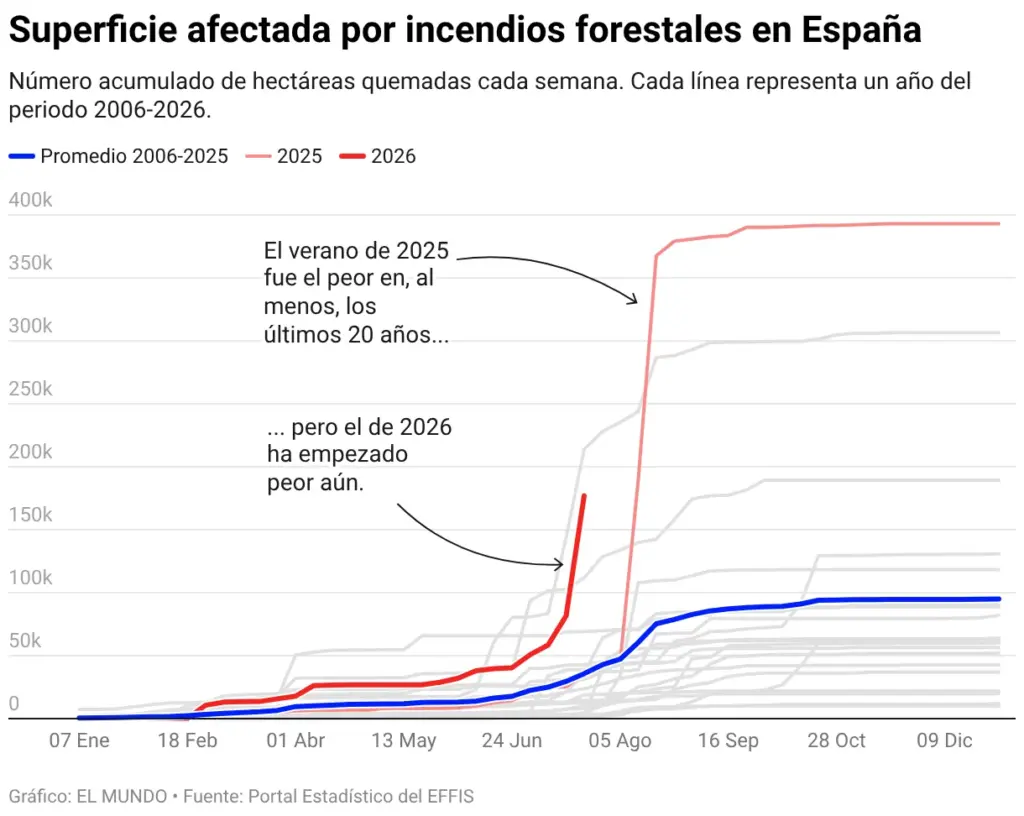
The different heat waves hitting Europe this summer have triggered wildfires across the Iberian Peninsula. The burned area in Spain between January and the end of July 2026 is already almost six times greater than that recorded in the same period of 2025, according to data from the Ministry for the Ecological Transition (Miteco). So far this year, more than 173,000 hectares have burned, compared to 29,817 hectares scorched between January 1 and July 28, 2025, according to official statistics.
Read more Treatise on Good Manners for a Catastrophe
The most dramatic situation last summer came in August, when the fires in Molezuelas de la Carballeda (Zamora) scorched 40,081 hectares between Zamora and León. Following that, in the same period, was the fire in Larouco, Quiroga, and Oencia (Ourense, Lugo, and León), which burned another 37,179 hectares. Both became the largest fires in Spain’s history.
However, that record was broken again this summer with the forest fire in Burgohondo and Navaluenga (Ávila), affecting more than 50,000 hectares, according to the latest available estimate from the European Forest Fire Information System (EFFIS), becoming the worst fire in Spain’s history.
The fire in Ávila started on the afternoon of Wednesday, July 22, when, according to initial investigations, the use of heavy agricultural machinery, prohibited at this time of year, caused the fire. That same day, in Toledo, two fires started in Almorox and Villa del Prado (Madrid) which began as separate fires but ended up merging hours later.
The next day, Thursday, July 23, a fire was detected in San Martín de Valdeiglesias (Madrid) after a vehicle caught fire at kilometer 57 of the M-501 road, from where the flames quickly spread to the forest, also affecting Pelayos de la Presa.
As hours passed and with the help of the wind, the fire expanded and devastated everything in its path. On Friday morning, the Government of Spain declared a national emergency in both areas (Ávila and Madrid).
Saturday dawned with uncontrolled fires ravaging everything in their path northward, to the point that they nearly joined near San Martín de Valdeiglesias (Madrid), after having already scorched 40,000 hectares.
By Sunday, the advance of the fire tongues from the Ávila fire caused a worsening of the situation in the Tiétar Valley area and also in a strategic enclave of the western Madrid mountains: the San Juan reservoir, where the material devastation has been profound. The fire has completely destroyed the La Ardilla Roja campsite, whose facilities have been reduced to ashes.
Up to 8,500 hectares already burned in Vall d’Uixó in its four days
While the center of the peninsula was burning on Saturday, a new fire started in Castellón. The fire in Vall d’Uixó faces its fourth day still active this Tuesday, after having burned about 8,500 hectares, and has about 10,000 people evacuated, after the Integrated Operational Coordination Center (Cecopi) authorized the return home of about 6,000 evacuated residents from four neighborhoods of the municipality on Monday night.
However, the Firefighters’ deputy of the Castellón Provincial Council, David Vicente, warned during this day that the fire remains “very active” and that a “long and complicated” afternoon is expected due to the terrain’s orography and weather conditions. The situation is compounded by increased wind in the area and the start of the fourth heat wave on the peninsula this Wednesday, July 29, which alerts and worries experts because “it complicates everything,” Vicente points out.
However, the Firefighters’ deputy of the Castellón Provincial Council, David Vicente, warned during this day that the fire remains “very active” and that a “long and complicated” afternoon is expected due to the terrain’s orography and weather conditions. This situation is compounded by increased wind in the area and that this Wednesday, July 29, the fourth heat wave of this summer will begin on the peninsula, which keeps experts on alert and worried because, as Vicente points out, “it complicates everything.”
The fires, in data
- Evacuated in Madrid: about 31,865 people evacuated in 13 localities (Chapinería, Navas del Rey, Colmenar del Arroyo, Fresnedillas de la Oliva, Robledo de Chavela, Navalagamella, Aldea del Fresno, Zarzalejo, Pedanía de Peralejo, Rozas de Puerto Real, Cadalso de los Vidrios, Cenicientos, and Valdemaqueda)
- Confined in Madrid: about 26,316 people (San Martín de Valdeiglesias, Villa del Prado, Pelayos de la Presa, and Santa María de la Alameda).
- Evacuated in Ávila: 25,087 people in 16 towns (Sotillo de la Adrada, Navahondilla, Casillas, Santa María del Tiétar, La Adrada, Piedralaves, Casavieja, Burgohondo, Hoyo de Pinares, Villanueva de Ávila, Urbanización La Atalaya de El Tiemblo, Pedro Bernardo, Higuera de las Dueñas, Gavilanes, Mijares, and Fresnedilla).
- Confined in Ávila: 8,735 people (Navaluenga, El Tiemblo, Las Navas del Marqués, and Cebreros)
- Evacuated in Toledo: 1,941 people (La Iglesuela del Tiétar, Sartajada)
- Evacuated in Castellón: About 10,000 people from several localities near Vall d’Uixó.
- Burned hectares: 80,000 between Madrid, Ávila, and Toledo, 8,500 in Castellón.


