






The first thing one notices when passing through the towns affected by the fires in Madrid is the silence. An absolute silence. The residents have not yet been able to return to their homes, still uncertain about the condition of those four walls that safeguard all their memories. On the other hand, in the municipalities where there are people, the windows and doors are tightly closed, sheltered and confined.
That very word recalls the Covid pandemic; the scene is similar. The driver of the car who took EL MUNDO exclusively to the heart of the lands affected by the fire stated: “I feel like I’m in a pandemic again, everything is deserted, not a soul.” In the sports centers for evacuees, the scene is not much different: rows of stretchers full of people waiting for good news.
Outside the vehicle, the scene is desolate, there is smoke everywhere… In certain areas, it is impossible to distinguish where the mountain ends and the sky begins; you cannot breathe. The thick smoke, with an intense smell of burnt pine, has spread throughout the Sierra Oeste region and has even touched bordering areas. And upon exiting, the stifling heat hits the body; only the click of the camera immortalizing the moment is heard.
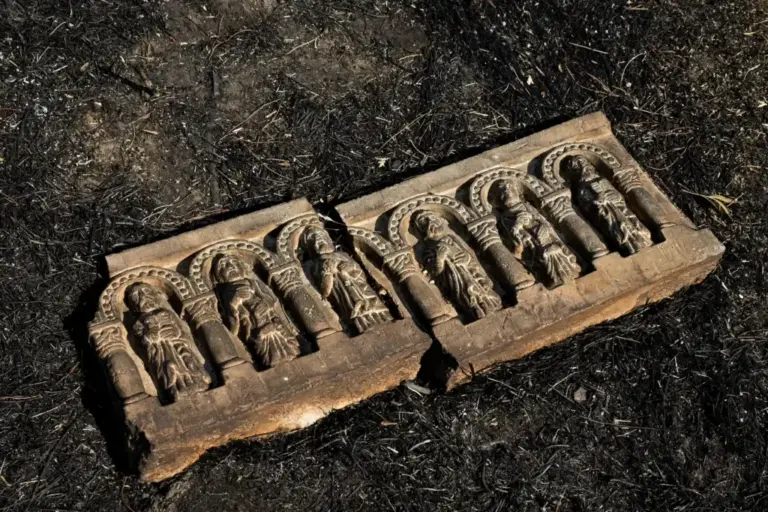
In Villa del Prado residents are already walking around the area with masks, but it is clear that the fire has deeply affected the place. No one speaks because the flames were too close to the houses. Many of the local livestock farms have disappeared, leaving only one survivor, half burned but still alive. Its entrance, once decorated with trees, is now adorned with their skeletons, and next to the road lies an ancient stone frieze that used to welcome visitors but now lies on the ground waiting to be picked up. Nearby, the Chapinería area presents a devastated landscape, completely charred and blackened, a testament to the uncontrollable advance of a fire that, fueled by shifting gusts of wind, ravaged pine forests and scrubland in its path.
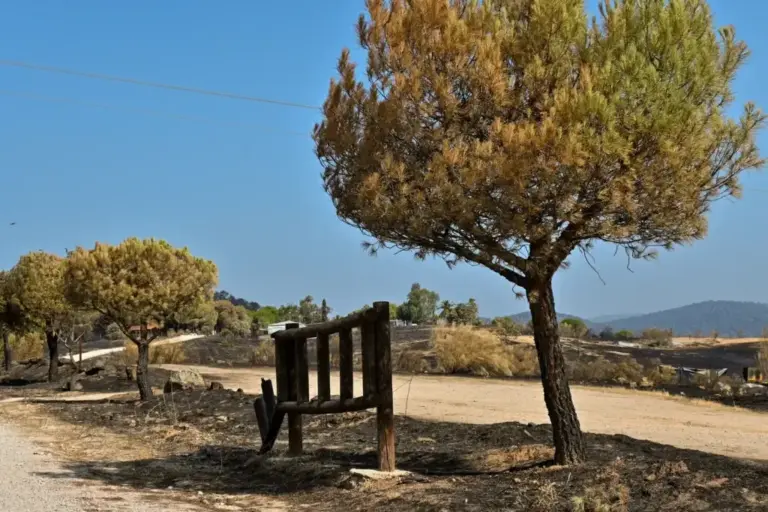
Further ahead, after traveling narrow and winding roads, is the Encinar del Alberche residential area, the first to be evacuated at the start of the fires. Luck has meant that it was ultimately saved from the fire, although it is currently uninhabited, waiting for its owners to return. The driver, who prefers to remain anonymous, tells EL MUNDO that this is not a matter of luck, but because “they have the area all clean and cared for, so the fire did not jump.”
The route continues along roads passing through Almorox, the fire’s origin where the flames crossed from Toledo lands, cutting axes like the N-403. Everything charred, everything black. The only sound is the crunch of footsteps on the completely scorched grass. The closer one gets to the San Juan reservoir, the more smoke there is and the harder it is to breathe; there, dozens of fire trucks, devices from the Community of Madrid, the City Council , and the UME are seen working in collaboration; they pass at a dizzying speed, trying to reach the fire’s focus with water as soon as possible.
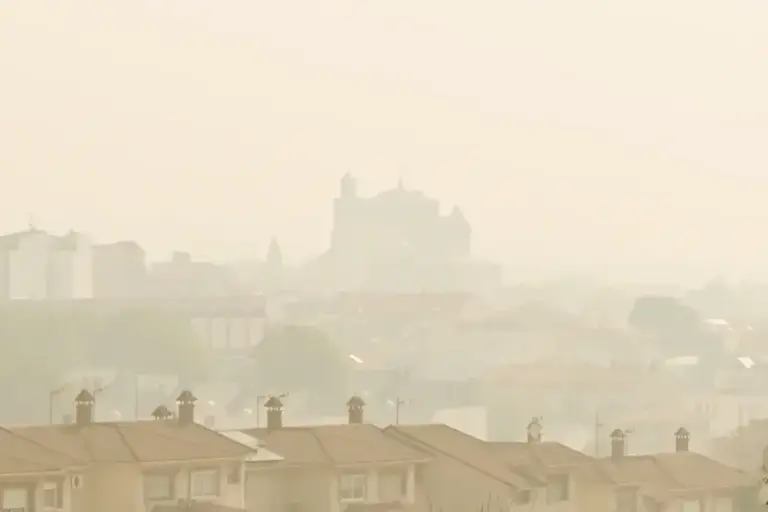
In San Martín de Valdeiglesias and Pelayos de la Presa there are still people confined; not many residents are seen, just a few in cars or walking quickly with masks. In the distance, through the smoke, the Coracera castle is not even visible, only its silhouette, and in the adjoining meadows, the desolation of the animals left alone is perceived, exposed to the sun or lying on the ground, waiting for their owners to return for them.
Read more The fourth heat wave of the summer begins tomorrow and is likely to extend beyond Sunday
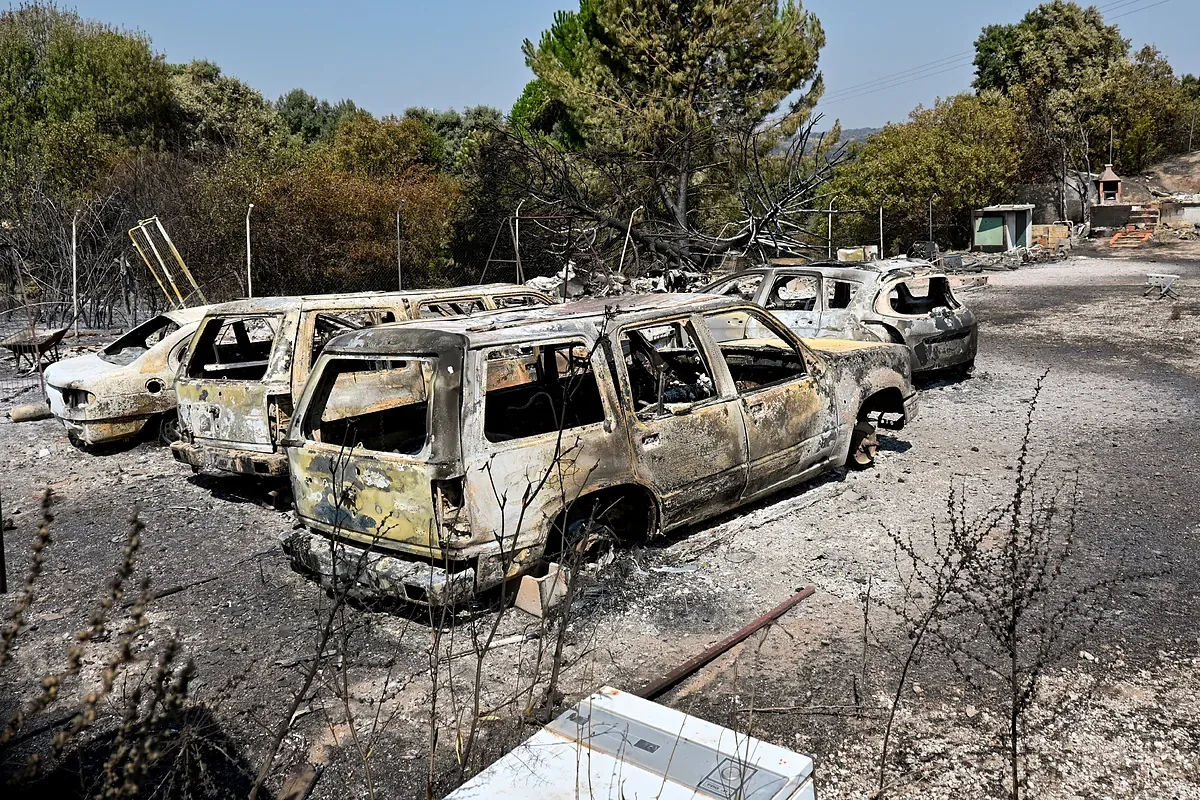
Continuing along the M-501 towards the reservoir, the road shows the marks of disaster: what seems to be an old garage or depot lies converted into a scrapyard of scorched and charred vehicles, reduced to metal skeletons. Further back, in contrast, a scene that catches the eye emerges: a valley full of goats of all colors remains isolated among a sea of ashes, while vultures orbit above them in the still leaden sky.
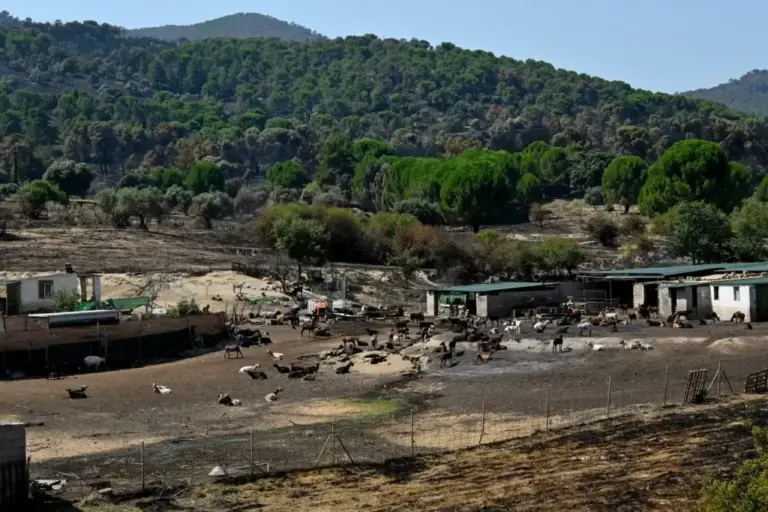
And between the two, the remains of the fire, smoking logs and small nooks on the mountain slopes that still have some lazy flame, no longer eager to continue ravaging the natural beauty of the area.
Despite the devastation, the day begins to offer a respite after endless days of tireless fighting by the forest crews. From five in the afternoon, the sirens gradually give way to a different calm. After the lived hell, evacuations and confinements have been lifted in much of the Sierra Oeste of Madrid and in the affected municipalities of the province of Ávila, allowing most residents to finally start the journey back.
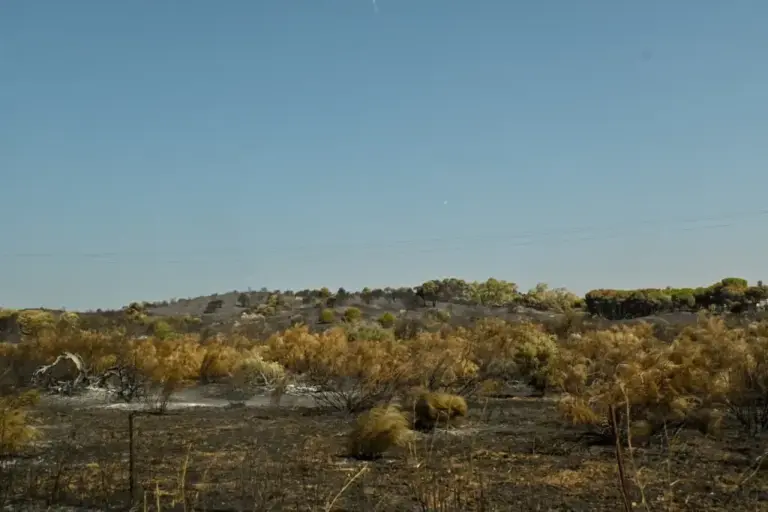
Although some residential areas in San Martín de Valdeiglesias or Encinar del Alberche must remain cautious and keep waiting, the tide of disaster is beginning to recede. Between the dissipating smoke and the still warm earth, people return to their homes with their eyes set on what remains standing.
It will not be easy to rebuild what the fire devoured, but the return of their people is the first sprout of life on the ash; the definitive proof that, where there were flames, the town rises again.
Read more This is the progress of the fires in Ávila, Madrid, and Castellón, explained in charts