










Upon returning from the past summer holidays, Pablo Notario opened the mailbox of his house, located in the Barcelona town of Sant Cugat, and found a health card in the name of a citizen who, judging by his surnames, seemed to be of foreign origin. He did not give much importance to the episode, but after a few days he came across an electoral census document in the mailbox in the name of another person, also apparently of foreign origin. So he decided to call the municipal police suspecting that someone had registered at his address, where he only lives with his wife.
The City Council not only confirmed his suspicions but also informed him that up to eight individuals had fraudulently registered at his address and sent him the list before automatically deregistering them. All were immigrants: seven of them of Arab origin and another Latin.
«The first feeling was ignorance. I was surprised at how easily a person can register at your house. It’s not funny that mail or health cards have been domiciled. At that time, the apartment was up for sale and I feared they wanted to occupy it.
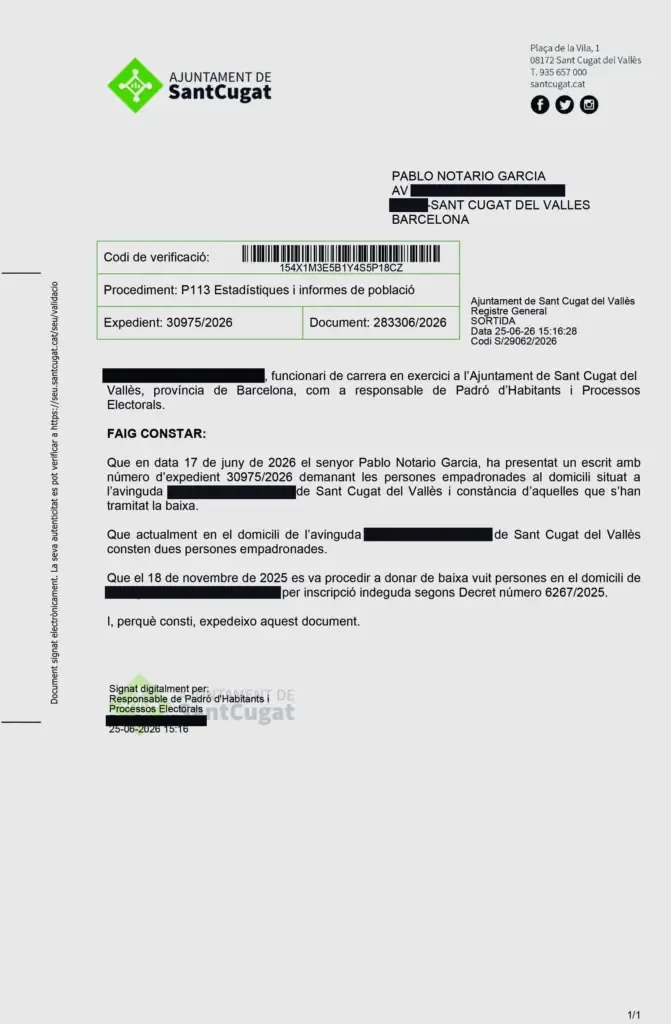
They must have taken advantage of that. They must have thought that no one would notice because no one would be living there,» recounts this 36-year-old architect to EL MUNDO and continues: «Then, you realize the obvious, that the sad thing is that there is a mafia that has made a lot of money with these immigrants; that has seen a way to charge these people and register them so they can easily access social services».
THIS IS NOT AN ISOLATED CASE
Pablo’s case was not isolated. The Sant Cugat City Council, with 97,000 inhabitants and governed by Junts, has deregistered 4,000 people from the municipal register in the last year after verifying that they did not reside in the municipality.
In addition, it has tightened control of the registry: although the procedure can be initiated online, it has become mandatory to physically go to the City Council to identify oneself within three months from the submission of the application to complete it. Otherwise, a home inspection is automatically activated to verify the identity of the registered person. This is supplemented by more random inspections to detect fraud and overcrowding of apartments with a lot of movement of registered cohabitants.
At the same time, the City Council has proposed increasing the minimum years of registration in the locality from three to ten to access social housing, in a move very similar to that just implemented by PP and Vox in the Andalusian Government pact, where they defend «the establishment of a reinforced minimum period of rooting, registration, and connection with the territory» for «access to all public aid, subsidies, and benefits» in order to guarantee «the priority allocation of public resources to those who maintain a real, lasting, and verifiable rooting». The Populars insist that «it will not be filtered based on the passport».
They do not do so either in Sant Vicenç de Castellet, a small town of 10,000 inhabitants located in the heart of Catalonia, very close to Manresa, which decided a year ago to draft a specific ordinance against «fraud in registration». Its mayor, Dani Mauriz, also from Junts, is blunt: «The regulation says that whoever lives here must be registered. But if you are living in Melilla or Murcia, you use their resources and not those of Sant Vicenç de Castellet».
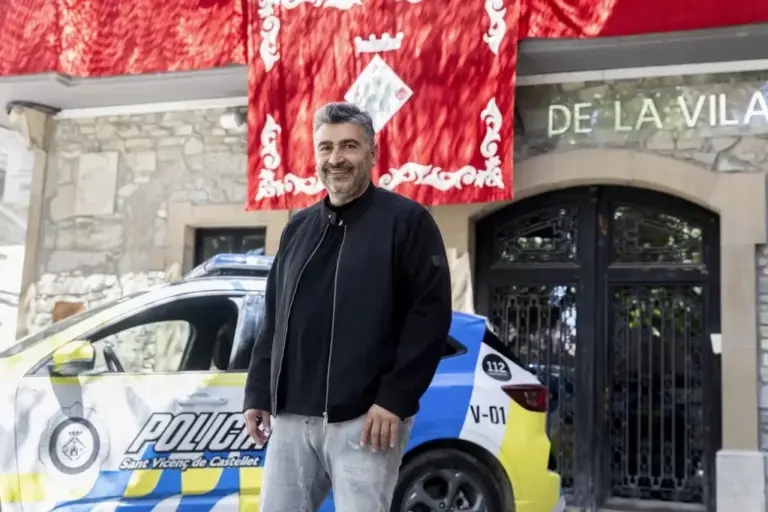
Mauriz describes that they have found up to 15 people registered at one address, when the habitability certificates set a maximum of six cohabitants. «People from here and from different countries,» he emphasizes. «We find all kinds. This ordinance wanted to avoid discretion. We do not inspect because they live in yellow or blue. We inspect because there are 15 people registered at that residence and we want to verify if they really live there,» he insists.
The result? In the last year, the City Council has deregistered 400 people from the register. «It’s not little,» celebrates the councilor, who acknowledges that previously «express registration certificates» were issued with practically no verification: «they came out with the register in their mouth». Now, in addition to inspections, a sanctioning regime with fines of up to 3,000 euros has been activated.
In the Girona town of Olot, with 39,000 inhabitants and also governed by Junts, 1,300 people have been deregistered from the register in the last year after carrying out 700 inspections. Its mayor, Agustí Arbós, defended when communicating the figures that «fraud was being committed and, therefore, public resources of the City Council were being unbalanced».
The PP intends for a similar policy to be carried out in Barcelona. Daniel Sirera, president of the Populars in the Barcelona City Council, proposed in the municipal plenary last May a series of measures to combat fraudulent registrations and strengthen the guarantees of property owners and legitimate holders of homes.
Among the defended initiatives was the creation of an automatic alert system that would immediately notify, via SMS, mobile app, or email, any registration, deregistration, or modification affecting the register of a property. The goal is for owners or holders to instantly know any change and, if detecting an irregularity, act quickly to avoid fraud situations.
«It is a measure of pure common sense. It brings more transparency to the administration, strengthens the legal security of citizens, and offers greater peace of mind to owners. City councils would gain credibility and neighbors would have an effective tool to protect their homes against possible irregular registrations,» Sirera tells this newspaper.
Currently, many citizens are unaware that there are people registered in their homes until they make an express inquiry or receive some administrative notification. «It cannot be that an owner discovers overnight that seven people are registered at their home without knowing who they are and that, moreover, to correct that situation, they have to face a real bureaucratic labyrinth. The consultation of the register and the warning mechanisms must be much more agile, accessible, and effective».
Sirera considers that the fight against fraud in the register must reconcile the right of people to register when they are entitled to with the obligation of administrations to prevent fraudulent uses of the municipal register, especially when they can serve to improperly access benefits, aid, or public services.
The president of the PP of Barcelona regrets that the PSC municipal government, led by Jaume Collboni, rejected this proposal considering that the alert system would be «a shortcut» that could violate certain administrative guarantees.
Sources from the Barcelona Government admit that, following complaints and proceedings initiated by the City Council, the Urban Guard, and the National Police, «4,000 deregistration files have been initiated and hundreds of addresses are preventively blocked in the computer system so that new registration attempts must be requested by application to be resolved».
However, they try to downplay the phenomenon by arguing that they have only received 141 complaints from «owners or illegitimate tenants» because «third parties have forged documentation to prove the availability of their homes». «If the cases were confirmed, the alleged forgery would affect 0.02% of Barcelona’s residential stock,» argue the sources of the socialist Executive, who also point out that «42 citizens have reported identity theft (in the sense that registrations have been made without their consent),» which in relation to the entire Barcelona register represents a 0.002% incidence. They also specify that the specialized unit of the National Police against Fraud (UCRIF) has informed them of the recent arrest of 22 people for forgery of registration procedures.
But what social rights does being registered grant access to? What explains this widespread fraudulent practice? Answers lawyer Marie Mateo Valenzuela, specialized in Immigration. «It is the gateway to obtaining the health card and access to the public health system, to training courses organized by city councils, to the schooling of minors, or access to social aid, school meal scholarships, and other municipal and regional benefits,» she specifies, while pointing out its value for basic procedures such as «opening a bank account in some cases or proving residence in Spain for numerous immigration procedures including the extraordinary regularization that ended last June 30».
WAYS TO COMBAT FRAUD
The lawyer considers it «positive that administrations combat fraud, because false registrations harm both the system and the foreigners who act in good faith». However, she points out that «it is also necessary to find a balance because each city council applies different criteria». «It would be advisable to move towards homogeneous criteria in all city councils, strengthening controls against fraud, but without hindering access to the register for those who really reside in Spain,» she evaluates.
The key, she indicates, is «to strengthen controls in the prior phase of registration, requiring documentation that really proves the occupation of the property, such as utility bills or proof of effective rent payment,» in addition to «focusing most efforts on pursuing criminal organizations that profit from these practices».
«The problem has evolved. A few years ago, registration certificates were directly manipulated; currently, they usually forge the documentation that serves as a basis to obtain an apparently valid registration,» she recounts and tells how lawyers have been summoned «as suspects or witnesses under suspicion of having participated in irregular registrations, when our intervention is limited to advising on the documentation required by the regulations and we have no capacity to verify the authenticity of all the documents a client provides».
«Currently, many foreigners reside in rented rooms whose holders do not want to register them for fear of losing certain aid or public benefits. This reality hinders access to the register and favors the emergence of mafias that offer illegal solutions. It would be desirable to streamline procedures such as registration without a fixed address, significantly reducing their deadlines (today it can take up to eight months), so that people in vulnerable situations can quickly access their rights without being forced to resort to fraudulent intermediaries,» she adds.
Read more The images from Ceuta shake the United States: «Spain could be heading towards a civil war»