








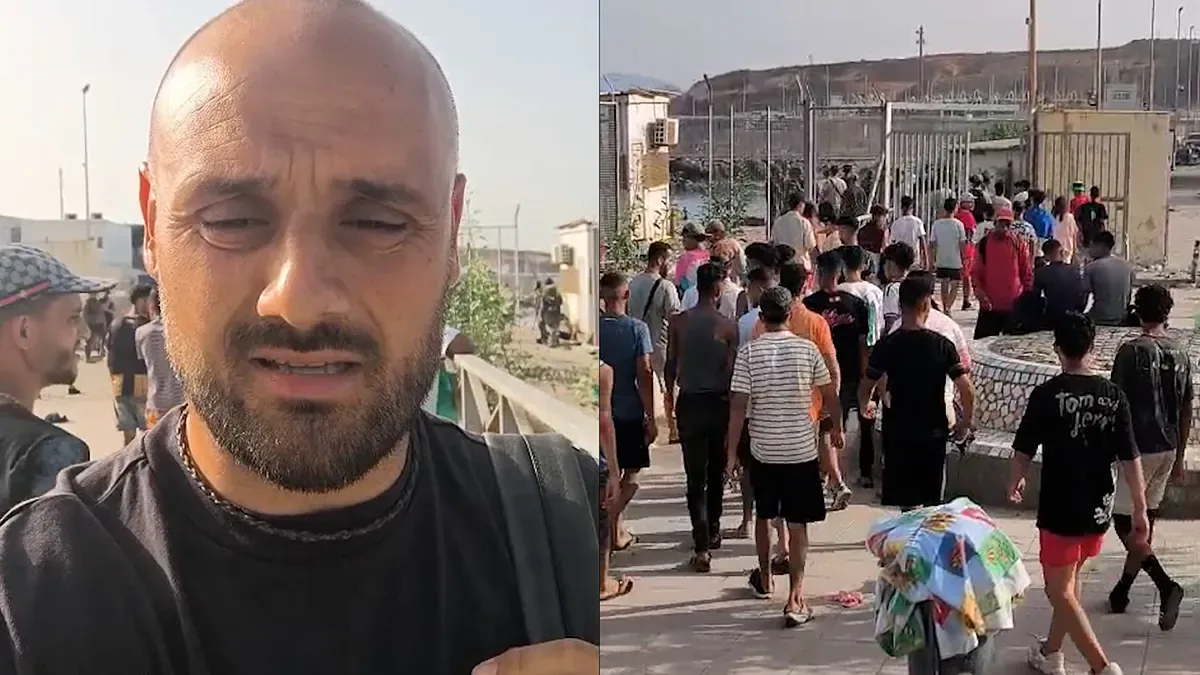
Youssef -barefoot, shirtless, with salt and sweat stains on his face- walks in the opposite direction to the route he took two days ago. His journey, although it had moments of ecstasy, has ended in disappointment.
The boy is 19 years old and has a tired look. On one of his cheekbones, he has a thick scar about seven centimeters long that almost reaches an eye. He says it was the result of a knife fight when he was still a kid.
«We are leaving. Spain doesn’t want us! They haven’t given us water, they haven’t given us a piece of bread…», he says in broken English. «Morocco is rotten. But Spain is kicking us out. We are very tired. We are leaving now. It was worth trying! We did it, but we were unlucky».
Last Thursday, Youssef threw himself into the sea with a group of eight friends from Tetouan, his hometown, to try to swim to Ceuta. They succeeded. At seven in the evening yesterday, just one day after setting foot on European soil, this young Moroccan was heading back downcast to his country of origin, Morocco.
He was one of the 50,000 immigrants that the Government estimates managed to access the autonomous city through the breakwater that separates Morocco from Spain. Part of the journey was also done on foot, among rocks. He says he saw two boys die before his eyes after falling against them, hitting their heads and backs, and not being able to surface because, like him, they did not know how to swim. Their bodies ended up swallowed by the gentle waves of these last days.
«I used my flip-flops to get there when I had to swim. I put them on my hands to push myself faster. I also had fins, but I lost one along the way», says this young man.
When EL MUNDO speaks with him, Youssef walks parallel to El Tarajal beach, heading towards a corridor set up between Spain and Morocco so that the exodus experienced these days is reversed. Those who arrived on Thursday began to leave en masse yesterday. Rivers of immigrants, mostly Moroccans from all over their country, took the same route that Youssef is now taking. The boy disappears from sight at the moment Spanish soldiers prevent the journalist from accessing beyond a fence next to the land border between Spain and Morocco, parallel to the coastal strip that separates the two countries.
The Spanish Government, through the Ministry of the Interior, stated yesterday that more than 48,000 people had already left Ceuta. It is a highly doubtful figure. At the close of this edition, thousands of immigrants were still wandering the city’s streets. Many others remained lying in parks, on beaches, in mountains near the border.
«MY MOTHER DIDN’T KNOW ANYTHING»
But the appearance of the streets had already changed by then. That massive return to Morocco was indeed happening, although not with the intensity claimed by the Spanish Government.
Minutes after talking to Youssef, a 15-year-old boy named Ahmed, small and narrow-shouldered, carried a black float around his neck identical to the hundreds and hundreds that the waves have been throwing onto the shore these days. He carried it with him because he thought he had to swim back to Morocco, just as he arrived. But a Spanish soldier deployed on El Tarajal beach explained to him, in Arabic, that he should follow that long human line led by a dirt path that ends in the neighboring country.
«I’m going home. I came alone», says the boy, who speaks to this newspaper with the help of the translation made by that soldier who accompanies him, originally from Ceuta. «My mother didn’t know anything. I’m from Tetouan. I don’t know when I will arrive», he manages to say while being accompanied beyond the fence that the press was allowed to reach.
Although most immigrants were returning to Morocco, hundreds more continued trying to access Ceuta throughout yesterday. However, they were returned to the neighboring country as soon as they touched land.
Meanwhile, Civil Guard divers continued recovering bodies from those waters through which immigrants arrived. When they found one, they raised their hands. Immediately, a Benemérita boat came to take the body out of the sea. Around half past seven in the evening, this reporter witnessed how four bodies were extracted from the water.
So far, at least 57 people have died trying to access Ceuta in this latest wave. It is the greatest migratory tragedy in the history of Spain, surpassing those recorded in 2014, when 14 died in these same waters, or in June 2023, when 23 people lost their lives in a jump over the Melilla fence, although Amnesty International raised the figure to 37.