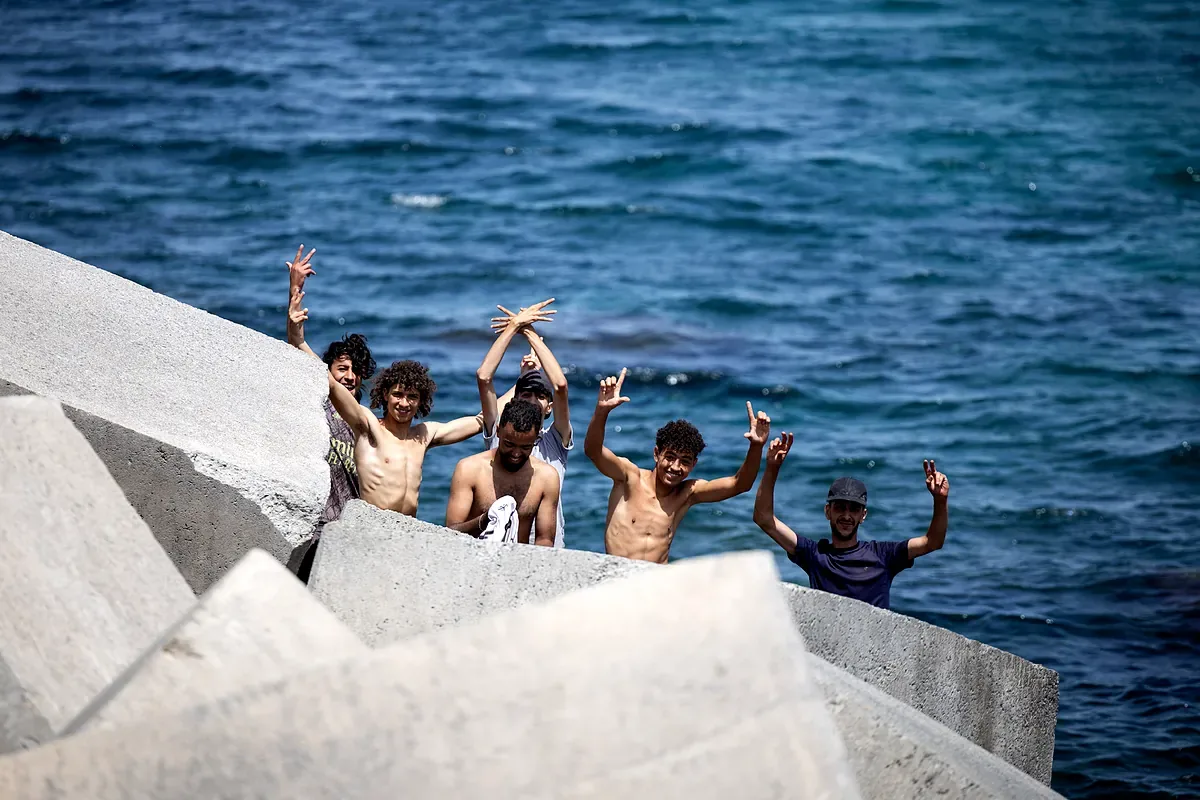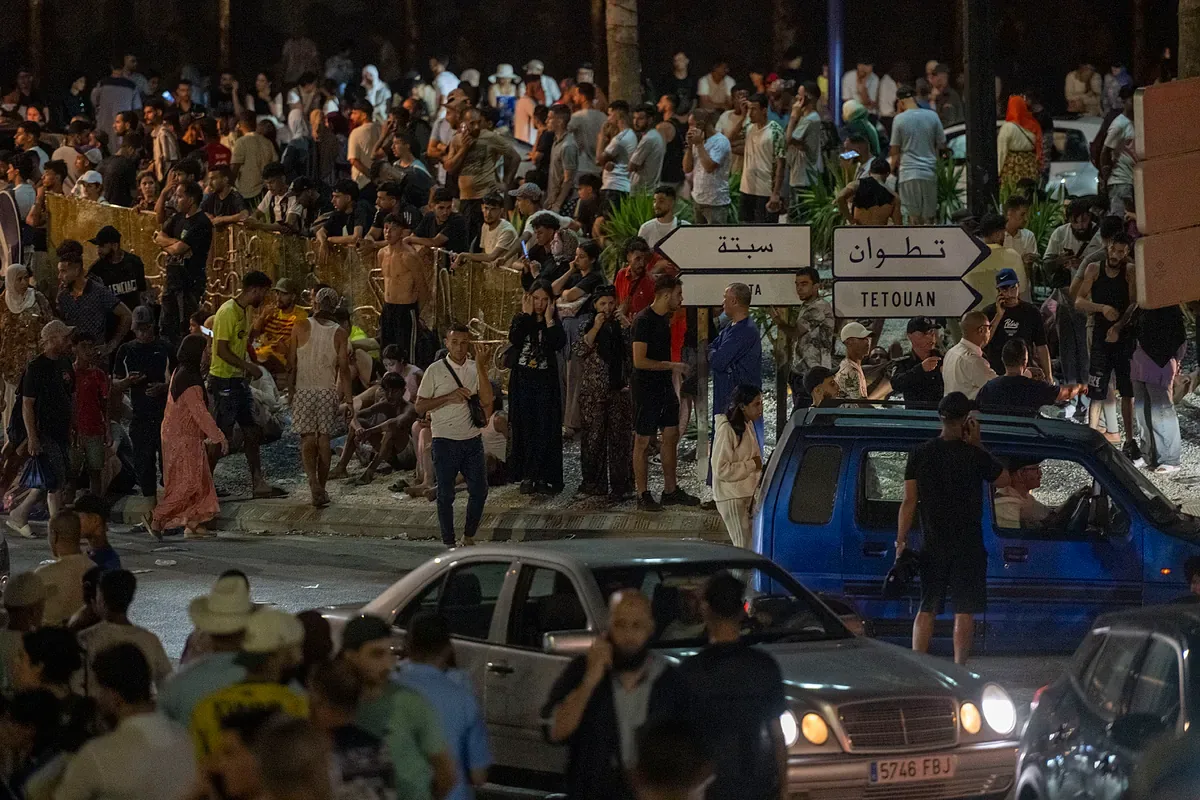








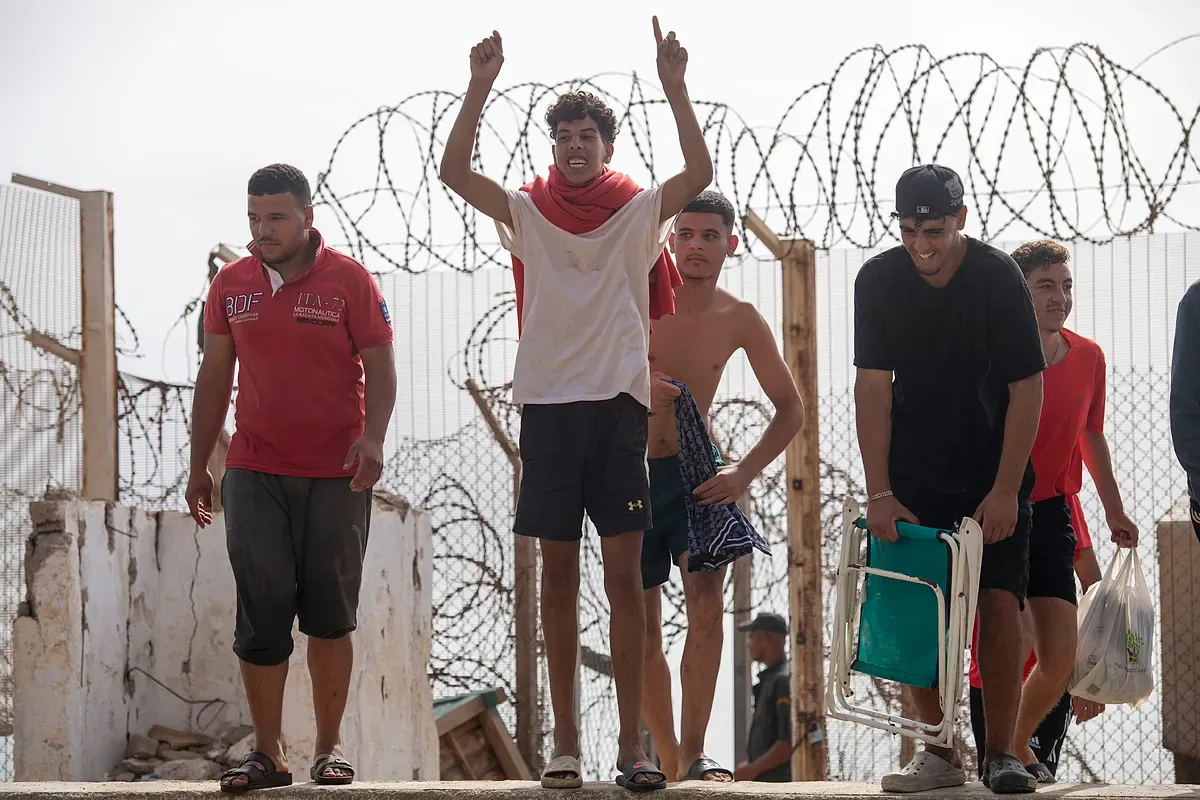
This morning the installation of containment barriers began on the breakwater at the Tarajal border, as announced this Friday from Ceuta by the Prime Minister, Pedro Sánchez, after around 60,000 immigrants crossed irregularly from Morocco, in a crisis that has left at least 67 dead.
Read more Once upon a time the ‘Spanish model’…
The Interior Minister, Fernando Grande Marlaska, has stated that Spain has reversed the situation in 24 hours, “alone, with the collaboration of Morocco” and has criticized the “ignorance and bad faith” of some European countries that have attacked our country’s management. On the contrary, the opposition leader, Alberto Núñez Feijóo, has asked the government if it had data on this “premeditated and unprecedented occupation” and has pointed to the Alawite kingdom.
Felipe VI expresses his “indignation” over what happened in Ceuta
Two days after swimmers began arriving massively at the beaches of Ceuta, and just a few hours after the Government declared the incident resolved, Felipe VI wanted to speak out after following “with great concern and indignation” what he called “serious events”.
In a statement sent through the communication department of Zarzuela, it is reported that over these days “the King has remained in contact with the presidents of the two autonomous cities, as well as with the Prime Minister and the opposition leader”. The Head of State has conveyed to them “words of encouragement and firmness”, reports Marina Pina.
According to the text, Don Felipe “believes it is necessary to adopt all measures that convey in a united, clear, and decisive manner to the populations of Ceuta and Melilla the support and affection of the rest of Spain”. The Monarch takes advantage of the brief text to remind the Government that “the State must ensure their security and prevent these events from happening again“.
EU Interior Ministers to hold urgent videoconference on Tuesday
Interior ministers of European countries will meet urgently next Tuesday via videoconference to exchange views “on the events in Ceuta,” announced this Saturday Micheál Martin, Prime Minister of Ireland, the country holding the rotating presidency of the EU Council.
Both Spain and a group of 22 countries had successively requested this extraordinary meeting to discuss the migration crisis in the Spanish autonomous city, as well as the diplomatic tensions arising from it.
“We remain in close contact with all member states and institutions, and continue to closely monitor the situation,” Martin added in a social media message reported by Efe.
Muresan (European Parliament) urges strengthening protection of Schengen borders
“What is happening at the border between #Spain and #Morocco poses a risk to the security of the entire European Union,” expressed Siegfried Muresan, Vice President of the European People’s Party, on social media. “Illegal immigration must be fought with all the instruments offered by the rule of law. Everything illegal must be fought and never encouraged.”
He specified: “The Government of Spain, led by Pedro #Sánchez, has the obligation to protect the borders of the Schengen area, apply European legislation, and act firmly against illegal immigration and any act contrary to the law.”
Trump praises “wise leadership” of Mohamed VI in Throne Day greeting
The President of the United States has celebrated the “wise leadership” and “commitment to peace” of King Mohamed VI on the anniversary of his ascension to the throne of Morocco and reiterated his full support for the Moroccan plan for Western Sahara as the only way, in his view, to break the historic “statu quo” in the area.
“The US is clear: we recognize Morocco’s sovereignty over Western Sahara and support the Moroccan proposal for serious, credible, and realistic autonomy as the only basis to reach a solution,” insisted Donald Trump in his congratulatory telegram reported by the official Moroccan news agency, MAP.
In general terms, Trump applauded the figure of the Alawite monarch, whose “wise leadership” he sees as “a pillar of stability” within the long relationship between both countries, which this year marks its 250th anniversary. “Morocco’s constant commitment to work for peace, combat extremism, and protect the security of Americans and Moroccans, including through its key role in the Abraham Accords, reflects a valuable alliance for the United States. To that end, we will also work together to ensure the security of the Sahel region,” Trump indicated.
NGOs estimate 100,000 displaced to Morocco-Ceuta border
Moroccan human rights organizations estimate that about 100,000 people moved towards Morocco’s northern border intending to cross into Ceuta, of which 60,000 achieved their goal.
The Moroccan Association for Human Rights (AMDH, leftist and the most influential in the country) stated in a communiqué this Saturday that this migration crisis “reflects the blockage of the social horizon” in Morocco and evidences the Moroccan state’s inability to guarantee “the minimum human dignity” to the population. Far from being an isolated event, it is the result of “decades of marginalization, impoverishment, and social exclusion”.
It also accuses Rabat of instrumentalizing migration for political purposes and criticizes “the use of the humanitarian card” as a pressure and negotiation mechanism with Spain and the European Union.
The Northern Observatory of Human Rights in Morocco claims to have detected, in the previous days, a intense spread on social media of calls to head towards Ceuta from accounts of unclear origin and with activity patterns that raise questions about possible artificial amplification of those messages.
Vivas denies Ceuta has returned to normality
“We are pleased that returns have begun but Ceuta has not achieved normality, we are not in normality because there are several thousand people who must be returned and there still exists a climate marked by unease and concern,” said the president of Ceuta, Juan Jesús Vivas (PP), this Saturday during his speech at a public event alongside the PP president, Alberto Núñez Feijóo.
The president insisted on the need to “complete” the return process and demanded the maintenance of “all deployed security devices” in the city to guarantee the population’s tranquility.
He also continued to appeal for the National Government to have a “firm, forceful, and immediate” response and the use of all legal and operational instruments at the State’s disposal: “Ceuta and Melilla are the only land borders of the European Unionon the African continent and that uniqueness must be effectively reflected in the regulations and the means they have, so we must lay the foundations so this does not happen again,” he emphasized.
Italy begins controls on travelers from Spain after suspending Schengen area
This Saturday, random checks are applied at airports and seaports on travelers coming from Spain, following the decision of Giorgia Meloni’s government to temporarily suspend the Schengen Agreement due to the migration crisis in Ceuta. At Rome’s Fiumicino airport, with an average of 55 daily flights from Spain in summer, Efe confirms these controls on commercial flights arriving from Madrid, Barcelona, or Málaga.
Agents of the Italian State Police have requested identity documents or passports from passengers coming from Spain, both EU and non-EU citizens, upon disembarking to verify nationality. More selective document requests were also made before leaving the airport, that is, in the public area where travelers usually wait after baggage claim.
Some of these travelers commented that the document requests caused some minor congestion upon disembarking, although some agreed with the measure.
Deployment of forces in Ceuta halts further arrivals this Saturday
The physical barriers around the Tarajal border breakwater and the deployment of maritime and land resources alongside the presence of the Army have stopped new migrant entries into Ceuta this Saturday despite a small number of people attempting by sea, who were intercepted by Morocco.
According to police sources and reported by Efe, about a dozen maritime units from Maritime Rescue, the Civil Guard, and the Moroccan Royal Navy are stationed near the breakwater. Added to this is the installation of 500 meters of pneumatic containment barriers, with a surface height of 30 to 70 centimeters and a submerged part up to one meter deep. This structure is combined with a first line of anchored buoys provided by the Navy.
The Army also continues with a special deployment in the area, with units of the Regular Forces, who are responsible for controlling the area in support of the Civil Guard.
France highlights Spain’s cooperation on migration
French Interior Minister Laurent Núñez emphasized this Saturday that there is no reason to suspend Spain’s participation in Schengen, with which cooperation on irregular immigration control is “very, very good”.
Núñez, questioned about the consequences of the Ceuta crisis during a press conference on the fire situation in France, clarified that what must be done is to implement the asylum and migration pact as soon as possible, which came into force on June 2 but needs legal instruments for its implementation.
Regarding whether Spain’s participation in the Schengen free movement area should be suspended, the French minister responded firmly: “Absolutely not.” “We have important cooperation with Spain,” he said before giving a figure to illustrate it. Specifically, he noted that when France arrests irregular migrants near the Spanish border, 70% of them are readmitted to Spain. “Therefore,” he added, “we have very, very good cooperation with Spain and there is no reason to request (…) Spain’s suspension from the Schengen area,” he assured, according to Efe.
Feijóo asks Government to explain if it had data on “premeditated occupation” in Ceuta and points to Morocco
PP leader Alberto Núñez Feijóo appeared in Ceuta alongside the president of the autonomous city of Ceuta, Juan Jesús Vivas, to criticize the Government’s “late and insufficient” response to the massive entry of irregular immigrants into Ceuta since last Thursday.
Feijóo lamented the “lamentable” image Spain has given to the world due to the migration crisis and committed that Spain will become “a safe country” again. “Spain’s territorial integrity is not negotiable, it is defended,” Feijóo stated, adding that the Government must clarify “what failed,” if it had data on this “premeditated and unprecedented occupation,” and must demand from Morocco a relationship based on “mutual respect” and “good faith.” “We have the right to know if the Government knew there was going to be an invasion, why it did not act.”
12 immigrants hospitalized in Ceuta, including two newborns
The University Hospital of Ceuta and health centers have attended to 613 people, of whom 12 were hospitalized – including two newborns – on Thursday and Friday after entering illegally from Morocco, and none are in serious condition.
According to the report presented by the National Institute of Health Management (INGESA), which manages health in Ceuta and Melilla, 76 Moroccan-origin people were attended at the Otero health center, 60 at the Tarajal health center, and 20 more at the Primary Care Emergency Service.
The 061 emergency service, with four medicalized teams, assisted 198 people, and the hospital emergency service attended 187 people during this migration crisis.
Hospitalization was necessary for 12 people, one in the ICU, another in pediatrics, two in obstetrics, and two in neonatology for two newborns from a twin birth. Additionally, one patient was admitted to traumatology and five more to the Emergency Observation area.
No deaths related to the border crossing or linked persons were recorded in INGESA centers, devices, and facilities in the Ceuta Health Area during July 30 and 31. Reports Efe.
Von der Leyen: “Not a single person reached mainland Spain or the rest of the EU”
The President of the European Commission, Ursula von der Leyen, reported on her X account the evolution of the migration crisis in Ceuta and assured that “the good news is that the vast majority of those who arrived illegally have returned to Morocco, thanks to the effective work of Spanish and Moroccan law enforcement. Not a single person reached mainland Spain or the rest of the EU. This shows why controlling our European borders is so important.”
“We have a solid system in place. But it needs to be strengthened even more. We must remain vigilant at every critical entry point and maintain close coordination among all authorities. At the same time, we need a lessons-learned process to improve our European resilience. The Commission has offered support to Spain from the start,” she assured.
“I received letters from several leaders and welcome the call for an extraordinary videoconference to assess what happened. Combating illegal migration requires solidarity and a united European response,” the statement concludes.
Melilla border reopens after 36 hours of closure due to migration crisis
The Beni-Enzar border crossing, the only operational one between Spain and Morocco in Melilla, reopened its doors this Saturday after 36 hours of closure due to migration pressure in the autonomous city.
Police sources informed EFE that this reopening will be gradual, with passage of 20 vehicles at a time to ensure the safety of travelers and police forces of both countries.
The land border reopening took place at 10:30 a.m. this Saturday, and the passage of the first vehicles was celebrated at the gate by some travelers of the Strait Crossing Operation (OPE) who have been blocked in Melilla since Thursday night.
According to the Government Delegation in Melilla, the procedure will consist of allowing access to the entry and exit ramp in groups of about twenty vehicles, and once these have passed Moroccan authorities’ control, a new batch of vehicles will be allowed through.
Dozens of Maghrebis still roam Ceuta center and hundreds in its neighborhoods
Of the more than 50,000 immigrants who have entered Ceuta in recent days by storm, by land and sea, many remain, an unquantified number, wandering the streets of the autonomous city, hidden in some cases and mostly wandering aimlessly.
In the center, despite being literally sealed off by police, on Saturday morning it was possible to see many groups of immigrants, mostly Moroccan. They were easily identified as part of the migration avalanche that has put the city in check in the worst migration crisis remembered. Tired, dirty, some barefoot, and many looking for something to eat in shops that have timidly begun to open. Others sought a mobile phone to call their families.
Read the full report by Chema Rodríguez
22 EU countries, led by Italy, request extraordinary meeting to coordinate external border control
Italy, Denmark, and 20 other countries requested this Saturday an extraordinary meeting of European Union (EU) Interior Ministers to analyze the migration crisis in Ceuta and agree on a coordinated response and immediate actions for external border control.
“This meeting should allow a common assessment of the situation and an agreement on a coordinated European response, including the rapid mobilization of available EU instruments and necessary support to Spain to restore effective control of the Union’s external border and prevent new uncontrolled crossings,” these countries state in a letter addressed to the President of the European Council, Antonio Costa, the President of the Commission, Ursula Von der Leyen, and Ireland, the rotating EU presidency.
The letter specifically requests reinforcement of Frontex support and the effectiveness of EU cooperation with Morocco. After expressing “deep concern about recent events at the EU external border in Ceuta,” these countries are determined “to prevent human traffickers from undermining the integrity of the Union’s external borders.”
They acknowledge that a recent Spanish Supreme Court ruling has been used to trigger this attack “and abuse our migration and asylum system.” “We have the duty to effectively deter and relentlessly combat irregular migration, coordinating our actions, strengthening our external borders, and addressing all policies that may serve as pull factors, such as regularizing a large number of irregular migrants,” the letter states.
The letter addressed to the EU leadership, promoted by the Prime Ministers of Italy and Denmark, is also signed by Austria, Belgium, Bulgaria, Cyprus, Croatia, Czech Republic, Estonia, Finland, Germany, Greece, Hungary, Lithuania, Latvia, Malta, Netherlands, Poland, Romania, Slovenia, Slovakia, and Sweden.
Estonia’s Interior Minister says expelling Spain from Schengen would be “betrayal”
Estonia’s Interior Minister, Igor Taro, criticized as a “betrayal” the possibility of excluding Spain, even temporarily, from the Schengen Agreement, after Italy introduced controls on travelers from the Iberian country following the Ceuta migration crisis.
“No, excluding Spain from Schengen, even temporarily, would be a capitulation, a betrayal against one of our allies in the EU and NATO,” wrote the politician from the liberal Estonia 200 party on his Instagram account.
“We have to think about how we can jointly support Spain, instead of discussing how to leave it out. No country is alone: the European Union border must be defended jointly,” he stressed, according to Efe.
Urmas Reinsalu, president of the main opposition party, Isamaa (Fatherland), expressed disagreement on social media and said Estonia should instead show solidarity with countries demanding a firmer action from Spain to protect its borders. “Suspending a member state from Schengen is a completely rational method to place new barriers to illegal migration in a critical situation where a country is unable to control the situation and is at the same time encouraging illegal migration,” added the opposition politician.
Marlaska: “The crisis is not closed, but the situation has been almost entirely reversed”
Marlaska: “It is very difficult to specify the number of people who entered illegally. It was between 50,000 and 60,000, but the vast majority have returned to their country. But I want to highlight the work of the Civil Guard, the National Police, and also the local police, to restore normality in the streets of Ceuta.”
Marlaska: “We have reversed the crisis alone, in collaboration with Morocco”
Marlaska accused some European countries of “ignorance and bad faith” for attacking Spain’s management of the Ceuta migration crisis. “We have reversed the situation that arose on July 30 alone, in collaboration with Morocco.” “Morocco is not a threat to Ceuta, nor to Spain; it is a reliable partner.”
Marlaska: “We must work with countries of origin to fight mafias to reduce departures”
Marlaska: “We must work with countries of origin to fight mafias to reduce departures. And we have been working on that for a long time, which has allowed irregular entries between 2021 and 2026 to be half those of Italy, for example. And that has allowed our borders to be among the safest.” “The situation has been reversed thanks to determined and permanent collaboration for years with Moroccan authorities.”
Marlaska: “Those who entered irregularly on July 30 have no option to regularize their situation”
Marlaska: “Those who entered irregularly on July 30 have no option to regularize their situation, which is why in less than 48 hours they have returned to their country. I know the images were very shocking, but I want to highlight our country’s efficiency in reversing the situation in just over 24 hours.”
Marlaska: “Fighting irregular migration is saving lives”
Spanish Interior Minister Fernando Grande-Marlaska speaks from Ceuta: “Fighting irregular migration is saving lives. At least 67 lives have been lost. And that has happened because of mafias trafficking in human lives.”
“In less than 48 hours, normality is being reached. Last night we began establishing the pneumatic barrier and a first line of buoys to comply with the circumstances required by the Supreme Court ruling.”
Ceuta shops resume activity, “although cautiously”
The Ceuta Business Confederation (CECE) reported Saturday morning that the city’s shops have resumed activity after the vast majority remained closed since Thursday following the massive entry of migrants.
The organization clarified that businesses are returning to normal “although cautiously.” CECE released the message after contacting “official sources” who, they said, informed them that today “there will be reinforced security presence at various points in the city to contribute to tranquility and the normal development of commercial activity.”
The entity noted that, according to their sources, around “5,000” people remain in the city from the 50,000 who entered Ceuta on Thursday, according to data provided by the Spanish Government.
The Confederation of Employers wanted to make “a call for calm, responsibility, and support for our local commerce.”
Portugal strengthens maritime border control in the south after Ceuta crisis
The Portuguese Maritime Police and Navy are strengthening maritime border control through regular and daily patrols, by sea and land, along the Algarve coast in the south of the country, following the migration crisis in Ceuta.
“These actions are carried out in a coordinated and integrated manner, ensuring a device both at sea and on land, and reinforcing surveillance, detection, and interception of vessels that may be related to irregular migration phenomena or other illicit activities,” the Portuguese Navy said in a statement this Saturday reported by Efe.
Both bodies emphasized that “maritime security is a shared mission” and called on the population to collaborate by reporting any suspicious movement.
The Portuguese Government assured on Friday that they do not consider it necessary to suspend Spain from the Schengen area after the migration crisis in Ceuta and requests from some European countries, and also explained that they are in constant contact with Spanish authorities.
Government assures Schengen area integrity is “fully guaranteed”
The Government assured this Saturday that the integrity of the Schengen area is “fully guaranteed” and that none of the people who crossed irregularly into Ceuta from Morocco have left the autonomous city towards the Peninsula, nor could they have done so, and also highlighted that the “practically all” of those entries have been “reversed” in less than 48 hours.
This is so, according to Government sources, because although Ceuta and Melilla are Schengen territory, they have a specific regime, unique in Europe. From both autonomous cities, it is not possible to travel to the Peninsula, by sea or air, without identifying oneself before the National Police at the port and airport. Additionally, shipping companies and airlines are obliged to verify documents.
Sources also highlight that in these territories, Spain applies a double filter: one at the border with Morocco and another, the Schengen control, on departure to the Peninsula, so that an irregular entry into the cities never becomes an entry into the rest of Schengen. This specific regime has been foreseen, they recall, since Spain’s accession to Schengen in 1991, in the Declaration on Ceuta and Melilla annexed to the Accession Agreement, and is preserved by the Schengen Borders Code in its article 41. Reports Efe.
Sánchez asks Brussels for urgent meeting over “selfish, polarizing, and illegal” reaction of member states to Ceuta crisis
The Prime Minister, Pedro Sánchez, has requested this Saturday that European authorities convene an extraordinary videoconference of the Interior Ministers of the 27 “urgently” in response to what he called a “selfish, polarizing, and illegal” reaction from member states that have reproached his migration policy after the avalanche of 50,000 people who entered by swimming into Ceuta this week.
In a letter sent to the President of the European Commission, Ursula Von der Leyen; the President of the European Council, António Costa; and the Prime Minister of Ireland, Micheál Martin, Sánchez argues that in less than 48 hours his Government has managed to “fully restore border control, provide extensive humanitarian assistance, return practically all migrants who crossed irregularly, and prevent any unauthorized movement towards continental Europe.”
“All this has been achieved in close coordination with Moroccan authorities and with very little support from other European states, while applying the effective and solidarity-based migration policy that Spain has been consistently developing over recent years,” the Prime Minister states in his letter. Reports Marta Belver.
Morocco transfers migrants who returned from Ceuta
Dozens of buses transported hundreds of migrants from early Saturday to different parts of the country who were in the Moroccan town of Fnideq (Castillejos) after entering Ceuta irregularly.
Hundreds of people, mostly Moroccans but also many sub-Saharan Africans, were waiting today for the departure of at least a dozen vehicles gathered on the outskirts of Fnideq to take them to other cities in the country, according to EFE.
The transfers began orderly and without incidents at dawn, according to local media.
Fnideq is gradually returning to normal after the tension recorded when on Thursday tens of thousands of people – 60,000 according to Spanish authorities’ estimates – took the city to cross irregularly into Ceuta. Their return to Fnideq on Friday overwhelmed this northern Moroccan town, with thousands wandering the streets and sleeping in parks and public spaces.
Government Delegation raises death toll to 67
The Civil Guard has recovered since Friday afternoon 10 new bodies of migrants who tried to cross into Ceuta from Morocco during Thursday’s massive entry. The death toll from the episode that caused the arrival of 50,000 people to the city is now 67, according to confirmations to Europa Press from the Government Delegation.
The armed institute has intensified the search for bodies at sea after, with the help of the Army and Moroccan authorities, they managed to stop the flow of irregular entries from the neighboring country.
Maritime Service agents continue combing the area to locate all victims of the migration crisis. By 5:30 p.m. last Friday, 57 bodies had been recovered by Security Forces in Ceuta waters. By 9:30 a.m. this Saturday, the figure increased by ten, according to the Delegation.
Calm returns to Melilla fence after second night of pressure
Calm has returned to the Melilla border fence after a night, the second consecutive, of migration pressure at different points of the perimeter and irregular entries that have not been officially quantified, which caused a large movement of patrols and use of riot control equipment to repel them.
According to EFE’s observation, one of the points of greatest pressure during the night was near the Beni-Enzar border crossing, the only operational one between Melilla and Morocco, which remains closed while more than a thousand travelers of the Strait Crossing Operation (OPE) remain blocked awaiting its reopening.
From before dusk until almost early morning, attempts to enter through that area were continuous by groups of young Maghrebi migrants who moved along the fence, some of whom caused damage to Moroccan surveillance huts and even a fire near the perimeter.
Some managed to climb to the top of the border fence and sit on the so-called inverted combs, which crown the fence closest to Morocco to hinder climbing before attempting to descend the Spanish fence to access Melilla, where numerous Civil Guard and Local Police patrols awaited.
The migrant groups followed the same dynamic for much of the night, moving along the perimeter to try to take advantage of any moment of distraction to achieve their goal, and some succeeded, as EFE observed near the Temporary Stay Center for Immigrants, where at least fifteen entered.
Recovered bodies rise to 60 after massive entry in Ceuta
The number of bodies recovered on the coast of Ceuta after the massive entry of people in the last two days rises to 60, according to the latest data provided to EFE by police sources.
The Civil Guard continues searching for bodies around the Tarajal border breakwater, which is where practically all bodies have been found at sea.
With these deaths, the number of migrants who have died this year trying to swim into Ceuta rises to 92.
Security forces and emergency services continue locating bodies of people who threw themselves into the sea from the Moroccan coasts of Castillejos to try to reach Ceuta’s coast by swimming. For this reason, the figure may continue to rise as hours pass, according to sources.
Containment barriers begin to be installed on the Tarajal border breakwater
The Interior Ministry informed EFE that at 7:50 a.m. the installation of containment barriers began on the Tarajal border breakwater, as announced this Friday from Ceuta by Prime Minister Pedro Sánchez.
The main element is a pneumatic barrier 500 meters long, with a surface height of 30 to 70 centimeters and a submerged part up to one meter deep. This structure is combined with a first line of anchored buoys provided by the Navy.
Additionally, an intermediate channel will allow Civil Guard vessels to guarantee the protection of the pneumatic barrier at all times.
About 69,500 migrants return to Morocco
State Security Forces estimate that around 69,500 migrants have left Ceuta for Morocco in the last 30 hours after the massive entry last Thursday.
Police sources told EFE that these figures may include migrants who had arrived in the autonomous city in days prior to that massive entry and even others who yesterday entered and exited more than once.
The Interior Ministry estimated 50,000 entries on the 30th, while the president of the autonomous city, Juan Jesús Vivas, said they could have reached 60,000. Interior sources reported this morning that the night in Ceuta passed normally, that entries “have stopped entirely,” and that departures to Morocco have continued.
After Thursday’s massive entry, thousands of people left yesterday towards the border to return to Morocco for several reasons, including the announced agreement between Spain and Morocco for their repatriation, as well as the absence of shops, commercial areas, or bars open in Ceuta to meet their most basic needs.
Morocco detains 70 people for violent incidents
Morocco has detained 70 people in recent hours for their alleged involvement in violent incidents following the irregular crossing of tens of thousands of people into the Spanish enclave of Ceuta, a crisis that has claimed at least 57 lives.
The detainees are being investigated for crimes related to attempted homicide, arson, and damage to public and private property, according to sources close to the investigation who spoke to EFE.
The charges stem from clashes that occurred early Friday in Fnideq (Castillejos), where minority groups entrenched in hills near the Ceuta border crossing confronted Moroccan security forces and set several vehicles on fire.