




The Ceuta crisis has been the opportunity for Giorgia Meloni, the Italian prime minister, to dust off the framework of her failed Albania plan, expensive and unproductive, and replicate it with the creation of deportation centers in third countries, mostly African, in the style of those located in the Balkan country. But this time funded with European funds.
Italy will propose this common strategy to the 27 EU countries to respond to situations like the one that occurred in the Spanish autonomous city. The Italian Interior Minister, Matteo Piantedosi, will convey the idea to his European counterparts in the videoconference held this Tuesday. The preliminary list of countries that could participate includes the African countries Rwanda, Ghana, Senegal, Tunisia, Libya, Mauritania, Egypt, Uganda, Ethiopia, as well as Uzbekistan, Armenia, and Montenegro.
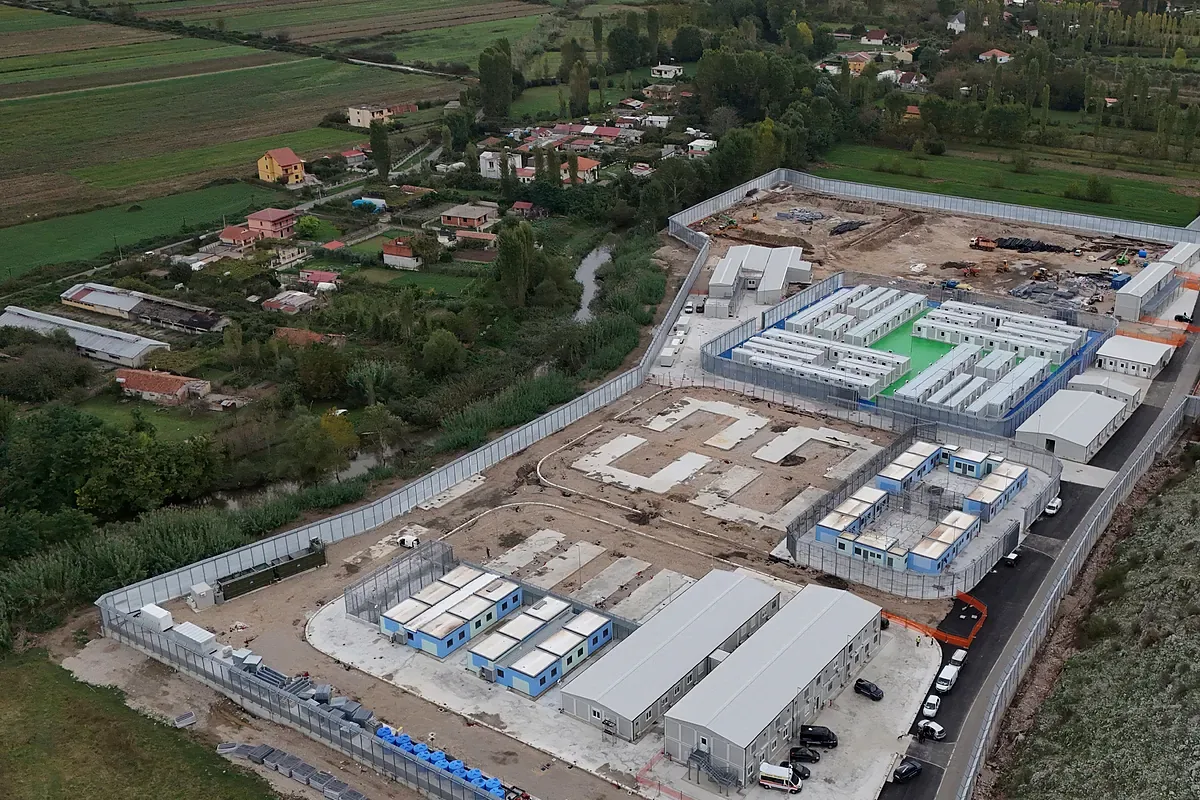
Although the Albanian centers are practically unused, Italy wants to give new life to its flagship bet of autumn 2024. Rome’s intention is that European partners, shocked by what happened last week in Ceuta, are convinced that the solution is to outsource migrant expulsions and send them to third countries.
So far, the Albania plan has been more media-oriented than effective due to logistical, economic, and legal problems. The difficulties are linked to the transfers, as moving migrants without international protection from the Central Mediterranean to the Albanian centers of Shëngjin – on the Adriatic coast – and Gjadër – inland in the Balkan country – involves two days of navigation each way. Additionally, many of those deported to Albania had to finally disembark in Italy due to judicial irregularities.
The strategy is also very expensive and ineffective. According to data published by various Italian media and opposition parties, the costs of the Albania plan will reach up to 1 billion euros during the first five years. However, in the last two years, barely 600 migrants have been deported to Albania. The average migrant transit in Shëngjin and Gjadër is about twenty people per month compared to the 3,000 migrants initially expected by Meloni’s plan.
Awaiting the rulings
On top of all this is the legal unfeasibility: the Court of Justice of the European Union (CJEU), based in Luxembourg, still has to rule on two appeals filed by Italian judges regarding the operation of these centers. The rulings will not arrive until at least next month.
Read more Cover of EL MUNDO on Tuesday, August 4, 2026
The Luxembourg CJEU will have to resolve three fundamental controversies: whether Italy can keep asylum seekers in Albania, whether the centers in Shëngjin and Gjadër legally count as Italian territory, and whether the agreement contradicts the exclusive competence of the EU in migration matters. The latter relates to the recently approved Migration and Asylum Pact – valid since June 2026. This allows sending an asylum seeker to another safe country, as in the case of several countries in the Balkans area. Additionally, European repatriation legislation, still without an effective date, will allow sending people awaiting expulsion to a third country (from a list of 12 countries).
The fact is that Ceuta does not belong to the Schengen area, and the migrants who crossed the border entered Spain but did not reach the Iberian Peninsula. So the Italian Government’s decision, from last Saturday, to suspend the Schengen border with Spain for at least the next 30 days, has more of a political than an effective value. There was no risk of free movement of the newly arrived migrants in Ceuta, geographically speaking, to the rest of Europe.
Meloni’s proposal to bring the revamped Albania plan to the Interior Ministers’ meeting for expulsions to Africa mainly has a media and show-of-strength value on the part of the prime minister. On the international stage, the Italian head of government has had months of friction with Trump following the White House occupant’s criticisms of Pope Leo XIV, which has diminished her influence outside Italy. With this proposal, Meloni returns to the forefront.
Domestically, the premier knows that her competition is no longer just her own vice president Matteo Salvini, leader of the populist League. In recent weeks, a new far-right party has been growing that could take part of her electorate: National Future (FN), led by Roberto Vanacci, who has 7% support in recent polls. Vanacci will take advantage of every Meloni mistake to present himself as an even firmer right-wing alternative to the current occupant of Palazzo Chigi.
Read more Panic on a beach in southern Russia with seven dead due to the downing of a Ukrainian drone