




There were indeed prior warnings about the magnitude of the Ceuta crisis. There were indeed forceful and unequivocal warnings about what was coming. And not one, but two. At least. There was even Moroccan police information that helped trigger alarms on the other side of the border. But there was no timely reaction, nor with sufficient force. Despite the Government’s denial, there were critical reports already pointing to the “massive” magnitude of the “collapse” that was “very likely” to come. The two key intelligence reports on the Ceuta crisis, to which EL MUNDO has exclusive access, prove this beyond doubt and without room for political justification, as their content is as crucial as it is clear.
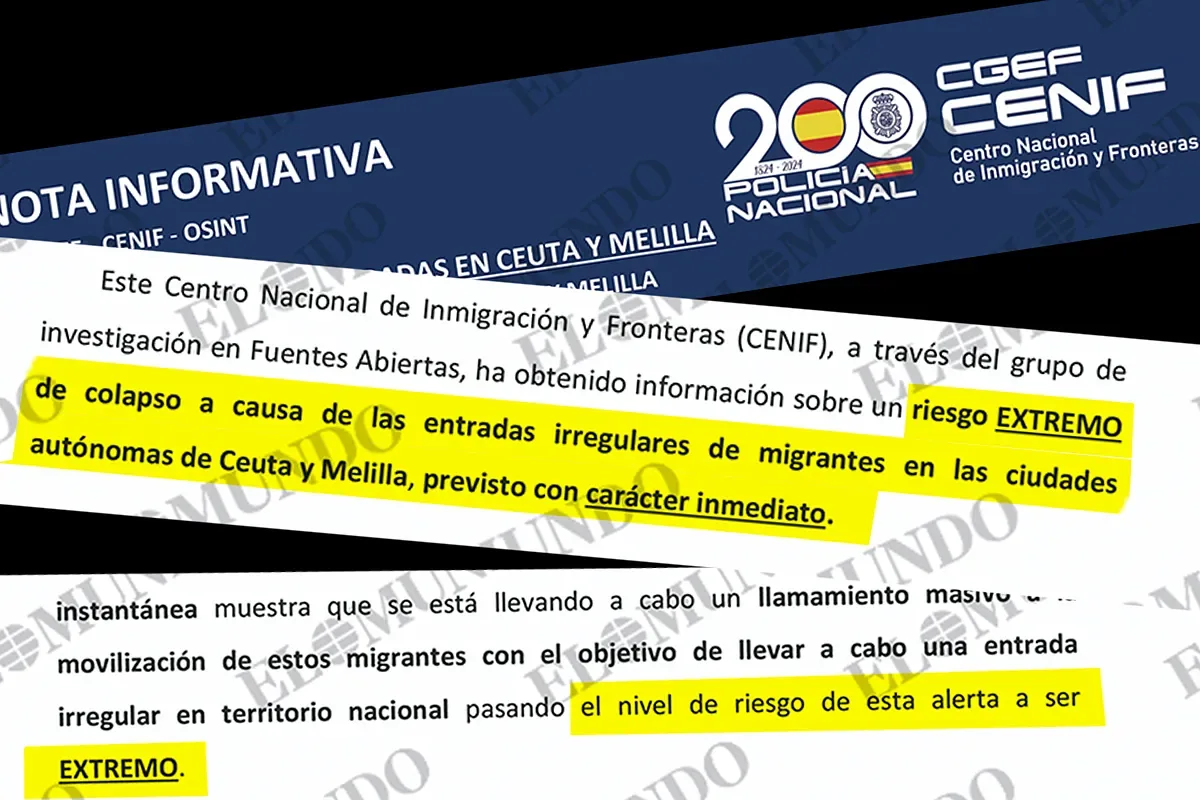
The first of the two reports in this newspaper’s possession is from military intelligence, which warned on July 27 that the “massive entry of irregular migration” into Ceuta on the 30th was considered “very likely.” And three days later, just before the avalanche, the National Police warned, in an internal information note, of the “extreme risk of collapse” with “immediate character.” The word “extreme” appears in uppercase, underlined and in bold. “Immediate character,” in bold and underlined.
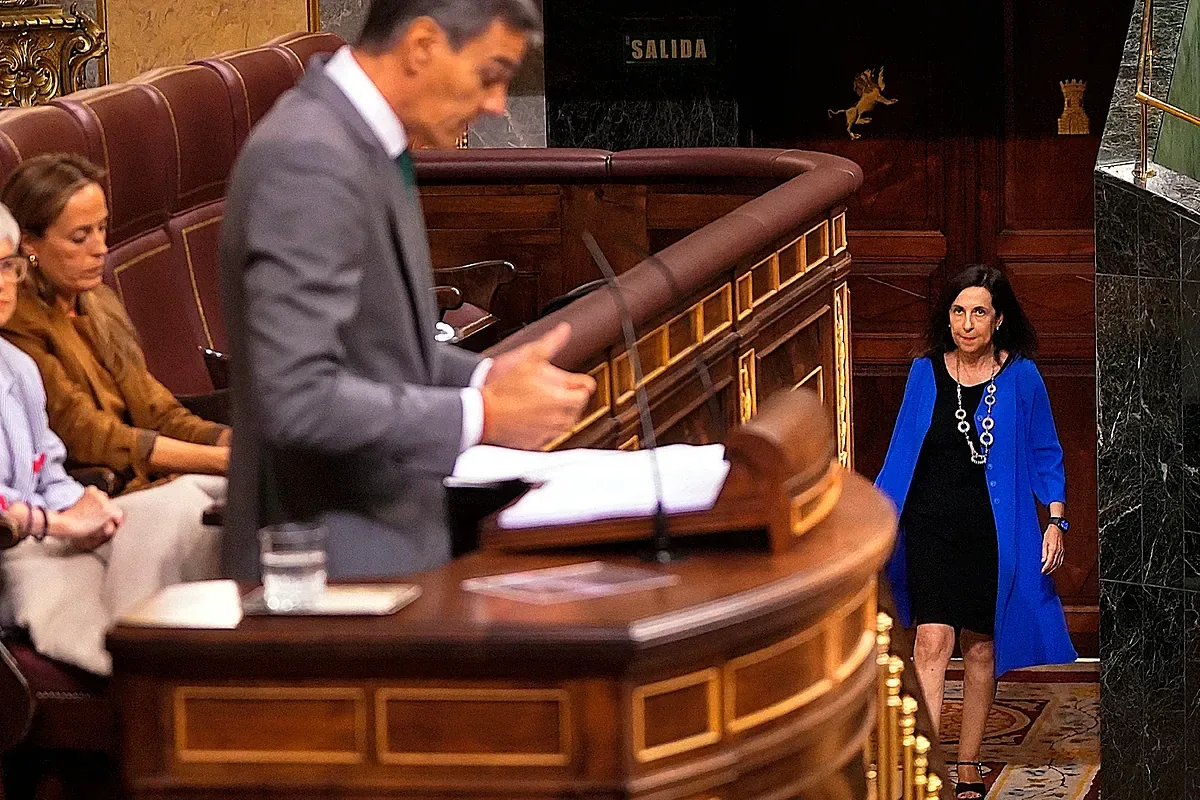
This is the first time a “massive entry” alert to Ceuta has been made public. And it is the first time an alarm about the “collapse” that was to happen “imminently” in the autonomous city, and which still persists, has been known. Until now, the Executive has defended that the warnings did not reflect the “magnitude” of the border assault, with more than 70,000 immigrants crossing the El Tarajal border and entering a city where 83,500 people live. This is what the Interior Minister, Fernando Grande-Marlaska, said on August 28 in Congress. With this statement, he faced Margarita Robles, Minister of Defense, who has always defended that there were indeed warnings and intelligence.

On Monday, July 27, three days before the “violation of Spain’s territorial integrity” – as defined by Pedro Sánchez -, the 32nd Electronic Warfare Regiment of the Army (REW 32), based in Seville, warned the Armed Forces Intelligence Center (CIFAS) that Moroccan border police agents had already detected the certain possibility of the migratory avalanche, and ordered that no one leave their post on the Moroccan side of the border. The information from those agents was that a large entry of immigrants into Ceuta could occur either on the night of the 29th or on July 30, “taking advantage of the Throne Day holiday in Morocco.”
CIFAS took very good note of this primary and on-the-ground information, and raised it to superiors on the 29th as a supported analysis report. That is, there is a third report in this line of warning. That document follows a chain of command: deputy director of the Center, director, and JEMAD (Chief of the Defense Staff).
Therefore, Robles was right when she said there were prior intelligence analyses – which we now know were also very accurate – about the possibility of a “massive entry” into Ceuta territory. This is demonstrated by the fifth and final point of the REW32 report, reproduced alongside these lines.
This implies that members of the Moroccan Police knew the immigrants’ plans, but their commanders did not activate the border closure, as they did on August 15. Later, it was shown that many Moroccan gendarmes actively participated in the operation, even engaging in “active guidance” of the people who entered.
It should be clarified that the 32nd Transmissions Regiment is an Army unit responsible for “operating very specific transmission systems contributing to the joint action of the Armed Forces, in collaboration with the systems of other armies.” Its information was vital for CIFAS to anticipate what happened.
Read more “We want to vote” against the emotional trauma of Ceuta
Three days after that alert with information from Moroccan border agents, the National Immigration and Borders Center (CENIF) of the General Immigration and Borders Police Headquarters issued a report shortly before the massive entry occurred – and therefore, during the morning, since the assault became massive at 11 a.m., according to Defense. It emphasized that “the risk level” of the alert had become “extreme.” Again, this last word was written in uppercase and bold.
One might ask why, if the Intelligence of the National Police and the Army had warned so clearly, the Government did not deploy the Army in Ceuta until late afternoon that day. And why there were only nine civil guards deployed, as this newspaper reported. At the moment thousands of people began crossing from Morocco, the Armed Institute had barely five agents on the ground at the border and four members of the Specialist Group in Underwater Activities (GEAS), the divers. To these last, their chief joined, despite being on leave. The device was completely overwhelmed and the pressure on the border kept growing. This unusual scenario pushed the 15 civil guards at the Ceuta Command to close the facilities to move to the border and reinforce the device and try to contain the entry.
That same morning, CENIF issued its internal information note, which began as follows: “Through the Open Sources investigation group, information has been obtained about an extreme risk of collapse due to irregular migrant entries in the autonomous cities of Ceuta and Melilla, expected with immediate character.”
What information did the Police have? “Yesterday, a forecast of scenarios about the events that could occur today was sent to the border posts of Ceuta and Melilla. The information obtained from social networks and instant messaging applications shows that a massive call to mobilize these migrants is being carried out with the aim of carrying out an irregular entry into national territory, raising the risk level of this alert to extreme. This information is exclusively transferred to the border posts of Ceuta and Melilla, as the information obtained refers to these autonomous cities.”
Then, the document warns that things could even get worse: “From this Center it is communicated that, in case of relevant developments in this regard, new information notes will be sent to expand the information provided so far.”
It should be remembered that Minister Marlaska said on August 28, in the Congress of Deputies, that there was no alert about the “magnitude” of the massive arrival through the border with Morocco that day. But the truth is that there were two very clear warnings. And another from the Civil Guard. Which one? The night before the immigrants crossed the border, the Benemérita warned that there were at least 3,000 already waiting to swim across. Where did they warn? Not in a secret report, nor orally, but no less than on the front page of EL MUNDO, in three columns and with a large photo: “There are 3,000 in Morocco waiting to swim across.” Impossible to ignore. “Morocco is not cooperating,” the agents complained.
Read more The Government, with no way out in the face of the outcry for Ceuta