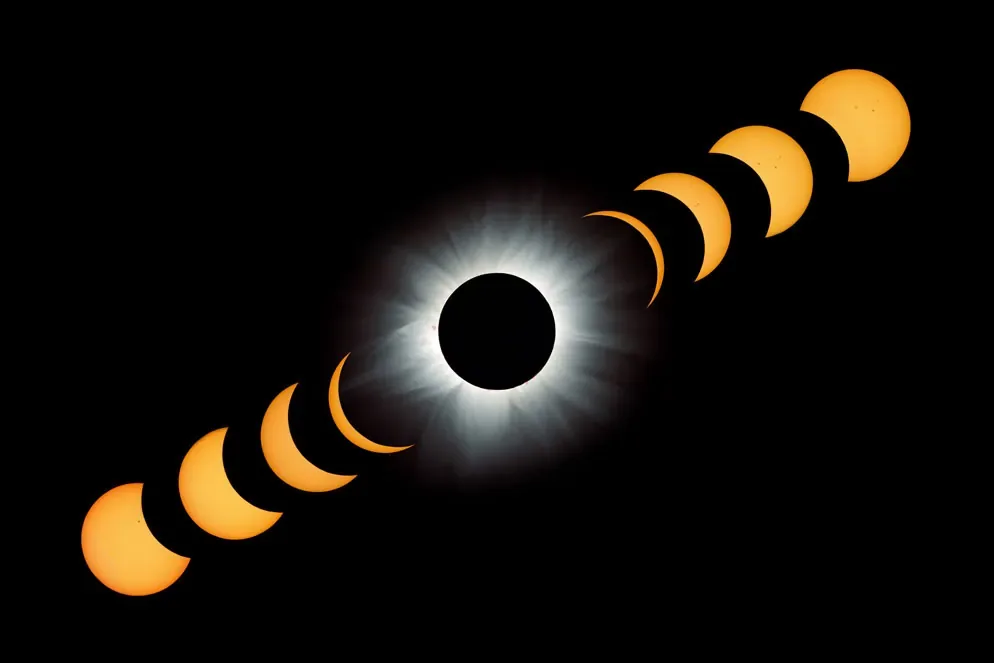






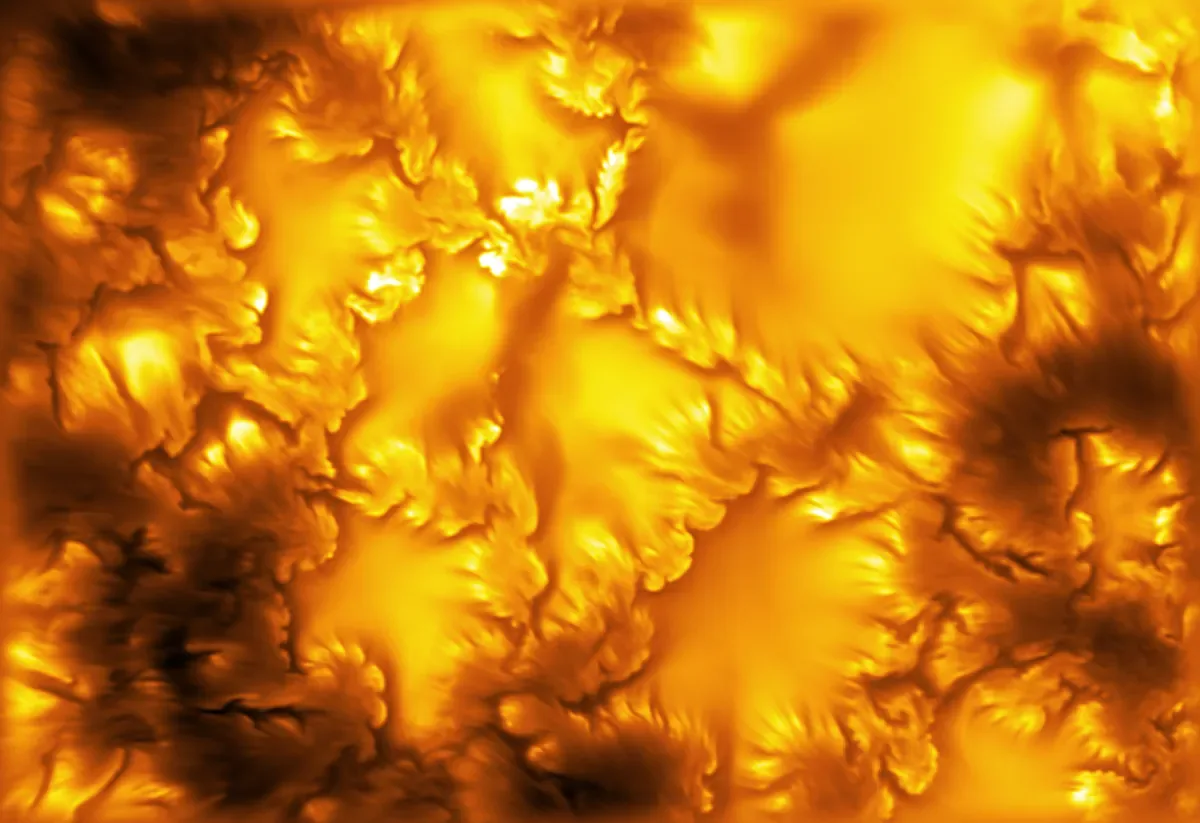
Just days before Spain looks to the sky to enjoy the total solar eclipse on August 12, new research allows us to observe what happens beneath that luminous disk through the highest resolution images of its visible surface. The surface of the Sun is not a calm plain of light, but an ocean of moving plasma.
The Daniel K. Inouye Solar Telescope has managed to observe there a phenomenon that physicists had been waiting decades to find: tiny whirlpools that appear when two plasma currents move at different speeds next to a region dominated by the magnetic field.
The finding, published in the journal Nature, constitutes the first clear experimental confirmation of the so-called Kelvin-Helmholtz instabilities in the photosphere, the visible layer of the Sun. These small structures could help understand how plasma mixes and how energy circulates through the solar atmosphere.
Although the name sounds complicated, the phenomenon has a simple comparison. Something similar happens when the wind blows over the surface of the sea and raises waves, or when certain clouds take on wavy shapes. Two layers move at different speeds and the boundary between them begins to bend until whirlpools form.
This process had already been studied on Earth, in the atmospheres of Jupiter and Saturn, and in other places in space. Possible signals had been found on the Sun’s outer layers, but it had never been observed so clearly on the visible surface.
The key has been the Inouye telescope, installed near the summit of Haleakalā, on the Hawaiian island of Maui. Its four-meter mirror allows distinguishing details of just 19 kilometers on the Sun, a tiny distance on a star whose diameter is about 1.4 million kilometers.
The images were taken on April 14, 2025, in a magnetically active area near a sunspot. For about three minutes, the telescope captured a surface full of curls, dark stripes, and small whirlpools that appeared and constantly changed around the magnetic concentrations.
The researchers studied 47 of those whirlpools. Some measured just 25 kilometers and others reached 170. In addition, they seemed to move around the magnetic regions at speeds of up to three kilometers per second.
To verify that these were not simply striking shapes, the team compared the observations with computer simulations of the Sun. The models reproduced very similar whirlpools, with dimensions, speeds, and behaviors similar to those recorded by the telescope.
The explanation is that the hot plasma on the solar surface moves toward areas with intense magnetic fields and is deflected when it reaches their edges. Since neighboring layers do not move at the same pace, the boundary begins to ripple and ends up forming small whirlpools.
Some of them join together, while others generate even smaller whirlpools. The result is constant agitation that mixes magnetized plasma with other material less influenced by the magnetic field and promotes the appearance of turbulence.
The simulations also indicate that these vortices are not simple drawings on the surface. They extend hundreds of kilometers into the interior of the Sun and can divide the magnetic structures hidden beneath the photosphere into smaller filaments.
A hidden mechanism that twists the magnetic field
Their importance goes far beyond the image. The solar magnetic field can twist and intertwine until it accumulates large amounts of energy. When that tension is released, it can power everything from small flares to huge eruptions and coronal mass ejections.
The latter launch plasma and radiation into space. If they travel toward Earth, they can cause disruptions in satellites, communications, navigation systems, and even power grids. Knowing the origin of these movements therefore helps to better understand so-called space weather.
The whirlpools could also provide a piece to the old mystery of the solar corona. The visible surface of the Sun is about 5,800 degrees, but its outer atmosphere reaches temperatures of millions of degrees. Scientists still do not fully understand how so much energy gets there.
“The Kelvin-Helmholtz instability is probably one of the mechanisms that contribute to heating the Sun’s outer atmosphere and part of the solution to the old enigma of why stars have coronas at millions of degrees,” explains Thomas Rimmele, co-author of the study and researcher at the National Solar Observatory.
The new study suggests that these instabilities could help transport energy to the upper layers. However, researchers still need to calculate how much heat they generate and how important they are compared to other processes that also act in the solar atmosphere.
The next step will be to locate many more whirlpools using automatic systems and better measure the energy they carry. The discovery does not suddenly solve all the secrets of the Sun, but reveals a mechanism that until now remained hidden. Part of the energy that ends up powering huge eruptions could begin in whirlpools just a few dozen kilometers wide.
Read more Sumar asks that Spain not co-host the 2030 FIFA World Cup with Morocco