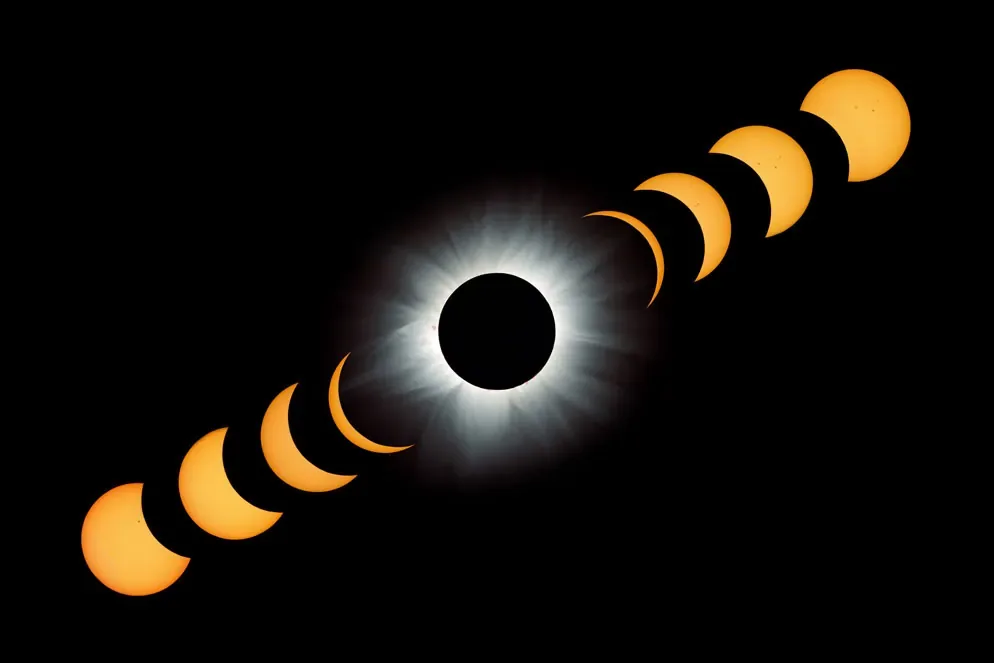




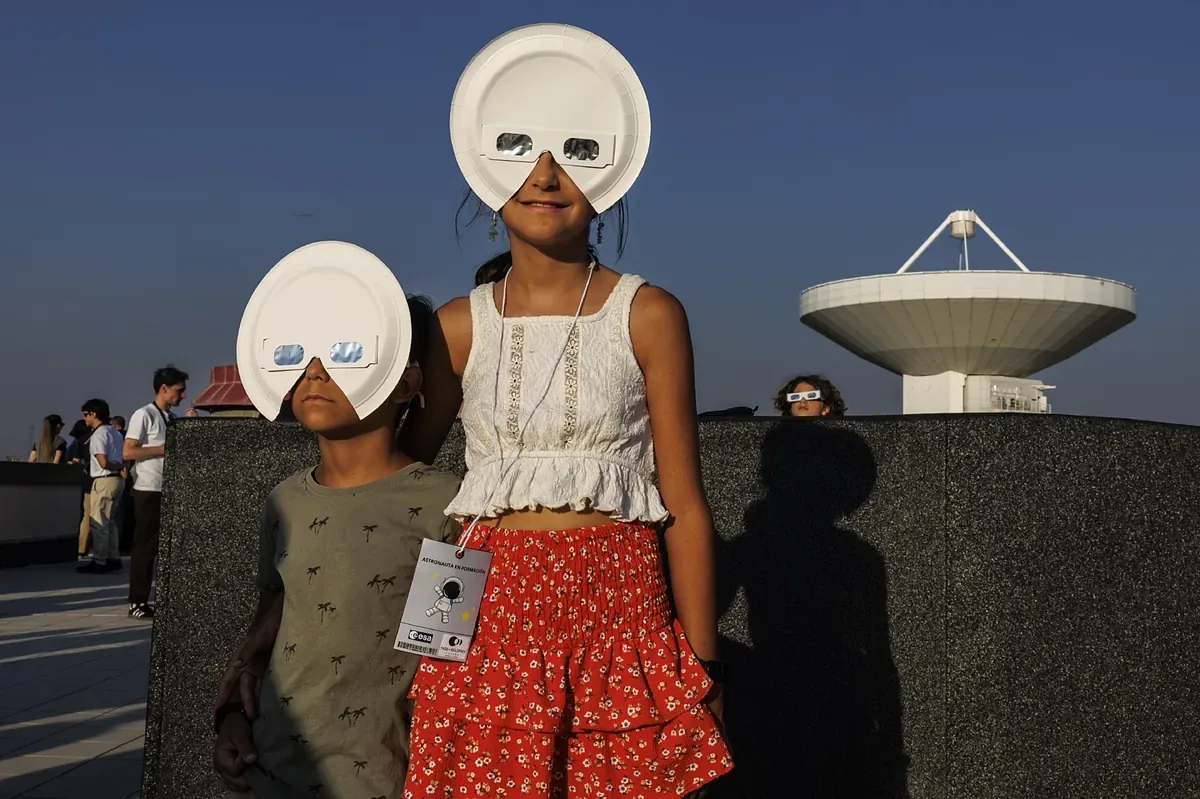
The solar eclipse that has captivated millions of people is the first of the trio of Iberian eclipses visible from different areas of Spain in 2026, 2027, and 2028. We have ahead of us two more astronomical phenomena that will unleash as much or even more excitement, as many citizens fascinated are already looking for where they can repeat the experience we lived on August 12.
The next dates will be the total solar eclipse on August 2, 2027 (visible in areas of the south of the Peninsula and in the autonomous cities of Ceuta and Melilla) and an annular eclipse on January 28, 2028 (it can be observed in almost all of Andalusia, southern Extremadura, Castilla-La Mancha, some areas of the Community of Madrid, Aragón, Murcia, Valencian Community, part of Catalonia, and in the westernmost islands of the Balearics).
What lessons can be drawn from Wednesday’s first total solar eclipse? Astronomers Rafael Bachiller (president of the Scientific and Advisory Commission of the Eclipse Trio), Pablo de Vicente (director of the Yebes Observatory), and Montserrat Villar (astrophysicist at the Institute of Astrobiology-CAB/CSIC-INTA) reflect on what was learned during this historic day.
1. DO NOT IMPROVISE
For Rafael Bachiller, the great lesson of 2026 is that an eclipse of this magnitude cannot be improvised. “On Wednesday we had the opportunity to test, under real conditions, a plan developed over several years (the Scientific Commission of the Eclipse Trio was established in 2023 and the Interministerial Commission, in which 13 ministries have worked in coordination along with the autonomous communities, in 2025). The experience of August 12 shows that planning years in advance is essential. Mobility, security, healthcare, weather, communications, and hosting capacity must be anticipated.”
He also considers that “the 2026 eclipse can be considered a dress rehearsal that allows us to better prepare for the August 2, 2027 eclipse. The goal for next year should not be to start over, but to learn from what happened, keep what worked, and correct what can be improved.”
Pablo de Vicente agrees: “Preparation and planning are fundamental; it is necessary to know in advance the place and time to have all the logistics needed to adapt spaces for the greatest number of people with the best safety and comfort conditions and to have a good view.”
2. FORGET ABOUT SCREENS
“The experience of a total eclipse is unforgettable and wonderful. There are no words or images that can do justice to the sight of the black Sun surrounded by its corona, nor to the emotion of feeling the changes in light that occur around us during the sudden twilight. It is a moment to put away phones, forget about screens, and simply contemplate nature in its purest state,” recommends Montserrat Villar.
Pablo de Vicente shares the same opinion: “I kept my mobile phone away during the entire eclipse,” he assures.
3. EXPLAIN THE SCIENCE BEHIND IT, DISSEMINATE AND ATTEND TO THE MEDIA
“It is a natural phenomenon that shows the grandeur of the universe and its beauty. Sensory and emotional enjoyment multiplies if preceded by a scientific explanation. Scientific explanations are necessary,” says De Vicente.
He also emphasizes that “dissemination and transmission of information are fundamental to inform citizens about the work being done. Every effort in this regard is necessary and welcome.” Therefore, he asks that “scientists do not skimp on attention to the media; they must try to attend to them as best as possible,” so that the information reaching the public is rigorous.
4. INSTITUTIONAL COORDINATION
According to Bachiller, the absence of major incidents in many territories indicates that preventive measures work when well coordinated. “The formation of an Interministerial Commission has allowed addressing all these aspects comprehensively. For 2027, it is advisable to keep what has worked and correct it based on objective data, not start over.”
He also highlights that the concentration of the public must be territorially planned. “I believe that defining official observation points at the regional level has worked well. It has allowed each municipality to prepare its own plan, but taking into account that movements affect entire regions, main and secondary roads, and neighboring municipalities. This has allowed working with flow maps and concentration scenarios.”
Another important aspect is planning both arrival and departure. “From the data I have seen in the press, the biggest traffic problems occurred in certain corridors and especially when many people tried to return simultaneously after totality. For 2027, strategies for staggered return must also be designed and encourage part of the public to extend their stay.”
5. TEAMWORK
In line with the previous points, Pablo de Vicente emphasizes that “teamwork is fundamental, with people assigned to different tasks (logistics, IT, science, dissemination, media) that allow dedicating more calmly and deeply to each area.” Such an effort, he assures, can only be undertaken with good coordination and adequate technological support.
6. WEATHER CONDITIONS AFFECT DECISIONS UNTIL THE LAST MOMENT
The 2026 experience, says Bachiller, has shown that “weather uncertainty can trigger movements toward certain areas. For 2027, it will be essential to have very localized forecasts and communicate their uncertainty clearly, avoiding last-minute mass movements.”
7. NATURAL SPACES REQUIRE SPECIFIC PLANNING
“An eclipse can attract thousands of people to places that do not have parking capacity, services, or evacuation routes. In the middle of summer, the risk of fires must also be part of the planning from the start. Restricting access to high natural value spaces has been a very wise measure,” says Bachiller.
8. MAKE BETTER USE OF PUBLIC TRANSPORT
“The greater the concentration of people traveling in private vehicles, the greater the pressure on roads and parking. For 2027, trains, buses, and other collective systems to the main observation points should be promoted well in advance,” says Rafael Bachiller
9. COLLECT QUALITY DATA
According to Pablo de Vicente, “the 2026 eclipse should not remain only in memory as it has left us something we did not have before: experience and quantitative data.” The experience must translate into data to improve the next one. “The 2026 data will be an extraordinary resource to prepare for 2027. Attendance, traffic, travel times, parking occupancy, health incidents, weather, media coverage, and citizen participation must be analyzed together.”
10. TECHNOLOGY
For organizing the broadcast and study of the eclipse, De Vicente considers that this event has taught them that “it is essential to have several instruments observing at different wavelengths with internet connections, duplicated power supply (or batteries), recording for later analysis, and that operate autonomously to enjoy the eclipse without attending to them.”