



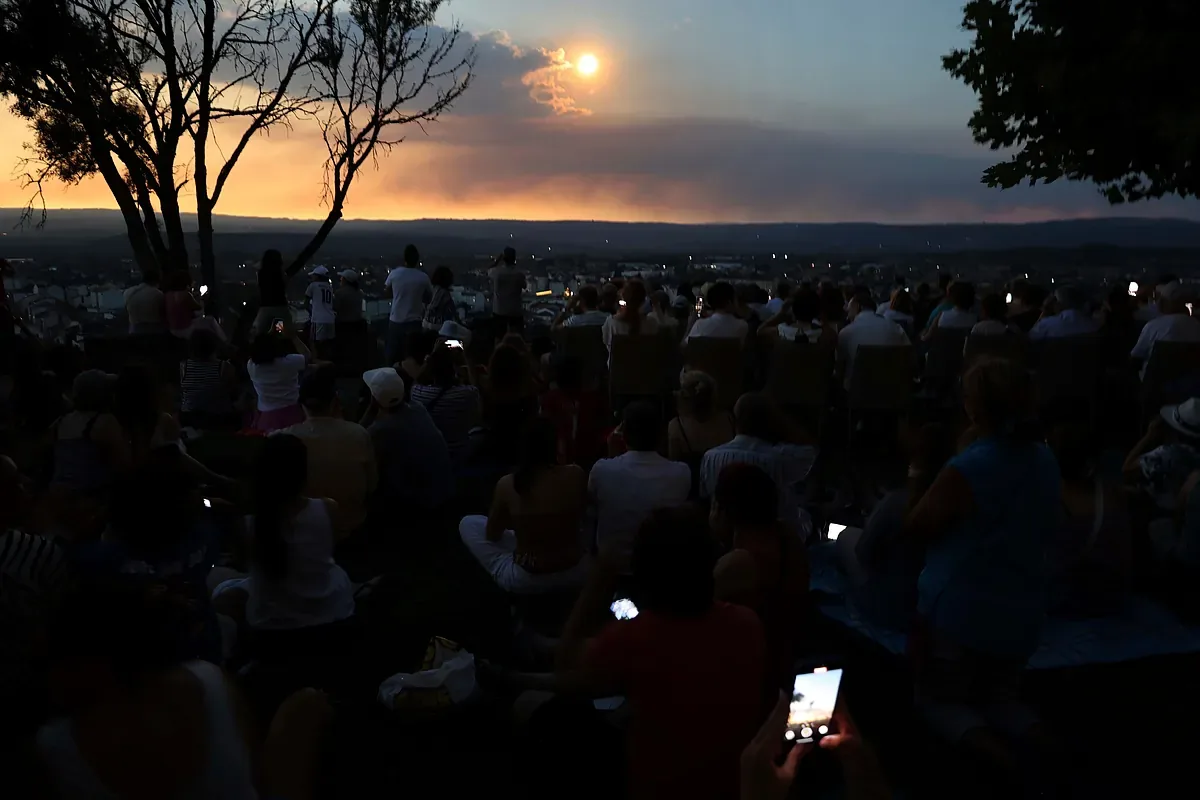
“Nothing is missing, mom! Nothing is missing, it’s going to look complete!” Teo shouts as he runs along the stone path that borders the Monforte de Lemos castle, dressed in an orange astronaut suit, with the NASA patch sewn on his chest. He is eight years old and barely catches up with his cousins, Marco and Roi, when the light suddenly begins to fade over the Parador esplanade, crowded after hours of waiting. The crowd stirs nervously, some rummage for their phones, others quickly adjust their cameras, and in the chill-out area, where drinks have been served all afternoon, the music suddenly lowers and even a waitress stops what she is doing to look up. At 20:29 totality arrives: for 41 seconds, the August afternoon turns into night. When the first edge of the Sun reappears, the entire castle bursts into applause.
By then, the surroundings of the fortress had been transformed for hours into a small astronomical camp: folding chairs, tripods, telephoto lenses, and dark glasses of all possible shapes. Some children’s parents had even glued them to cardboard plates so they wouldn’t end up on the ground at the worst moment. Monforte was within the narrow band from which the Moon would completely cover the Sun, one of the privileged points of the first total eclipse visible from the Iberian Peninsula in more than a century. For a few hours, the hill seemed to belong only to the sky.
The eclipse overwhelms half of Spain
- Editorial: TERESA GUERRERO Yebes (Guadalajara)
- Editorial: CARLOS GARCÍA POZO ((Photography))

The solar eclipse from an Iberia plane full of astronomers: “Not even Ferran Torres’ goal, dude!”
- Editorial: GONZALO SUÁREZ
The fever had started months before. “By November we had practically closed everything and since then we have had to tell many people there was no space,” explains Sara Espinosa, head of reception at the Parador. Not even the full booking stopped the last optimists. “This morning a family from Vigo came with their children to ask if any spot was left and we had to tell them no. People have also come with expired reservations, hoping to get in.”
Among the crowd, Galician and Spanish can be heard, but also Italian, Danish, and English. Spanish, European, and a good handful of American travelers have arrived. Some have fit the phenomenon into their vacations. Others have built their vacations around those seconds of darkness. Marlon Sandler belongs to the second group. Retired and from Houston, he has been stationed for hours in the front line with a large telephoto lens aimed at the horizon and a smile that suddenly takes years off him. “I have been planning this trip for a year just for the eclipse,” he explains. The route was planned to do the Camino de Santiago and arrange the stages so that on August 12 they would find themselves here. “We organized it so that it would catch us in a privileged place and we chose this one.”
He is not an astronomer, he is an enthusiast, although he comes from the city that houses NASA’s Johnson Space Center and speaks about these phenomena with familiarity. “I had already tried to see two eclipses and couldn’t in either. This has been the first time.” After two failed attempts, a year of preparations, and thousands of kilometers, his 41 seconds have finally gone well.
A few meters away, Fernando Martínez waits, a physicist from Murcia who studied which places offered the best conditions. Just next to him rests a telescope equipped with a CCD, a sensor that collects and accumulates light during exposure. “It’s like a camera that captures light and accumulates it,” he summarizes. And he doesn’t keep it to himself: he has placed it in the front line so anyone can look through it, while adults and children pass by like a small museum queue.
For the little ones, moreover, the sky was not entirely unknown. Among those who came this August to watch the eclipse were students and teachers from IES A Pinguela, a school especially linked to astronomy thanks to the Matías Vázquez planetarium, promoted by the Physics teacher. The first setup was born in 1990 and six years later the current installation was inaugurated, the only outdoor one in an educational center in Galicia, when that initial experience became too small. Since then, several generations have learned there to recognize constellations, to orient themselves in the sky, and to look up knowing what they see.
Vázquez recalls that it all started precisely because they didn’t know how to do it. When he went out young with other classmates to try to observe Halley’s comet, he discovered they had the whole sky in front of them but no tool to read it. “They told us to look towards the Taurus constellation and we didn’t even know where it was,” he remembers. Years later, already as a teacher, he decided his students wouldn’t go through the same experience and built with them a first cardboard dome alongside a rudimentary star projector. “We managed to make the kids understand it, to get them interested, and there came a time when there was no room left.”
From that almost artisanal device, they moved to a larger dome, about six meters, built amid many difficulties and over time turned into a small educational rarity in Monforte. That is why it is not surprising that this August teachers and students have gathered again around the sky, after weeks of activities and preparations at the center. “In the end, it’s about teaching people to look, to understand what they have in front of them, and to truly enjoy a historic moment.”
Read more The solar eclipse from an Iberia plane full of astronomers: «Not even Ferran Torres’ goal, dude!»