






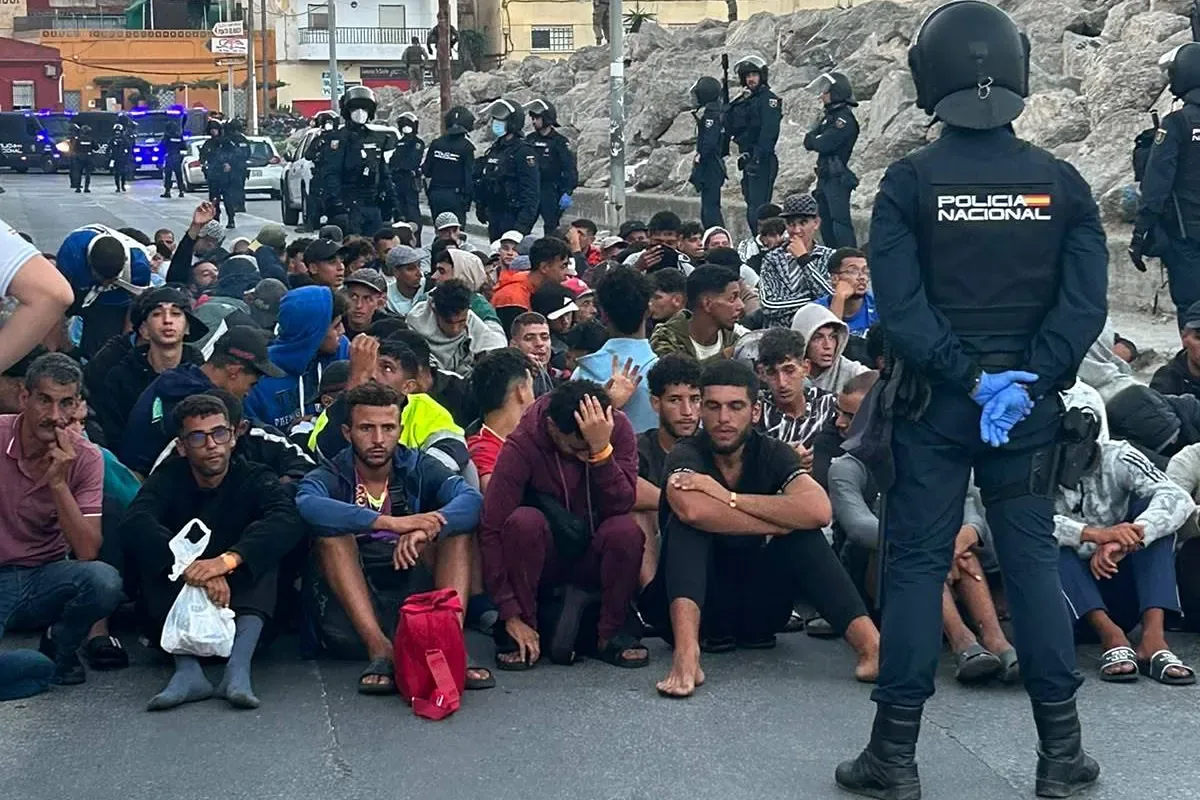
The police operation to transfer immigrants who remain in Ceuta illegally began around 6:30 a.m. on Benítez beach and continued on Trampolín beach, settlements where more than 3,000 people stayed, although the exact number will be known as they are transferred and registered in the new facility.
Read more USA grants visas to this country during the war with Iran so it can attend the UN General Assembly
According to the Government Delegation, most of the migrants who broke through the police cordon and started running were minors, although the incidents were not serious.
The transfer began after the National Court rejected this Thursday the urgent precautionary measure requested by the Unified Police Union to prevent the start-up of these facilities, located on the esplanade of the Poniente Dock.
The camp has tents and other spaces intended as a rest area, infirmary, and dispensary, as well as areas for social care and intervention, health services, offices for the staff of the entity responsible for providing the service, and a booth intended for security service.
The Port of Ceuta assures that no one has informed them about the transfer
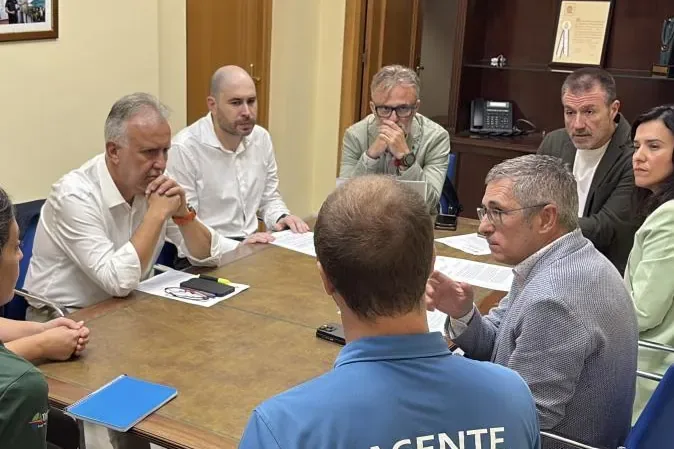
Juan Manuel Doncel, president of the Port of Ceuta, stated on RTVE that no one has contacted the institution to inform about the operation that started at 6:30.
On RNE microphones, Doncel regretted that he found out about the transfer of immigrants to the facilities enabled at the port through the media.
Concern about security at the Port of Ceuta
Sources from the Government Delegation have expressed concern about the risk of stampedes during access to the enclosure, especially when capacity limits are reached and some of the people involved in the transfer have to remain outside.
In previous operations of this nature, some migrants who could not access the facilities tried to force their way in, which raises concerns about security during this Thursday’s operation.
The activation of the port device also comes a day after the National Court lifted the ban on its use, after the court had temporarily halted its operation due to doubts about its location near infrastructures considered strategic.
Security Forces charge to contain immigrants on the beaches after attempts to mass-move to the Port of Ceuta
The State Security Forces and Corps were forced to charge against immigrants who tried to break through the containment to try to reach the Port of Ceuta en masse and running.
The transfer of many migrants staying in the settlements on the Trampolín and Benítez beaches began early this Friday. The security forces started accompanying a crowd towards the Port device, which only holds 1,800 people, although it is estimated that there are more than 4,000 between the two beaches.
For this reason, moments of tension occurred as some migrants started running and reinforcements from the National Police were necessary.
The PP holds the Government responsible for the ineffectiveness in Ceuta
‘This is how Pedro Sánchez manages an invasion. “The living image of normality.” The “subjective insecurity” is evident. Once again leaving national police, civil guards, and military sold out. Ceuta abandoned to its fate. We will never forgive you,’ writes Ester Muñoz on her X account.
Elma Saiz defends the Government’s response to the Ceuta crisis in Melilla and downplays the boos
The Government spokesperson and Minister of Inclusion, Social Security, and Migrations, Elma Saiz, defended yesterday in Melilla the Executive of Pedro Sánchez‘s response to the migratory crisis that Ceuta has been experiencing since late July and downplayed the boos and shouts of “out, out” she received during the official acts of Melilla Day.
Asked about the public’s reaction during the celebration, Saiz said she also heard applause and emphasized that the Government of Spain “governs for all citizens,” placing “shared prosperity and the general interest” at the center.
“That is how this Government operates, listening, of course, to both positive and negative messages, but governing for everyone, for the vast majority.”
The minister considered it an “honor” to participate for the third time in Melilla Day and highlighted during her speech the importance of coexistence, plurality, and respect in the city.
Support from the Army
Among the State forces and corps were also several detachments from the Army, Civil Guard, National Police, and members of the UIP, the largest and specialist unit in handling large crowds.
The transfer operation was carried out through Explanada de Poniente street, a road parallel to the sea that separates Benítez beach from the Port of Ceuta, the final destination of this transfer, which was done in stages to later facilitate access to the port, details Luis Núñez-Villaveirán, a witness to the transfer in Ceuta.
The transfer is carried out in groups of 100 immigrants
It was just after 8:30 in the morning when the State Security Forces and Corps began transferring migrants camped in the substandard housing built on the city’s beaches. Members of the National Police were responsible for carrying out this transfer by grouping around a hundred migrants. At the start of the march, as the police tried to ensure the movement was orderly and safe, nerves set in among the groups of migrants gathered around Benítez beach, and tense scenes occurred among the crowd, forcing officers to fire rubber bullets and intervene with members of the Police Intervention Unit.
Among those transferred was a minor, whom the police referred to civil protection members. Some migrants shouted “thank you, thank you brothers” to the people leading them to the Port of Ceuta, where their accommodation is planned until their situation in Spain is defined.
Read more A case of monkeypox detected in a minor under 13 years old housed in a youth center in Ceuta
During the transfer and scuffle, some migrants suffered minor injuries caused by pushing and the eagerness to move from the substandard housing built on the beaches, reports Luis Núñez-Villaveirán, special correspondent in Ceuta.
The European Parliament points to Sánchez as responsible for the “invasion” of Ceuta and proposes sanctions on Morocco
European socialists refused to approve a joint resolution with the European People’s Party (EPP) on the Ceuta crisis. They did so because they did not want to participate in a document “against the Government of Spain,” according to its president, Iratxe García, and also to try to shield Morocco and avoid criticism from the European Parliament towards this country. But what their refusal ended up causing is that the EPP has agreed with ECR, Giorgia Meloni’s group, and Patriots, to which Vox belongs, a much tougher text. It points to the Spanish Executive President, Pedro Sánchez, as partly responsible for the massive arrival of immigrants to the autonomous city and even proposes economic sanctions against the Moroccan regime.
“It calls for a stricter and more transparent framework to regulate the disbursement and supervision of the Union’s development and cooperation funds to third countries; insists on introducing robust mechanisms that allow immediate suspension and full recovery of funds in case of lack of cooperation or when the interests of the Union or Member States are at stake,” states the resolution approved yesterday by the Eurochamber despite the socialists’ veto. Including the Spanish.
The document adds that “preferential access to the Union market, Union financing, and strategic cooperation must be conditioned on effective cooperation, also in border management, combating illicit trafficking and migrant smuggling, and must seek clear and measurable commitments to prevent illegal crossings, ensure effective returns, and protect the Union’s external borders.”
Read the information by Daniel Viaña.
The big question, 50 days later: What if 70,000 immigrants never returned? What if more than 80,000 entered?
On August 4, when the first voluntary departures ended after the invasion of Ceuta, Pedro Sánchez’s Government assured that only 2,000 immigrants remained in the Autonomous City. Later – on August 13 – the Interior Minister, Fernando Grande-Marlaska, raised this figure to 5,000 people.
And that was it. But the current accounting of the Executive shows significant discrepancies with the figures the Government has maintained so far and raises doubts about the number of immigrants who entered and have remained on Ceuta’s streets for 50 days. Because while Marlaska stuck to those 5,000, there were actually many more.
According to the latest official figure provided by the central government, 72,000 people entered Ceuta irregularly between July 30 and 31. This update dates from August 4, when the Government shared that in the first mass returns about 70,000 immigrants would have returned to Morocco. The difference, of 2,000 people remaining on Ceuta’s streets, was later raised to 5,000.
Read the information by Silvia Lorenzo.
Games of checkers, alcohol, and hashish: nights on the Trampolín
It is past 11 p.m. when the newspaper EL MUNDO enters Trampolín Beach to understand how this large ecosystem established in Ceuta functions. Hundreds of shacks built do not allow the sandy ground to be seen. There is barely space between them. Bamboo canes, plastics, and cardboard raise the small structures where thousands of immigrants sleep crowded. About six or eight per shack. Counting how many there are is impossible.
July 30 and 31 marked a before and after in the autonomous city. Immigrants from Morocco and, to a lesser extent, from other countries such as Algeria, Sudan, Chad, or Eritrea are those who still remain in the city. But those who inhabit these structures are practically all of Moroccan origin. The makeshift huts made of cardboard, plastics, and bamboo canes have been removed by the police more than once, but the next day, almost like magic, they reappear. A life with schedules, some even with routines. Others without any control or order.
This mixed atmosphere is felt when night falls. For some, the Trampolín is what they have made their home; for the people of Ceuta, it is the place they have not been able to enjoy during the summer. It is a space where no Ceutan walks anymore, except those who have to access their homes through there. Of course, they do not go out at night.
Read the report by Elena Iribas from Ceuta.
The walk is approximately two kilometers
State security forces have divided the migrants into groups, whom they will accompany on foot to the new port facilities (the fifth space enabled by the Government) to accommodate them.
From previous operations, the time it can take to cover the two kilometers on foot that separate the beaches from the port can be two hours.
More than 4,000 migrants camped on the beaches
The police device faces the operation to transfer migrants to facilities at the Port of Ceuta with a capacity for 1,700 people. According to calculations based on assistance to migrants, there could be about 4,500 people camped, as that is the number of food rations distributed.
That would be the reason why many of them have tried to escape the control of the Civil Guard, aware that the capacity of the centers enabled at the port is much smaller.
The National Police joins the operation
The riot police of the National Police have joined the operation to transfer migrants.
As in previous operations, the agents try to contain the massive flight of people camping in Ceuta, and many ran to avoid eviction.
The transfer is halted
The chaos unleashed by the migrants’ surprise at the police presence caused the transfer to be halted.
Transfer to the port facilities
The Government has enabled facilities at the port with a capacity for 1,700 people. The agents transfer the immigrants to these barracks.
The transfer of migrants to the Port of Ceuta begins
After 6:30 a.m., an operation coordinated by the Civil Guard began in Ceuta to transfer the thousands of migrants camped on the beaches.
Early in the morning, Benítez beach experienced chaos due to police presence before “an uncontrolled mass” showing nerves and confusion.