








“How many of you are sleeping on the street in this neighborhood?” “About a thousand,” answers the Moroccan immigrant. Although he speaks Spanish well, we ask the question again thinking he didn’t understand us properly and that he is counting everyone scattered around Ceuta, those who are not in the white tents set up to house them nor in the shantytown camp they have built on their own on El Trampolín beach. “I mean just here, on this hill where we are, which is like a hundred houses.” “A thousand,” he repeats. “A thousand around here?” we insist incredulously. “Within 100 meters to the right and 300 meters up, a thousand,” he clarifies in case we didn’t understand.
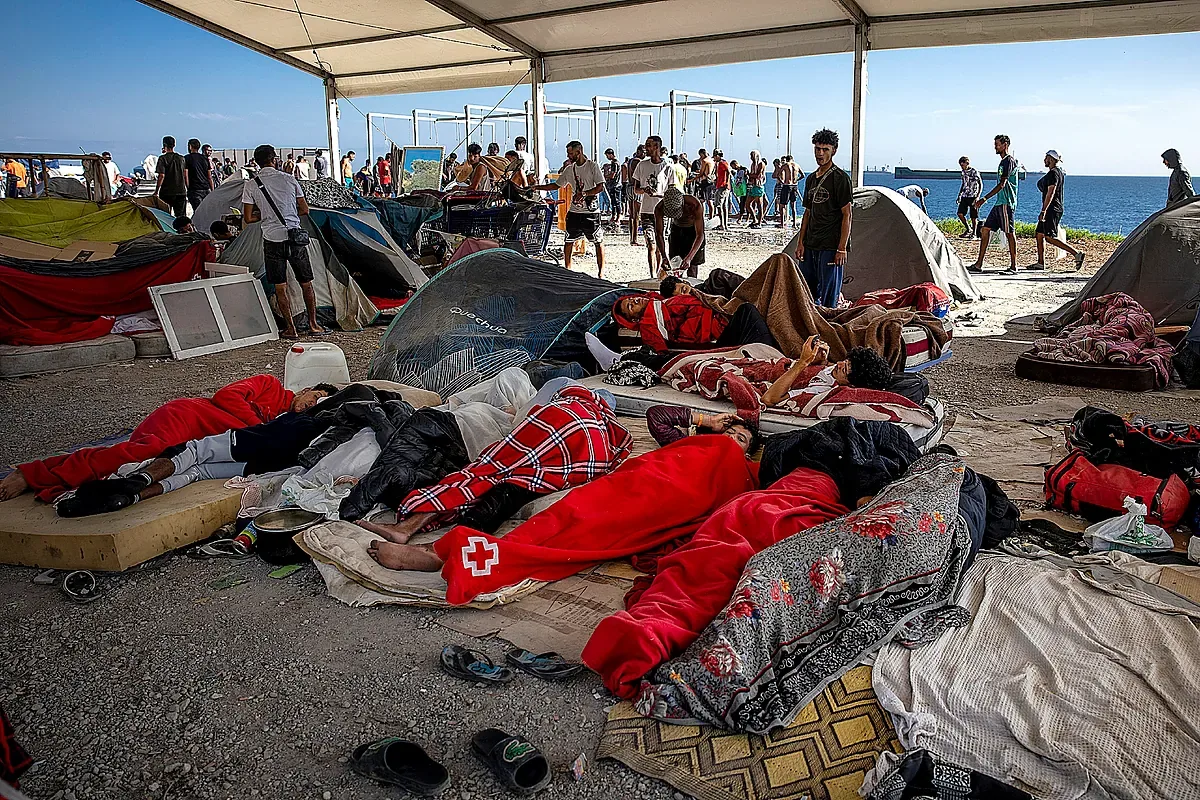
The settlement on El Trampolín beach occupies at least a kilometer in length, a distance along which tents and shacks made with blankets and sticks are crowded together, having already spilled over to the adjacent beach, Benítez, located on the other side of the desalination plant.
The president of Ceuta, Juan Jesús Vivas, estimated a week ago that about 4,500 were camped on the beach. The resources of the State and the City of Ceuta include 4,160 adults and 2,348 minors. These three figures alone add up to 11,000 people. Plus the 1,000 they tell us are on the hill opposite the El Tarajal border. Not to mention those in the humble neighborhood of El Príncipe, where the population is mostly Muslim, and in other parts of the city.
They can be seen inside abandoned cars in vacant lots, in gardens, garages, basements, and overcrowded apartments for which they are charged. There are more in houses of relatives or acquaintances and some wealthier ones in rented apartments. How many immigrants really remain in Ceuta?
Although the Government initially spoke of creating 6,000 reception places to house those who arrived between July 30 and 31, last Monday, the Prime Minister, Pedro Sánchez, in an interview with El Gran Wyoming on La Sexta raised the figure by saying that the Government’s current goal was to enable spaces in the autonomous city to accommodate up to 10,000 people.
Two days later, on Wednesday, September 16, the Government of Ceuta broke down its data on the migratory pressure the city is under and raised the number of those still remaining in its territory—20 square kilometers—to 12,700, adding that they had made the count “conservatively.”
This was reported at the press conference following the government council by the spokesperson for the Ceuta Executive, Alejandro Ramírez, who explained, for example, that although Red Cross is distributing “around 4,500 meals daily” at El Trampolín, they lowered the figure to 3,000 in case some were repeating.
He estimated only a thousand immigrants were unlocated, those who remain illegally in Ceuta residents’ homes and those hiding “in the hills and on the coast,” although he said he feared the number was even higher, especially the number of minors still on the street, which the Government estimates between 700 and 1,000.
Read more USA grants visas to this country during the war with Iran so it can attend the UN General Assembly
His data—“conservative,” he insisted—reached 12,700 people, a figure he rounded to 13,000. “You have to add the 5,300 people who have left voluntarily and have been expelled. We are talking about nearly 20,000 people remaining,” said the spokesperson, who also valued the figure of 10,000 given by Pedro Sánchez on El Intermedio. “The president is getting closer and closer to the number of people remaining in the city. It is outrageous that to this day the Government of Spain does not know how many people remain, who they are, and, most seriously, how they will be returned to Morocco and when Ceuta will return to normal.”
Even higher is the figure that, according to what this newspaper has learned, was considered at the meeting of the national Subcommission on Immigration of the Spanish Bar Council—the highest body of lawyers in Spain—which was held this week, where the figure of 15,000-20,000 was handled—the double of the places announced by Pedro Sánchez—of which 4,000, they estimated, would be minors.
The Ceuta immigration lawyers to whom we conveyed the figure for their assessment do not find it an unreasonable number at all. “It is quite possible,” they say.
If Ceuta usually has about 80,000 inhabitants—83,595 in 2025 according to the National Institute of Statistics—with those who arrived in the influx who have not returned to Morocco, the autonomous city would currently have 100,000 people. Immigrants would account for 20%.
The public defenders accompanying immigrants already registered for interviews where it is determined if they have the right to asylum explain that “15 interviews are conducted daily; 20 on the best days.” Since some immigrants have their own lawyer, they estimate that, generously, the total number of those undergoing the process to access international protection may reach 50 per day.
Attending to the 20,000 would therefore take 400 days, more than a year. “Unless they take them to the Peninsula and do it there,” they clarify. “Many sub-Saharan Africans, since there is no return agreement with their countries, give up asylum and are sent directly to the Peninsula,” they explain.
As for minors, 10 are being registered daily, but only one interview is conducted, which will be expanded to two. “There is a two-month wait,” they assure. Priority is given to sick minors and those about to turn 18. “Minors do not worry us because it is likely they will be transferred to the Peninsula and continue the registrations there. And if they have a relative in EU countries, a father, mother, uncle, or sibling, they can request to be sent and registered there.”
Read more A case of monkeypox detected in a minor under 13 years old housed in a youth center in Ceuta