




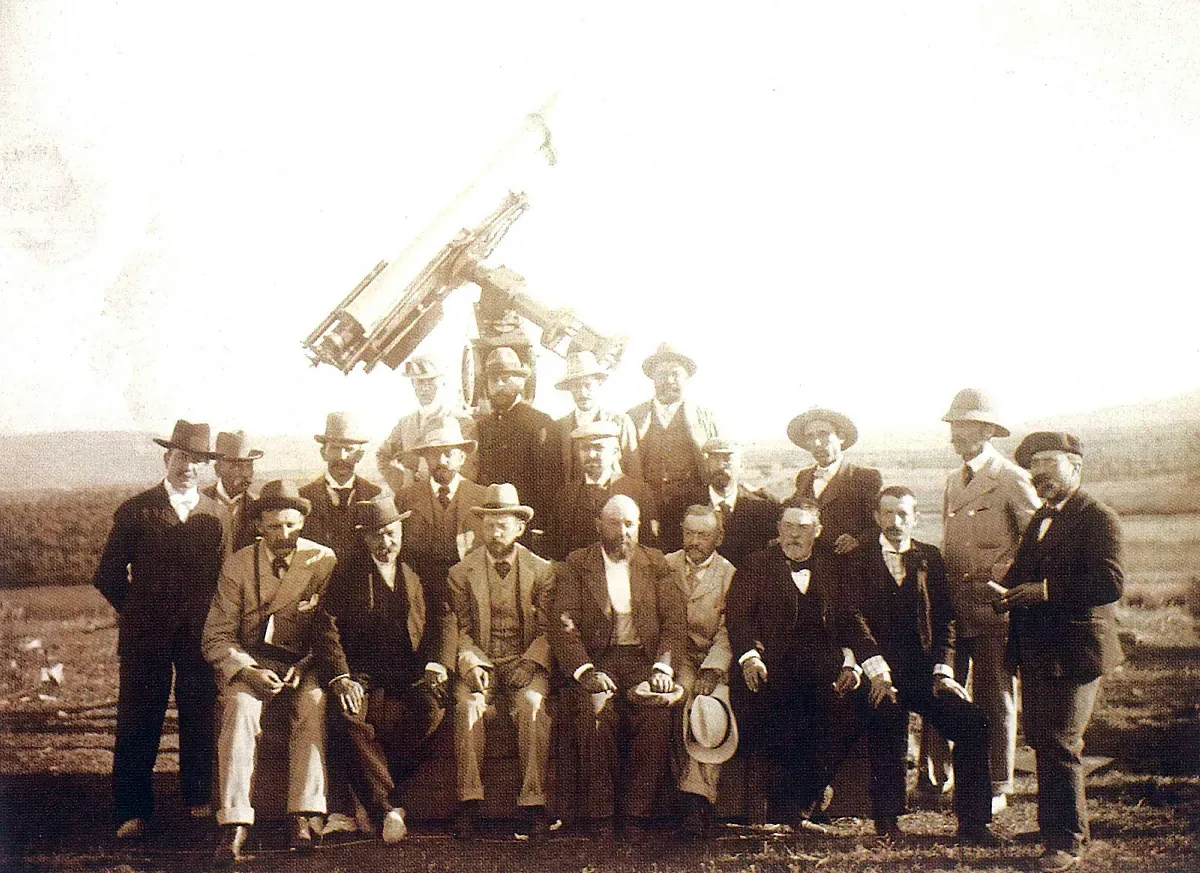
British people got off the train with telescopes the size of a cannon, French people loaded with wooden boxes that seemed to contain a piano, and German gentlemen whose main concern was to find a perfectly level orchard. They asked about the state of the sky, discussed clouds, and measured the horizon with precision rulers. On May 28, 1900, Plasencia ceased to be a quiet Extremaduran city to become the capital of the universe. Those foreigners had traveled half of Europe to witness an eclipse or, in other words, a minute and a half of darkness. The locals, on the other hand, witnessed something much more extraordinary: the astronomers.
Newspapers of the time describe the continuous arrival of scientific expeditions from the United Kingdom, France, Germany, and the United States. Some belonged to national observatories; others were amateur astronomers with enough fortune to cross Europe. They had all made the same calculation and Plasencia, a city of 8,000 inhabitants, was the best place in the known universe.
It was not easy at all to find locations for the 1900 eclipse. First, because the path of totality was very narrow, barely 70 kilometers crossing Spain from east to west. Second, because it was only going to last 80 seconds, enough time for a passing cloud to ruin the show.
Dragons, giant wolves, and toads: the eclipse-devouring monsters
- Written by: RICARDO F. COLMENERO
Sex during the eclipse: what Greenlandic Inuit and Australian aborigines recommend to the world
- Written by: RICARDO F. COLMENERO
The 1900 eclipse coincided with a period of blossoming scientific knowledge, which led to the city experiencing a situation that seemed like a Luis García Berlanga film shoot for several weeks. The city lived a peaceful invasion of scholars. Inns hung the full sign before such signs even existed. Whoever had a room rented it out; whoever had a corral offered space to store equipment; whoever had a terrace suddenly discovered they had privileged views of the universe. Cafés filled with conversations in English, French, and German, while children followed the expeditions as if accompanying a traveling circus.
The director of the Madrid Observatory insisted on the need to acquire advanced telescopes to be on par with international expeditions, and thus they obtained funds to acquire two 20-centimeter aperture telescopes from the prestigious Grubb house in Dublin. Of course, in 1900, Spain was still Spain, and to the despair of the astronomers, the process of acquiring and paying for the telescopes was prolonged. They arrived just 11 days before the eclipse, and transporting them was not easy either. According to local chronicles, the latest in space observation arrived at its destination in “ox-drawn carts”.
Most expeditions aimed to photograph the solar corona in unprecedented detail, that outer atmosphere of the Sun that remains invisible the rest of the time due to the blinding brightness of the solar disk. The few seconds of totality are the only opportunity to study it.
Others pursued an obsession that today sounds like a Jules Verne novel: Vulcan. Since the mid-19th century, some astronomers were convinced that a hidden planet between Mercury and the Sun would explain the anomalies of Mercury’s orbit. Taking advantage of the eclipse’s darkness, they hoped to see it appear next to the Sun for the first time. But it never appeared. Fifteen years later, Einstein would solve the mystery with general relativity.
Read more Rodri rejects the offer from Real Madrid and will try to sign for Barça
Other expeditions only aimed to capture the best photograph. British observatories transported gigantic cameras and lenses with several meters of focal length. The trip took months of preparation to obtain just two or three useful plates under the threat of a cloud. Others hoped to see something that lasts barely two seconds: the so-called flash spectrum, the reddish flash that appears just before and after totality and allowed the study of the solar chromosphere. A race against time: if the operator triggered the camera one second late, the phenomenon disappeared.
There were even those who traveled only to measure how much the temperature dropped or if the wind changed during the passage of the lunar shadow, a matter that still sparked debate at the beginning of the 20th century.
Each expedition sought the best location. Temporary observatories were set up in orchards, estates, and clearings nearby. Telescopes had to be leveled, tents pitched, cables laid, wooden platforms built, and the sky constantly watched in case clouds decided to ruin years of preparations.
Meanwhile, the city continued its routine. Gardeners went to the market dodging boxes with delicate optical instruments. Horse-drawn vehicles shared the street with carriages loaded with telescopes. The curious made bets on whether the Sun would really disappear or if those scholars had traveled half of Europe for nothing.
But there was an eclipse and, for the astronomers, it meant a unique opportunity. Those images would become part of the great advances in solar physics at the beginning of the 20th century.
When it was all over, the expeditions dismantled their observatories as quickly as they had arrived. The foreigners disappeared, the telescopes returned to their boxes, and Plasencia regained normality along with a unique awareness of the universe in the world.