


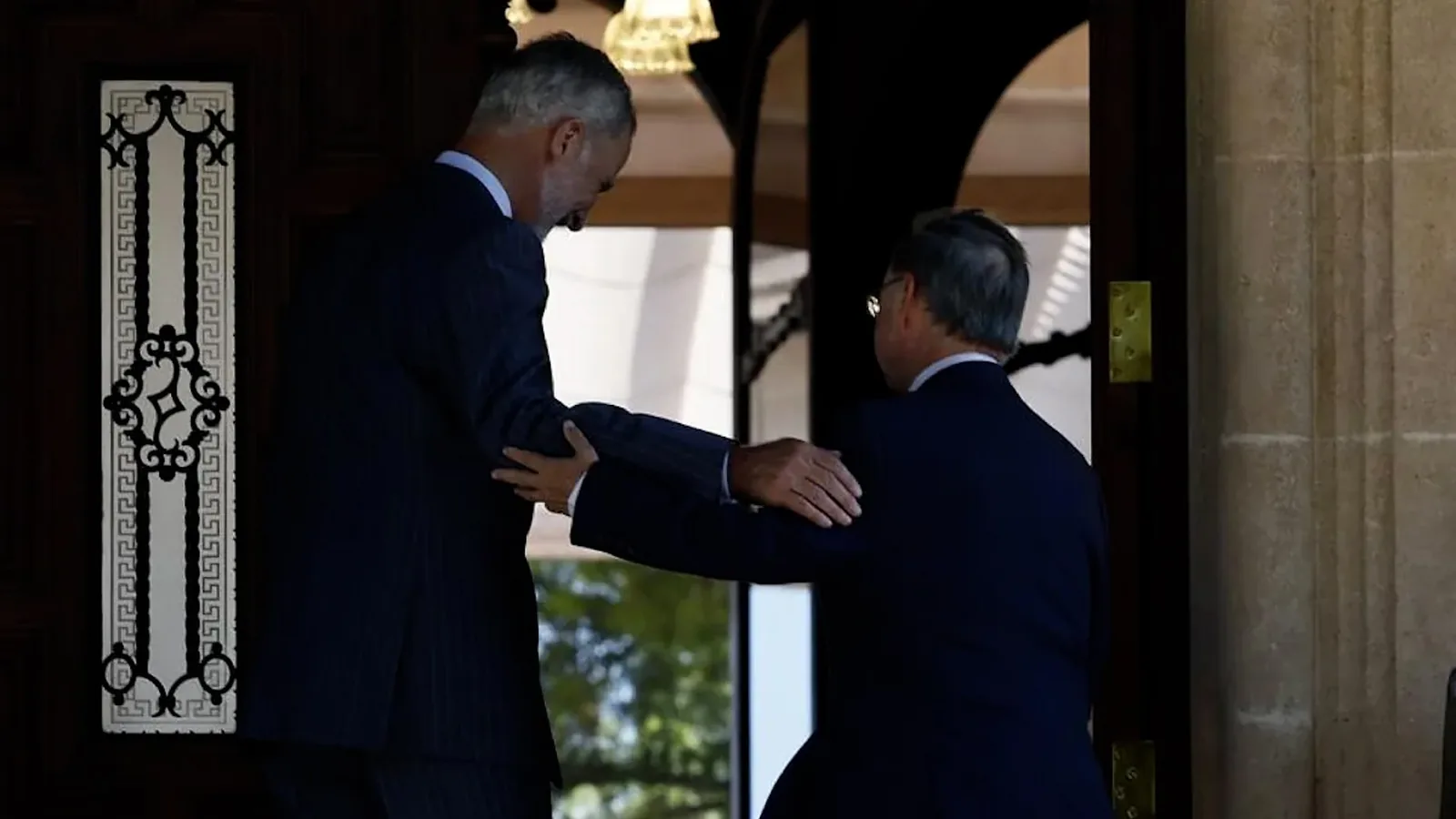
“That the head of State wanted to convey a message of encouragement, support, and affection to Ceuta is especially significant,” praised yesterday the president of the autonomous city, Juan Jesús Vivas, after holding a meeting with Felipe VI at Marivent (Palma) that lasted more than an hour and a half. And, thanking him “publicly,” he also revealed that the Monarch “is committed to the visit to Ceuta and will make it, because the King fulfills his commitments. What I cannot say is when.”
Read more Welcome Mr. Eclipse: the day Plasencia became the capital of the universe
That unknown left open by the Ceutan president is because the visit of Felipe VI to the autonomous city is not in the hands of the Monarch, but of the Government. The King requires endorsement from the head of the Executive and his ministers to make any official trip, as stipulated in the Constitution, which in its article 64 also states that such endorsement makes those who sign it “responsible” for the acts of the head of State.
Precisely, yesterday Felipe VI received Vivas in audience at Marivent, the official summer residence of the Royal Family, due to the lack of government endorsement to travel to Ceuta. The meeting in Palma was in any case an extraordinary gesture, as it is the first non-Balearic autonomous president received by the Monarch at Marivent, responding to Felipe VI’s desire to show the Ceutans the support of the head of State after the migration crisis caused by Morocco last July 30, when 72,000 migrants swam across the El Tarajal crossing.
The Executive avoided commenting yesterday on the commitment Felipe VI made to Vivas during his audience at Marivent. “The Government does not comment on the King’s commitments nor on his trips,” sources from Moncloa limited themselves to saying, without entering into evaluations. Only if the Executive considers a visit by the head of State to Ceuta appropriate will a greater pronouncement occur, in the form of endorsement.
“I have no doubt that the King will visit us, maintaining the constitutional role that corresponds to the King,” Vivas stressed at the end of the meeting with Felipe VI, who received him shortly before six in the afternoon on the steps of the Marivent palace. They greeted each other affectionately, after having maintained permanent contact since the crisis began, but showing a serious expression, proof that the content of the meeting was arduous. Vivas defined the current moment as “one of the most critical and difficult in the history of [his] city” and stated that its population “has not recovered from that trauma.”
“Ceuta is on edge, the population feels threatened and vulnerable. The Ceutans wonder if it will happen again and it has been made clear that our border is in the hands of a third country,” also said the president of the autonomous city in statements to the media. He said this referring to Morocco, “which does not recognize the sovereignty of Ceuta and that generates anguish in the population,” he added.
Moroccan propaganda
The truth is that the Government’s reservations to endorse a visit by the Monarch to the autonomous city lie precisely in the interpretation Rabat could make of that trip. In his 12 years of reign, Felipe VI has never visited Ceuta nor Melilla – they are the only Spanish cities he has never been to. His father, Juan Carlos I, did visit, but only once: in November 2007, with José Luis Rodríguez Zapatero as president. More recently, Princess Leonor, aboard the frigate Blas de Lezo, made a technical stop in the city. Pedro Sánchez, for his part, has been the president of the Government who has traveled most times to Ceuta and Melilla.
Although the Executive has made efforts in recent days not to hold Morocco responsible for what happened last July 30, the possibility of some negligence in controlling its border does not seem to invite the Monarch’s visit to the autonomous cities anytime soon.
Furthermore, simultaneously in these days, Rabat has deployed its propaganda power by instrumentalizing precisely Felipe VI. One of the official news agencies of the Moroccan Government issued a statement making public the congratulations that the King of Spain sent to Mohamed VI on the occasion of the 27th anniversary of his proclamation. A festivity known as Throne Day that was celebrated in Rabat on July 30, while thousands of people crossed the Tarajal border and many others arrived in Castillejos to do the same. According to the mentioned agency, the Monarch expressed in the message, “in his own name and on behalf of the Government and the Spanish people,” his “warmest congratulations and best wishes of happiness and health to his brother” Mohamed VI. He also wished “prosperity and well-being to the Moroccan people.” A formality that, according to Zarzuela’s explanation to this newspaper, was drafted days before the massive crossing at the request of the Ministry of Foreign Affairs, which coordinates this type of communication.
In response to this attempt to show Felipe VI’s support for the Moroccan regime, the King responded yesterday with the audience with the Ceutan president, in which he sealed that commitment to visit the city, after he acknowledged in a statement sent through Zarzuela’s communication department that he had followed “with great concern and indignation” the “serious events” of the past week. A similar term, the latter, to the one Vivas used yesterday: “It is an extraordinarily serious situation, it is not a usual migration crisis.”
Given this situation, Vivas asked to return to “normality” as soon as possible and demanded “guarantees in the security of the border, which is the border of Spain and Europe.” “Ceuta needs a morale boost through a series of actions to stimulate confidence in the future of our city,” said the autonomous president, who wanted to leave a message: “Ceuta has problems, but I want to say that Ceuta is not a problem for the rest of Spain.”
Read more Rodri rejects the offer from Real Madrid and will try to sign for Barça