









Article 45 of the Charter of Fundamental Rights of the European Union: “Every citizen of the Union has the right to move and reside freely within the territory of the Member States.” That basic pillar of the EU, perhaps the most sensitive for nationals of all countries who could move freely across the European area, is threatened from this Friday. The escalation of tension between Pedro Sánchez and Giorgia Meloni, or between Meloni and Sánchez, depending on who took a coercive measure first with their partner, has led Spain and Italy to mutually reinstate controls for those coming from the other country, arriving by airports or ports.
Read more Aemet forecasts for the day of the eclipse mostly clear or slightly cloudy skies in most of Spain
The Spanish and Italian heads of government, representatives of opposing ideological trends in Brussels, have clashed in the Ceuta crisis with the definitive element of divorce. That disagreement is not unrelated to the domestic situation of each. In Sánchez’s case, due to his polling weakness and doubts generated by the management of the current crisis, from his capacity for anticipation. In Meloni’s case, because, a year before re-election, she has competitors on the right.
For those reasons, and because they are naturally opposed, the migration crisis in the autonomous city has served to accentuate polarization. And their respective offensives end up dragging the EU into a historic fracture, because it shakes a main beam of the community building: free movement and the scope of European citizenship.
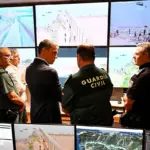
Brussels is in a state of shock after the announcement by the Sánchez government late Friday that it is imposing, on a “temporary” basis, controls at internal borders of ports and airports for movements coming from Italy. The decision was made after the Meloni government ignored the ultimatum that Moncloa had in turn given it to withdraw those applied to travelers coming from Spain following the massive arrival of immigrants to Ceuta from Morocco.
This measure, according to the Spanish government, is applied in response to “the persistent irregular migratory pressure suffered by the transalpine country” and is operational from 00:00 hours this Saturday, August 8, until next September 7, “unless a change in the circumstances that motivated its adoption advises modifying that period.” “It will consist of identity control (passport) and nationality of travelers and, in the case of third-country nationals, visa or residence permit,” they specify.
The head-on clash between two of the main community partners occurs after Sánchez’s government on Friday had asked Italy to “rectify” and “end border controls” on its citizens. If it did not do so before the end of Sunday, August 9, Sánchez’s office already threatened that they would be forced “to adopt proportional measures to protect the interests and dignity” of Spaniards.
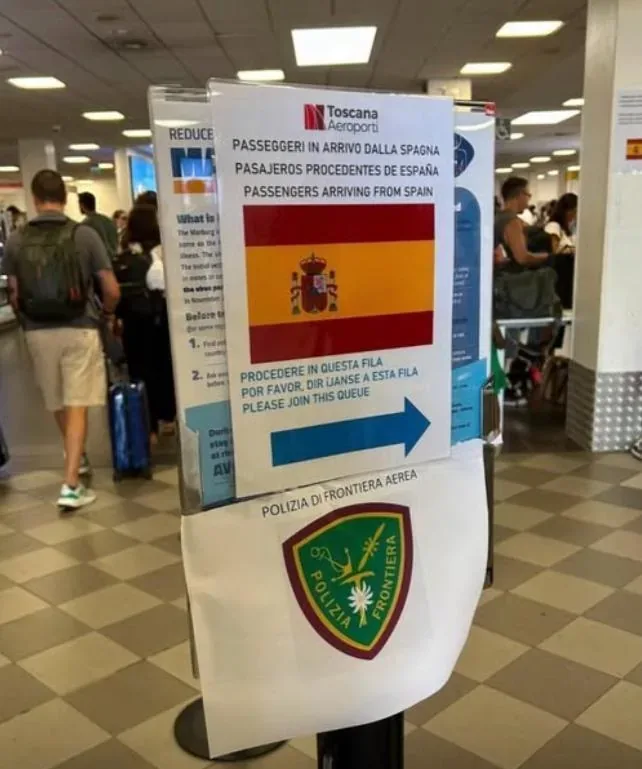
The request from La Moncloa received a firm refusal from Palazzo Chigi in Rome: the country will not reconsider its decision to randomly request the ID card or passport from Spaniards arriving at its airports or ports until at least August 15. In a statement, it indicated that it will only lift it when it has “certainty that there are no security risks or terrorist threats, that there will be no new migratory wave and that there are no irregular migrants heading towards European territory.”
“This measure is directed at and attacks Spaniards and Europe,” Foreign Minister José Manuel Albares responded upon his arrival in Colombia, where he accompanies the King to participate in the inauguration of Abelardo de la Espriella. “This measure by the Italian government is a torpedo to the waterline of the European Union,” he insisted.
According to sources from his department, the head of Spanish diplomacy demanded that Meloni’s government “withdraw the unjustified measures it has introduced” against citizens of a community partner, emphasizing that “there is no reason to introduce these measures.” He also recalled that Italy is the EU country with “the highest number of irregular entries” and stressed that “Europe needs unity.”
According to the Spanish government, the temporary suspension of free movement from Italy – in effect since last Saturday – is “affecting the mobility of thousands of passengers and generating legal uncertainty in the middle of the summer period.” “This unprecedented measure in recent history was adopted without prior notice, unilaterally and with spurious arguments that do not comply with either the Schengen Borders Code or the truth,” they add.
In this regard, Moncloa points out that Italy ignores that “none of the migrants who irregularly entered Ceuta last week could or can freely enter the Schengen area because the autonomous city has a special regime within it,” in addition to the fact that “virtually all of them have already returned to Morocco.” They also indicate that the transalpine nation is “the member state that has recorded the most irregular crossings in recent years, with figures that have doubled those of Spain.”
Likewise, the central government emphasizes that since Meloni came to power in 2022, her country “does not comply with the Dublin Regulation, generating an additional burden of migratory pressure” on the rest of the community partners and that, despite this, “Spain has never introduced controls” on its citizens. “In fact, it has always shown solidarity with it, hosting part of the migrants who arrived in Lampedusa in 2023 and recurrently opening its ports to migrants rescued on the central Mediterranean route,” they underline.
For all these reasons, before applying the same measure to Italy, Sánchez’s office stressed that the controls were “unfair, contrary to the interests of the European Union and discriminatory against the Spanish population.” They also warned that “governments are there to promote understanding between countries and the general interest of their populations, not to create fractures and sterile conflicts driven by internal electoral motivations.”