






“Italy does not accept ultimatums or impositions from abroad regarding national security and border control.” The Government of Giorgia Meloni responded on Friday with this firmness to the request that just a few hours earlier had been conveyed by the Executive of Pedro Sánchez to “rectify” and withdraw the instruction to randomly request the ID card or passport from travelers coming from Spain arriving in its territory by air or sea.
Moncloa, in turn, reacted last night to its refusal by announcing the application of the same measure randomly to people coming from the Italian republic, which will be in force from 00:00 this Saturday until September 7 “unless a change in the circumstances that motivated its adoption advises modifying that period.” The official argument is that it is applied in the face of “the persistent irregular migratory pressure suffered by the transalpine country.”
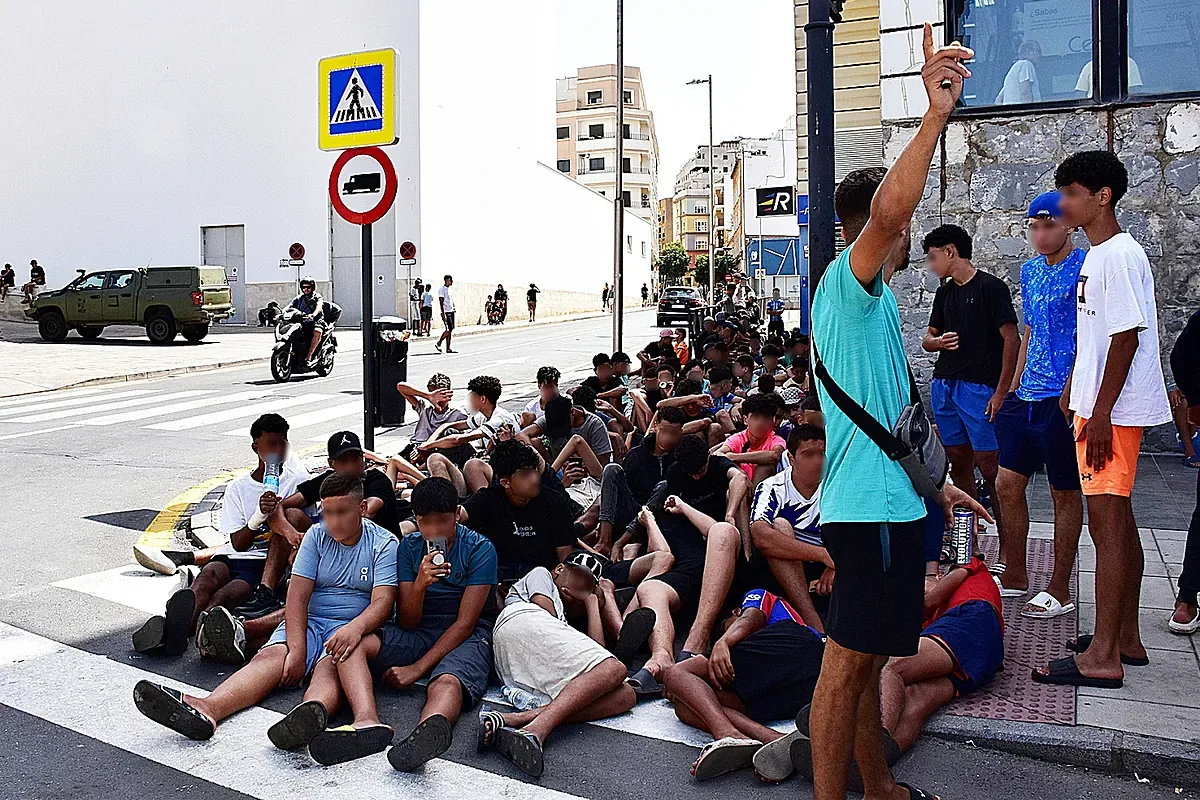
However, the unprecedented clash between the two community partners occurs after Madrid had given a deadline until Sunday for its demand to be met that the order that Rome conveyed to its security forces following the avalanche of at least 72,000 foreigners who arrived last week in Ceuta from Morocco be eliminated. And, faced with the scenario that its request was ignored – as finally happened – it openly threatened to “adopt proportional measures to protect the interests and dignity” of Spaniards.
The reaction of Palazzo Chigi to this ultimatum left no room for ambiguity: “We have no intention, in any case, of reviewing the decision to suspend the application of the Schengen Agreement for third-country nationals coming from Spain at least until August 15 and, in any case, until the risks for security and terrorism in Italy are completely ruled out.”
This escalation of tension between Sánchez and Meloni has led to a historic fracture within the 27, to the breaking of a basic pillar: Article 45 of the Charter of Fundamental Rights of the European Union, which states that “every citizen of the Union has the right to move and reside freely within the territory of the member states.”
Italy’s justification for maintaining the suspension of the Schengen area is that, “as announced by the Spanish authorities themselves,” by August 15 “a new migratory wave is expected in Ceuta.” Therefore, they argue that only when “there is certainty that there will be no risks for security or terrorism” in their country, that there will be no other massive arrival of foreigners in an irregular situation and that it is guaranteed that those who have already entered are not heading to European territory “can what has already been decided be reviewed.”
Regarding the possibility that the avalanche of immigrants at the border between Spain and Morocco could be repeated, the Ministry of the Interior limited itself to stating this Friday that “National Police and Civil Guard are monitoring this issue on social networks to have the necessary information to make the decisions that are pertinent at each moment.” “Continuous monitoring is carried out,” they emphasized in the department led by Fernando Grande-Marlaska.
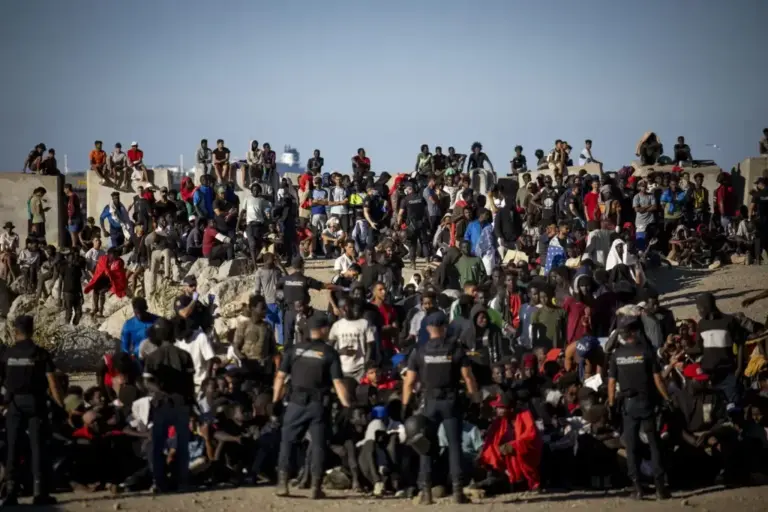
However, after the telematic coordination meeting of this crisis chaired by Pedro Sánchez from La Mareta (Lanzarote), the Government has decided to deploy another Police Intervention Unit (UIP) in Ceuta, made up of 45 agents. The new contingent joins the reinforcements sent since July 30, when three riot teams from Seville and later from the Central and Málaga were incorporated, completing a force of 225 personnel, reports Europa Press.
Read more Aemet forecasts for the day of the eclipse mostly clear or slightly cloudy skies in most of Spain
For its part, the Civil Guard maintains the increase in the staff in charge of border surveillance with three additional platoons made up of a total of 60 agents. Likewise, the Ceuta Citizen Security Unit has the support of 160 officials from different Andalusian commands and the collaboration of another 2,000 members of the Armed Forces stationed in the autonomous city.
“Legal insecurity”
According to the Spanish Government, the temporary suspension of free movement in Italy – in force since last Saturday – is “affecting the mobility of thousands of passengers and generating legal insecurity in the middle of the summer period.” “This unprecedented measure in recent history was adopted without prior notice, unilaterally and with spurious arguments that do not conform to either the Schengen Borders Code or the truth,” they added.
In this regard, Moncloa pointed out that Italy ignores that “none of the migrants who irregularly accessed Ceuta last week could or can freely enter the Schengen area because the autonomous city has a special regime within it,” in addition to the fact that “virtually all of them have already returned to Morocco.” They also indicated that the transalpine nation is “the member state that has registered the most irregular crossings in recent years, with figures that have doubled those of Spain.”
Likewise, the central government stressed that since Meloni came to power in 2022, her country “does not comply with the Dublin Regulation, generating an additional burden of migratory pressure” on the rest of the community partners and that, despite this, “Spain has never introduced controls” on its citizens. “In fact, it has always shown solidarity with it, hosting part of the migrants who arrived in Lampedusa in 2023 and recurrently opening its ports to migrants rescued on the central Mediterranean route,” they emphasized.
For all these reasons, Sánchez’s cabinet insisted that the measure adopted by Italy is “unfair, contrary to the interests of the European Union and discriminatory against the Spanish population.” Despite the ultimatum and the threat to lift the controls, they maintain that they trust that “Europeanism, common sense and good faith will prevail” because “governments are there to promote understanding between countries and the general interest of their populations, not to create fractures and sterile conflicts driven by internal electoral motivations.”
Before the escalation of tension reached its peak, Meloni’s cabinet countered, in turn, that this temporary suspension of the Schengen area does not imply “any prejudice against a friendly country like Spain, similarly to similar decisions adopted in the past by the Italian Government, for example with respect to Slovenia, and by European governments regarding Italy and Spain itself.” They also pointed out that when the “risks” disappear, they are willing to continue “a constructive dialogue” with Madrid.