





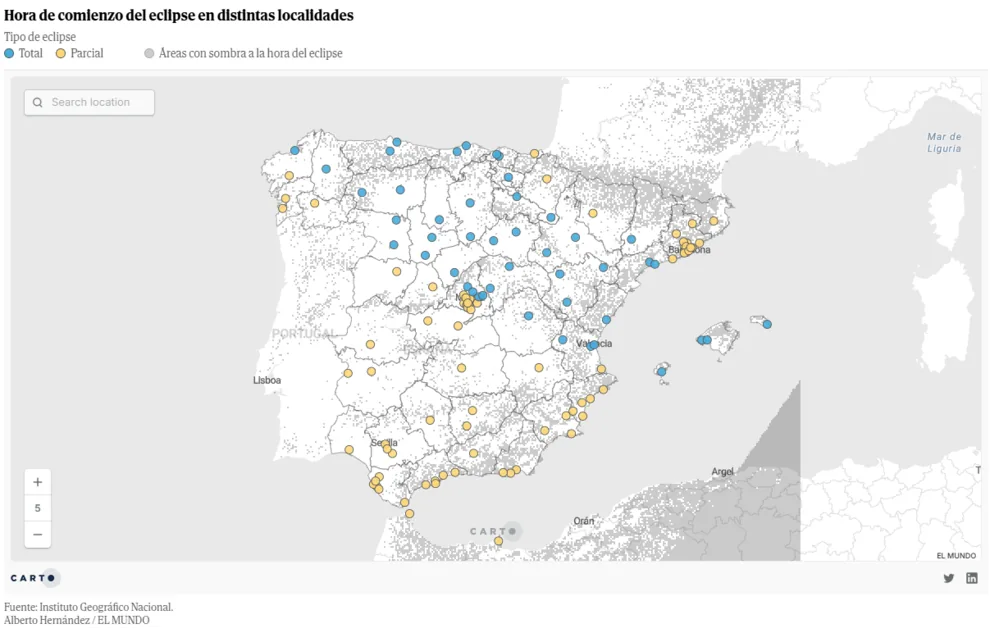
On August 12, Spain will experience one of the most important astronomical events of the century with a total solar eclipse that has not occurred since 1912. For a few moments, the Moon will completely cover the solar disk and the sky will darken in broad daylight, a phenomenon that can be seen throughout the Peninsula, although only some areas will enjoy the totality of the eclipse.
Read more Felipe VI and Milei coincide at the inauguration of De la Espriella and protagonize a unique moment
For those who want to experience it under the best conditions, the National Geographic Institute (IGN) has enabled an interactive viewer that allows you to know precisely from which municipalities the eclipse will be observed at 100%, as well as the start times, the moment of maximum coverage, and the end of the phenomenon. Galicia, Asturias, Cantabria, La Rioja, and large areas of northern Castilla y León, Madrid, Aragón, Castilla-La Mancha, the Valencian Community, Catalonia, and the Balearic Islands are among the privileged places to witness it in all its splendor.
Experts recommend planning both the observation location and travel in advance, as a significant influx of people is expected towards the path of totality. They also advise checking the weather forecast, looking for locations with a clear western horizon, and, once the eclipse is over, delaying the return to avoid the expected traffic jams. Additionally, the coincidence with the Perseids meteor shower that same night makes the day a unique opportunity for astronomy enthusiasts.
Read more The ‘weapons’ of Spain to neutralize Morocco’s pressures with migrants
Safety will be another fundamental aspect. Specialists remind that the Sun should never be observed without certified protection, except during the brief moments when the eclipse is completely total. Glasses must have the CE mark and comply with the international standard ISO 12312-2:2015, while conventional sunglasses, X-rays, smoked glass, or homemade filters do not protect the eyes and can cause irreversible eye injuries. Telescopes, binoculars, and cameras must also use specific solar filters placed in front of the lens.