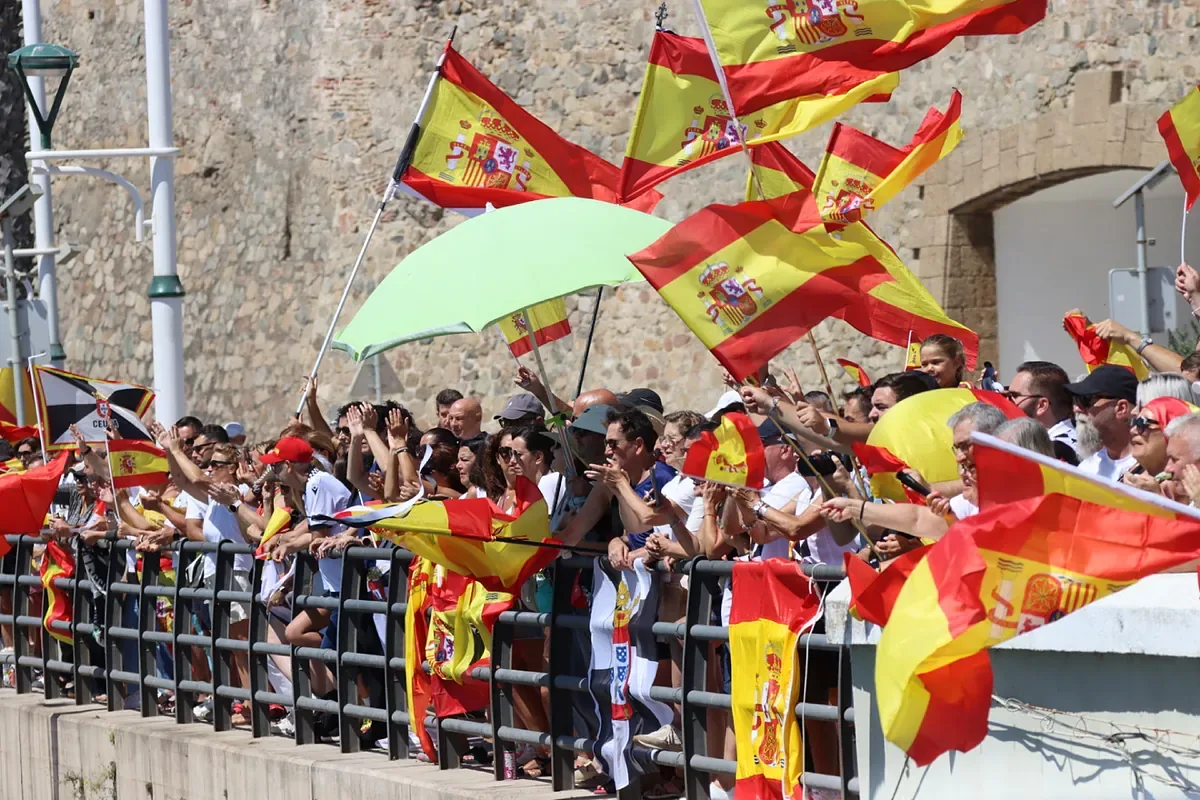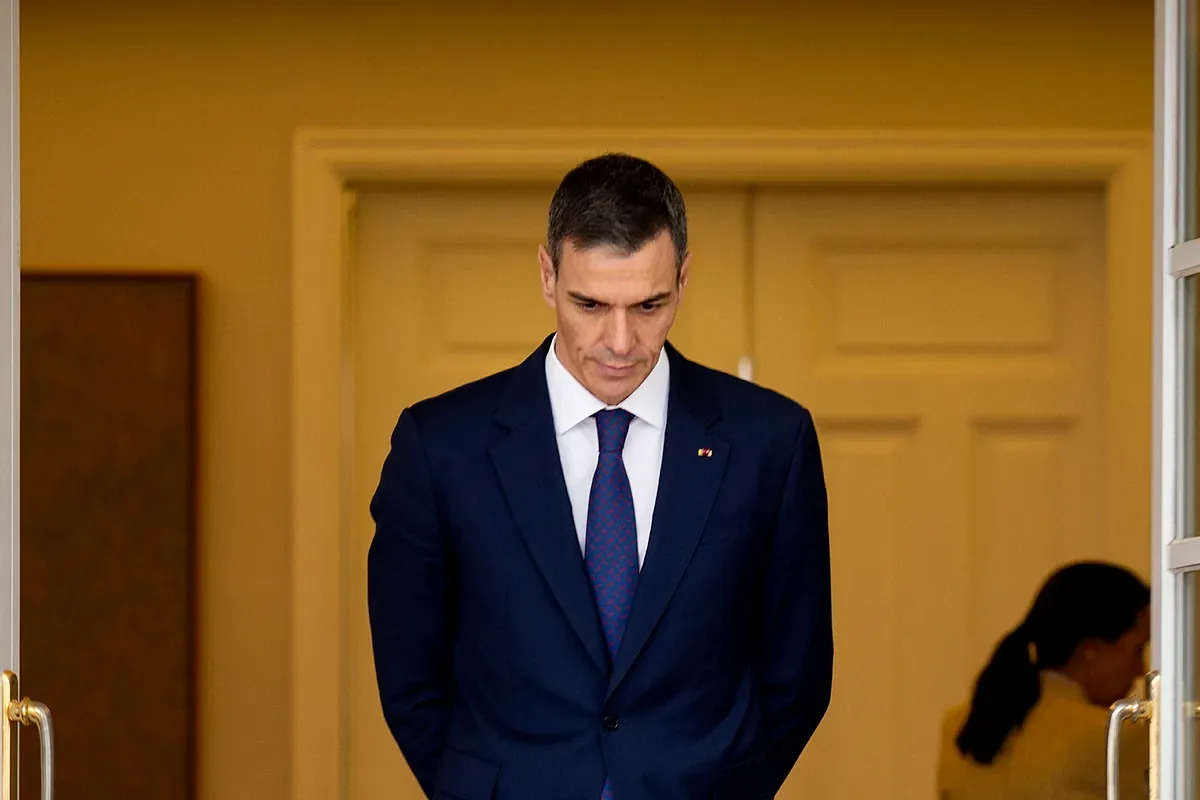









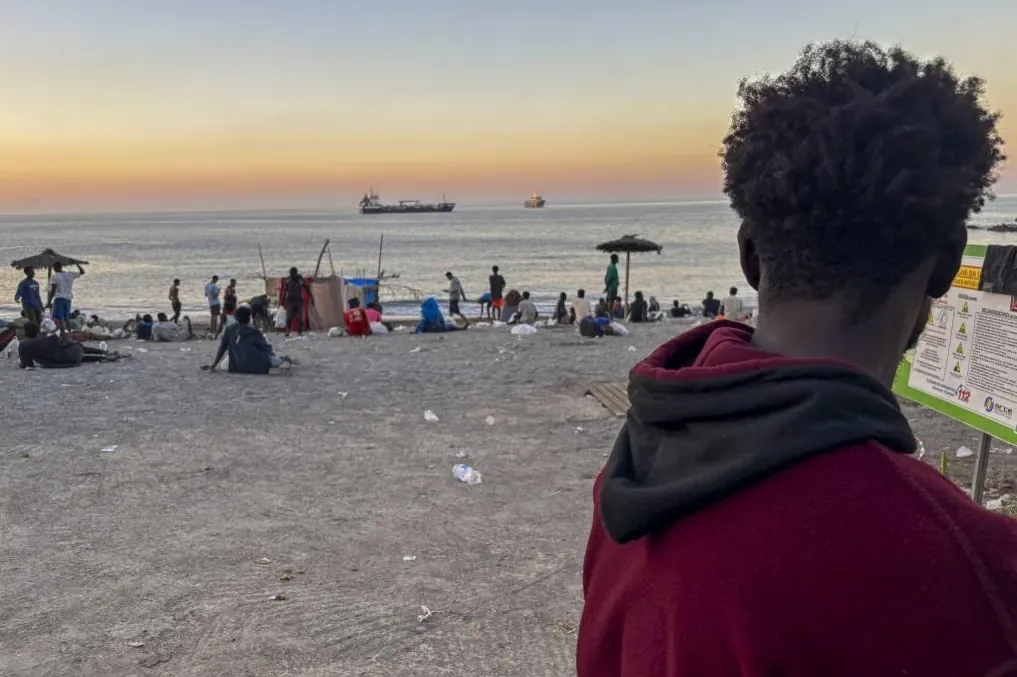
The official version from Pedro Sánchez’s Government, placing all the responsibility for the influx of at least 72,000 foreigners who crossed the Ceuta border on the mafias trafficking people, has not resonated with the Spanish population. Only 6.2% believe this is the main reason for the crisis that opened in the autonomous city on July 30, according to the Sigma Dos survey for EL MUNDO. And, also contrary to the idea the Government has tried to convey, almost half of the citizens (47.6%) understand that behind what happened in Ceuta there is an attempt at “pressure” by Rabat.
The disbelief caused by the Government’s interpretation is shown not only by the overall data of Spaniards who disagree, but also by the fact that these proportions extend when looking only at what PSOE voters think. That is, what those who trusted Sánchez as president in 2023 think. They also do not now believe the theses presented by the Government about what happened in Ceuta: that the influx was triggered by the action of human trafficking mafias is supported by only 9.9% of PSOE voters, while 61.9%, the majority, see it as a gesture of “pressure” from Morocco, a hypothesis that Moncloa has insisted on distancing itself from by praising mutual cooperation.
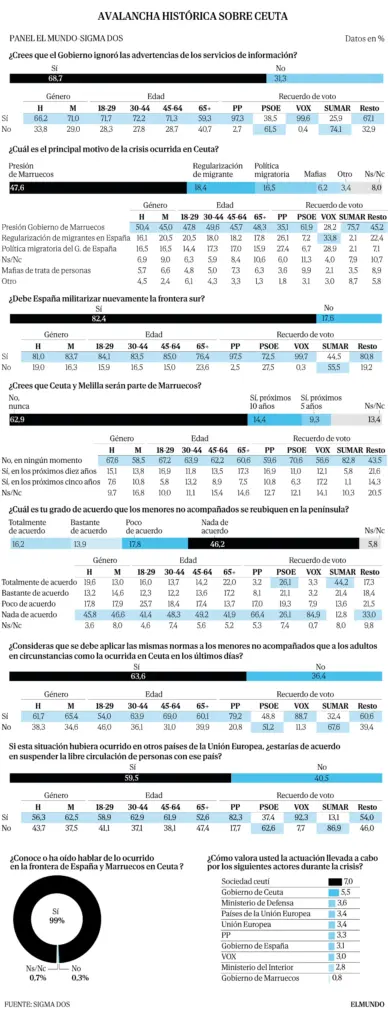
The distrust in the justification given by the Government for what happened, pointing to the mafias, is shared among voters of all stripes – only 3.6% of PP voters, 2.1% of Vox, and 3.5% of Sumar believe it. However, consensus is not as widespread when it comes to identifying what is considered the trigger for the human tide that crossed the border. At this point, a divide appears between blocs: on the left, they massively point to Morocco as the agent behind what happened – this is believed by, in addition to 61.9% of socialists, 75.7% of Sumar voters – but right-wing sympathizers are divided between those who support this opinion and those who believe the influx responds to the Government’s migration policy or, in particular, to the ongoing regularization – this is thought, in general terms, by 16.5% and 18.4% of Spaniards, respectively, according to the survey conducted on Wednesday.
Only 35.1% of PP supporters and 28.2% of Vox blame Rabat, while among the Popular Party, 27.4% blame Sánchez’s migration policy – 28.9% of Vox – and 26.1% hold responsible the process of granting papers – shared by 33.8% of Santiago Abascal’s voters, the majority. Thus, if socialist voters did not believe Sánchez’s explanations, right-wing voters also do not fully agree with their leaders regarding Morocco: Alberto Núñez Feijóo avoided blaming Rabat – although a third of his faithful do, the majority – and Abascal, who pointed to the neighboring country, is not followed by even three out of ten of his voters – it is the only party where this thesis is not the most supported.
That said, whatever the origin of the massive entry on July 30, the majority of Spaniards (82.4%) believe the southern border should be militarized, either to protect Spain from possible pull effects caused by migration policies or from new attempts at pressure from Morocco. An overwhelming 99.7% of Vox voters and 97.5% of PP demand it – Abascal requested it – and in the PSOE, the majority also see this measure as necessary (72.5%). Only Sumar voters are more opposed, although there is division: 44.5% do support militarization.
But despite demanding this extra protection, Spaniards do not fear too much that, in the future, Ceuta and Melilla could become Moroccan territory: 62.9% believe this will never happen, with consensus among different political sensitivities ranging from 56.6% of Vox voters to 82.8% of Sumar voters – 59.6% of PP and 70.6% of PSOE. On the contrary, 14.4% of Spaniards think the two cities will have the Moroccan flag within a decade and another 9.3% think it will happen in five years. All this after Sánchez defined what happened as an “attack on the territorial integrity of Spain,” but without attributing it to Rabat.
Morocco, the worst affected
In line with the positions, the Government of Morocco is the worst affected by this crisis, with a rating of 0.8 out of 10. But the truth is that only Ceuta’s society (7) and the city’s Government (5.5) pass. Spaniards fail the opposition – giving a 3.3 to PP and a 3 to Vox – and European countries (3.4), which held the Spanish Government responsible for its migration policy. And Sánchez’s cabinet and the ministries responsible for the crisis are not spared either: the 3.1 rating the Government as a whole receives, 3.6 for Defense, and 2.8 for Interior reflect citizen dissatisfaction with this having happened and with how it has been managed.
It is also striking that 68.7% do not believe the Government when it says that intelligence services did not warn of the influx and, consequently, maintain that those warnings were ignored – this would explain why Defense, on which the CNI depends, has a better rating than the Government in general or Interior. That said, PSOE and Sumar supporters do trust what Moncloa says on this.
Consensus among Spaniards also breaks down, based on their ideological affinity, when asked what to do with the 1,342 unaccompanied minors currently hosted in Ceuta. 64% oppose distributing them across the Peninsula to ease the city’s care burden, but while this is not supported by 83.4% of PP voters and 92.8% of Vox – in line with what the parties defend – only 26.4% of Sumar supporters oppose the distribution. Among socialists, despite Sánchez defending the distribution, the division is total: 47.2% in favor, 45.4% against. The pattern repeats regarding whether the same protocol should be applied to children and adults who have arrived: 63.6% of citizens ask not to make distinctions.
Spaniards’ reluctance to host migrants is also evident from the majority response to a third question: 59.5% say that if the Ceuta influx had occurred in another EU country, free movement of people with that country should be suspended. Something Italy did, which triggered an unprecedented clash with Spain that persists.
Technical sheet
Reference population and geographic scope: People aged 18 and over residing in Spain with the right to vote.
Information collection technique: Through the Sigma Dos Panel by Trust Survey./ online (CAWI)
Sample sizes: 1203 interviews.
Selection of sample units: In the telephone interview by random household selection and application of sex and age quotas in the selection of the final unit. In the case of the panel, proportional assignment by sex and age group has been applied. The sample distribution has been proportional by autonomous community in both samples.
Margin of error: The absolute sampling error can be bounded by ±2.9% for a confidence level of 95.5%, and assuming variables with two equally distributed categories.
Fieldwork date: August 5, 2026.
Conducted by: SIGMA DOS SL. Calle Velazquez 50, 2nd Floor (28.001-Madrid).
Technical direction: José Luis Rojo Gil / Ignacio Javier Clemente Sierro.