




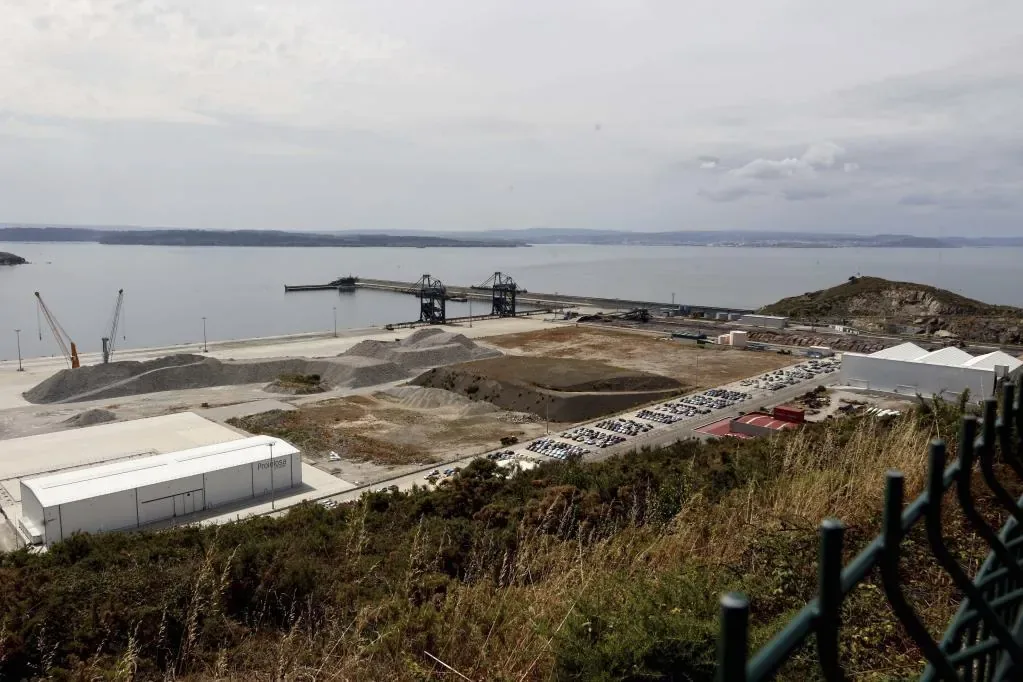
The Chinese car manufacturer SAIC Motor has chosen the port of Ferrol to establish its first plant in Spain. There was a possibility that this project would materialize in Vigo or Gijón, but in the end, the Chinese closed a deal to do it at the entrance of the estuary, a short distance from the Ferrol military arsenal, a key port of the Navy, a mooring and maintenance point for the F-100 Frigates and the Supply Ships C.
Read more How gas stations have become an oasis in the middle of the road
Additionally, in that port, Navantia has a shipyard, with a direct workforce of 1,885 employees and a total impact of 9,000 jobs in the area when including the auxiliary industry and the value chain. And it is in that geographical area, strategic for the Spanish naval industry, where China wants to assemble vehicles and have its ships transit to take them to other points in Europe.
Although the plans are for the factory to be operational in 2028, all this worries military sources consulted by this newspaper. So much so that the Ministry of Defense has reports reflecting what both sides see as “a threat.” In the military and security world, they only see drawbacks to this project. According to what this newspaper has learned, Spain runs the risk that NATO and the European Union will stop seeing Ferrol as a safe port. Because the Chinese presence at the entrance of the estuary would mean exposing to a “systemic rival”—as the European Union defines the Asian giant—an almost daily knowledge of the movements of the Spanish frigates and their technologies.
There are two types of ships that might interest Xi Jinping’s people. On one hand, there are the F-100s, the missile-launching units of the Navy that act as escorts for other types of vessels—mainly aircraft carriers—and Spain has five operational: the Álvaro de Bazán, Almirante Juan de Borbón, Blas de Lezo, Méndez Núñez, and Cristóbal Colón.
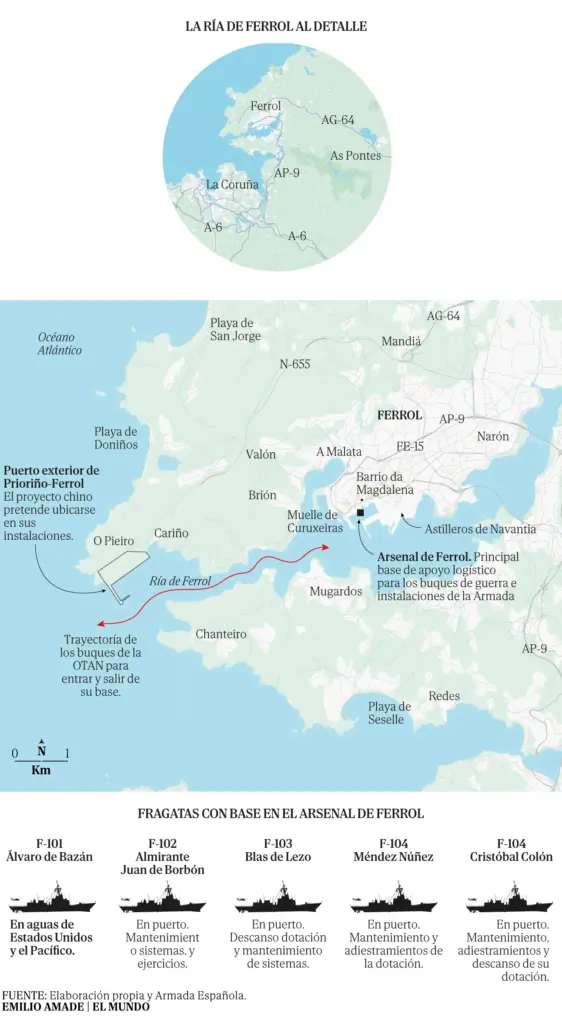
All of them are based in Ferrol and participate in multinational NATO missions. The Álvaro de Bazán, for example, is on a very demanding 165-day deployment, now heading towards Ecuador after participating in exercises in Hawaii with the U.S. Navy. The Juan de Borbón commanded NATO’s Standing Naval Group One until April, while the Blas de Lezo participated off the coasts of the United States in Fleetex-250, a multinational exercise commemorating the country’s independence.
These ships also have the American Aegis system integrated, which uses powerful radars and computers to track and guide missiles to destroy enemy targets.
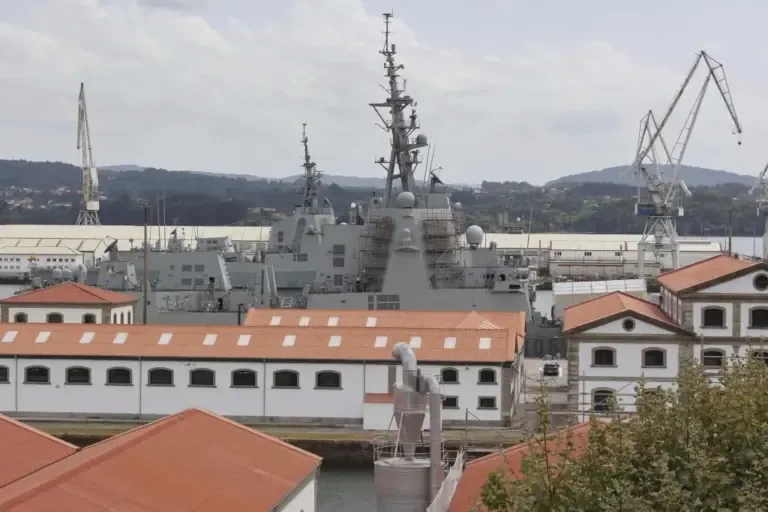
On the other hand, there are the F-110 class frigates. The F-110 frigate program, whose execution order was signed in 2019 and construction began three years later, includes the manufacture of five units for a total value of 4.325 billion euros. These are versatile escort ships, with anti-air, anti-surface, and anti-submarine capabilities, and can operate in combination with other units.
The first of these frigates, the F-111 Bonifaz, reached the milestone last May of starting two of its four diesel generators for the first time. If the Chinese factory is located at the entrance of the estuary, it could follow the progress of the ships’ navigation tests. Additionally, the presence of a Chinese factory could reduce the interest of potential foreign buyers, such as Portugal, Belgium, or the Netherlands.
The Asian giant has had its eyes on European ports for years. Both commercial and military. Thus, concern about its presence in critical infrastructures is a fact.
“For years, in Europe, we viewed the arrival of Chinese capital to our port infrastructures as an economic opportunity. Ports in need of investment after the 2008 financial crisis found in Chinese state companies a partner willing to provide a lot of money when few others were interested. Today, that enthusiasm has given way to distrust,” a European Union delegation official in Beijing explains to this newspaper. “What was once seen as a simple commercial operation is now analyzed from a security perspective.”
This Chinese expansion officially began in 2013, when President Xi Jinping presented the Belt and Road Initiative, the ambitious project aimed at rebuilding the ancient trade routes that for centuries connected China with Europe. The so-called Maritime Silk Road quickly became one of its fundamental pillars. While trains crossed Central Asia, a true naval highway began to take shape from the South China Sea, crossing the Indian Ocean, skirting Africa, and entering the Mediterranean to reach the main European ports.
Read more What is the bear crawl: this is the exercise that works the whole body without the need for weights
The executor of that strategy was Xu Lirong, president and secretary of the Communist Party at Cosco, a dual role that illustrates how large Chinese state companies operate. Under his leadership, the conglomerate has gone from being a shipping company to becoming one of the largest port operators in the world. It controls a fleet of more than 400 container ships and holds stakes in nearly a hundred ports spread across more than fifty countries. For Beijing, each new terminal acquired means securing the global supply chains through which much of the exports supporting the world’s second-largest economy flow.
The best example of this strategy is found at the gates of Athens. When Greece was on the brink of bankruptcy after the debt crisis, Cosco took the opportunity to first take over management and later gain majority control of the port of Piraeus.
Beijing usually presents the Greek port as proof that its investments generate growth and employment. But for many European officials, this case demonstrated how a strategic asset can fall under the influence of a foreign state whose foreign policy and public companies respond to the interests of the Chinese Communist Party (CCP).
That experience would also mark the path toward Spain. In 2017, Cosco acquired 51% of Noatum Ports, gaining control of the terminals in Valencia and Bilbao. ACS had previously sold those assets to a fund managed by JP Morgan, which ended up negotiating their sale with the Chinese company. For Beijing, Valencia was already the largest container port in Spain and one of the best connected in the Mediterranean, an ideal platform to integrate Spain into the Maritime Silk Road.
Since then, Cosco’s ships began using Valencia as one of their major European logistics centers. The Spanish port now even moves more containers than Piraeus.
Chinese investments extend from the ports of Hamburg to Antwerp, passing through Rotterdam, Genoa, or Marseille. In some cases, Cosco directly controls terminals; in others, it participates through joint ventures with European operators. This network is joined by investments from other state giants like China Merchants, which has also acquired stakes in numerous international terminals.
Beijing claims the project is driven solely by economic reasons
Portugal appears as the next major target. The port of Sines, located on the Atlantic facade and the main Portuguese maritime infrastructure, has been attracting the interest of Chinese companies for years due to its privileged position to connect Europe with America and Africa. However, European officials point out that the increasing tightening of scrutiny over strategic investments is slowing the entry of Chinese capital into a project that just a few years ago seemed destined to become another major conquest of Beijing.
“Our main concern is that excessive dependence on operators linked to the Chinese state could give Beijing an influence capacity far beyond the economic sphere,” say the EU delegation in the Chinese capital. The sources refer to NATO reports warning that ports are critical infrastructures where huge amounts of logistical data, goods movements, digital management systems, and essential supply chains converge.
“The concern is that this information could be valuable for intelligence activities or that, in an international crisis situation, an operator closely linked to the Chinese government could exert pressure on services considered strategic,” they explain. In some cases, the alarm increases because certain Chinese industrial investments around port facilities are close to military infrastructures or regularly used by allied ships, a scenario that fuels the debate about risks to national security.
From Beijing, Chinese officials insist that their investments respond exclusively to commercial criteria and recall that many European countries sought Chinese capital during the worst years of the financial crisis. They also argue that the modernization of ports like Piraeus shows that cooperation “benefits both parties” and that turning any Chinese investment into a security issue “responds more to geopolitical rivalry driven by the United States than to real threats.”
Read more Summer colds and sore throats, is the air conditioning always to blame?