



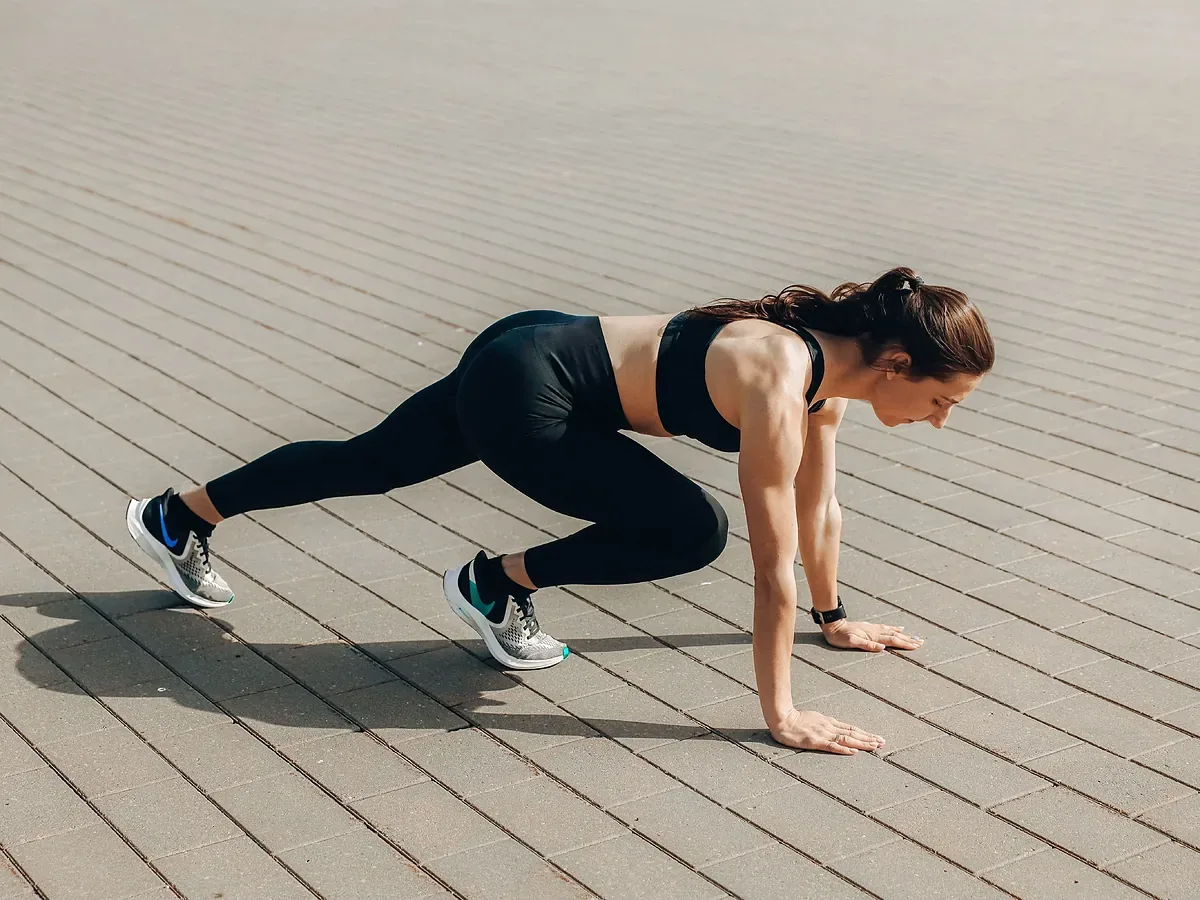
You don’t need to go to the gym or have a lot of equipment to do a complete workout. The exercises performed with your own body weight are very effective for improving strength, stability, and overall physical condition. Among them, the bear crawl stands out, a functional movement that has gained much popularity because it allows you to work the whole body.
Read more Summer colds and sore throats, is the air conditioning always to blame?
What is the bear crawl?
The bear crawl is also known as the bear step or bear crawl. “It is a bodyweight exercise performed in a quadruped position, that is, supported on hands and feet,” explain the physical training platform Befit. As shown on YouTube by the experts from the Guanathletics gym, it consists of moving with the hands and feet while keeping the legs straight and the hips elevated.
The key to this movement is to keep the abdomen engaged throughout the entire movement to prevent the hips from swaying or the back from losing its natural alignment. As you move forward, a hand and the opposite foot move in a coordinated manner, mimicking the movement pattern of a bear.
The bear crawl, the exercise to work the whole body without weights
One of the reasons the bear crawl has become so popular is its ability to engage practically the entire body in a single movement. “This exercise activates all the muscles to mobilize, condition, and strengthen, while stimulating the movement patterns that we often neglect with a sedentary lifestyle,” say the experts from the physical training platform Entrenemos.
Additionally, it is easy to incorporate into any training routine since you don’t need weights or any other equipment and it can be done practically anywhere. You just need a stable surface and enough space to move a few meters, as shown in this video by physiotherapist Ana Galeote on TikTok.
Moreover, it easily adapts to any physical condition. You can modify the speed, the distance covered, or the execution time.
Read more Ceuta cries out «Enough already» and demands answers from Spain and Europe
Benefits of the bear crawl
Practicing the bear crawl regularly can provide numerous benefits. The experts from Befit highlight the main ones:
- Helps strengthen the core: the abdominal and lumbar muscles remain engaged throughout the movement to stabilize the spine and maintain correct posture.
- Can improve stability and coordination: moving alternating opposite hand and foot promotes balance and coordination between different parts of the body.
- Helps increase muscular endurance: by keeping several muscle groups working continuously, it promotes the development of physical endurance.
- Contributes to improving shoulder stability: the shoulders support part of the body weight during the exercise, which helps strengthen the stabilizing muscles of this joint.
- Is a low-impact exercise: although demanding, it does not involve jumps or repeated impacts on the joints, making it a good alternative within a training routine.
- Helps activate the whole body: it is a global movement that involves both the upper and lower body, as well as the trunk muscles.
How to do the bear crawl step by step
The bear crawl is a simple exercise, but it requires a good amount of body control and concentration. However, with a little practice, you will surely master it.
Ana Galeote shows how to do the exercise step by step. Take note:
- Get into a quadruped position, placing your hands just below your shoulders and your knees below your hips.
- Stretch your legs, keeping your back straight and your abdomen contracted. Look down to align your neck with your spine.
- Move forward by moving a hand and the opposite foot at the same time. Keep movements short, slow, and controlled, avoiding excessive hip sway.
Variations of the bear crawl
This exercise has several variations. One of the most popular is the low-hip bear crawl, taught on YouTube by experts from the Northwest Paterna training center. It is performed with knees bent and slightly lifted off the ground. This position increases core work and requires greater activation of the stabilizing muscles.
Additionally, the bear crawl can also be done backwards or with lateral movement. Other variations include fast speed or on an inclined surface. Whatever the chosen variation, the important thing is to prioritize correct technique.
Read more Mohamed VI, luxury summer vacation in his favorite residence a stone’s throw from Ceuta