



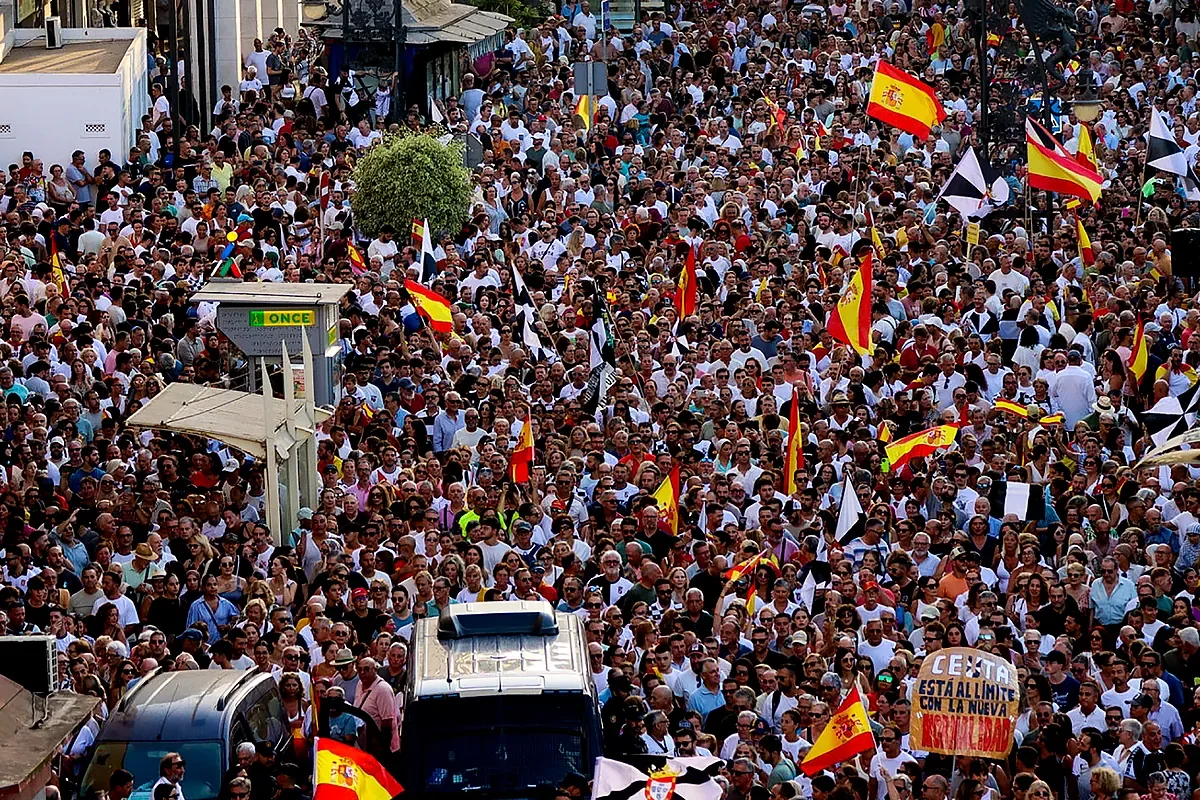
Thousands of Ceutíes took to the streets this Sunday in a massive demonstration that filled the Plaza de la Constitución to demand a response to the serious situation the city is facing after the massive entry of migrants on July 30 and to send a message that echoed throughout the afternoon: “Enough already. Ceuta does not surrender.”
Read more Mohamed VI, luxury summer vacation in his favorite residence a stone’s throw from Ceuta
More than 10,000 according to the organizers and just over 5,000 according to the National Police, called by the Christian, Muslim, Jewish, and Hindu communities along with the Provincial Federation of Neighborhood Associations of Ceuta, demonstrated without incidents for just over an hour.
Citizens from different neighborhoods, ages, and sensitivities in a gathering conceived from the start as an expression of unity above creeds, cultures, origins, or ideologies.
The presence of thousands of people was the main feature of an afternoon in which flags, voices, and messages from citizens occupied the public space.
Today, the organizers repeated, it was not a time for political colors or religious differences, but for Ceuta and the Ceutíes, in a day when the city’s different communities wanted to show they share the same land and the same destiny.
Among the attendees was the President of the City, Juan Vivas, accompanied by members of the Assembly and representatives of various political groups, although institutional presence took a back seat to the citizen response.
One of the most notable absences was the Government Delegate in Ceuta, Miguel Ángel Pérez Triano, who did not attend the demonstration and was loudly called for his “resignation”.
The gathering took place in a packed Plaza de la Constitución, where attendees chanted at various times slogans such as “Enough already”, “Sánchez resignation” accompanied by some insults, “Spanish Ceuta”, “illegal expulsion” or “Ceuta does not surrender”, among others, while displaying flags of Spain and Ceuta.
The atmosphere was one of protest, but also of calm, in line with the organizers’ call to maintain coexistence and avoid any confrontation.
The central moment of the mobilization was the reading of the “Manifesto for the Unity of Ceuta”, by the President of the Hindu Community of Ceuta, Ramesh Chandiramani, representing the religious communities and neighbors who promoted the call, and it was preceded by the Spanish national anthem, which played over the loudspeakers.
The manifesto began with a strong declaration: “Ceuta is Spain”, then claiming a plural city, built over generations by people of different creeds, cultures, and origins, but united by the same coexistence.
“We are Ceutíes. We are Spaniards. And we defend our Spanish identity from unity, coexistence, and mutual respect,” Chandiramani proclaimed.
The document described the current situation as “extraordinarily critical” and denounced that Ceuta has suffered “a violation of territorial integrity,” while calling on the Government of Spain, European institutions, and all public administrations for an “immediate, decisive, and proportionate” response to migratory pressure, humanitarian care needs, and security challenges facing the city.
Read more US Intelligence concludes that Putin could test NATO’s resolve with a limited incursion
The religious communities and the Federation of Neighbors have requested sufficient human and material resources, priority attention at the borders, and a stable response that guarantees security, humanitarian assistance, protection of public services, and the well-being of Ceutíes.
“Ceuta cannot face alone a situation that far exceeds its capacities and affects all of Spain and Europe,” the manifesto states.
But the text read before the thousands of attendees also sought to distance itself from any message of rejection towards those arriving in the city and emphasized coexistence.
“This call does not arise from rejection of anyone, but from responsibility towards all,” Chandiramani said, defending that protecting coexistence means preserving both the dignity of people and the security of the population and social cohesion.
The four religious communities also claimed their willingness to be part of the solution and appealed to shared values of peace, fraternity, solidarity, justice, and helping others.
The manifesto thus included a message of hope addressed to a city that, according to its promoters, has shown throughout its history the ability to overcome especially difficult moments thanks to the strength of its citizens and solidarity among neighbors.
The mobilization ended with a call to authorities to act with “responsibility, commitment, and responses”, to Spanish society to show solidarity, and to the Ceutíes themselves to maintain calm, confidence, and unity.
A message that was again summed up in the slogan that presided over the entire call: “Ceuta does not surrender, Ceuta does not divide, and Ceuta does not lose hope.”
The event, which after staying in Plaza de la Constitución for more than half an hour, moved to the vicinity of the Government Delegation, where Pérez Triano was heckled and the chants that had centered the entire demonstration continued.
After just over an hour of protests, the demonstration ended without incidents and with citizens gradually leaving Plaza de los Reyes after a gathering that left as its main image thousands of people together, beyond their differences.
The last sentence of the manifesto summed up the spirit of an afternoon in which the protagonist was neither any political party nor any institution, but a city that wanted to speak with one voice: “Long live coexistence. Long live Ceuta. Long live Spain.”


