




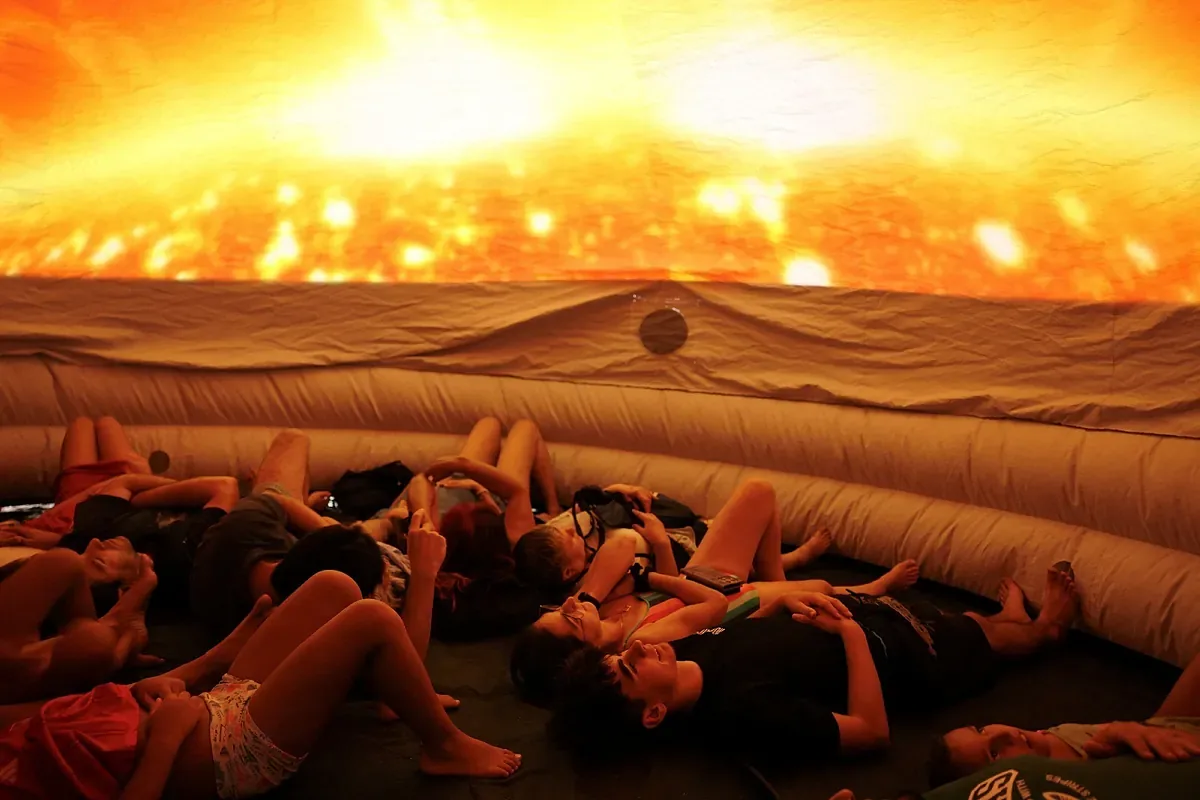
As the minutes count down until the historic total solar eclipse that will cross much of Spain this afternoon can be seen from Spain, and which began at half past five in the afternoon in the Bering Sea (between the U.S. and Russia), traffic jams are starting to be noticed on Spanish roads. Many people are leaving the cities in search of places to witness the eclipse. Traffic jams have already begun on the A-6, which connects the Community of Madrid with Castilla y León. There are also traffic jams on the Burgos highway (A-1), in Venturada, and on the Valencia highway (A-3), in Villarejo de Salvanés.
Three accidents complicate traffic this Wednesday in Cantabria, Zamora, and Barcelona, especially on the AP-7 in Martorell heading towards Tarragona.
Before entering the peninsula, the eclipse will be seen as partial in much of North America or Europe, but the path of totality will be restricted to the Arctic Ocean, northwest Greenland, and the far west of Iceland before Spain becomes the best setting to witness an exceptional astronomical event.
In Andalusia, traffic is affected in places like Jaén, Málaga, and Seville. The A-35 in Valencia, in the Canals area, and the A-7, in Ollería towards the Turia capital, also present complications.
Galicia will be the first ‘balcony’ from which to start observing the phenomenon, around 19:30. The sun will begin to regain its brightness at the end of the phenomenon, at 21:21.
The same sequence will occur, with very few minutes difference, along a west-to-east route, with a wide path of totality over which many provincial capitals lie: A Coruña, Lugo, Oviedo, León, Santander, Burgos, Zamora, Palencia, Valladolid, Segovia, Soria, Guadalajara, Logroño, Vitoria, Bilbao, Zaragoza, Teruel, Cuenca, Tarragona, Lleida, Castellón, Valencia, and Palma.
From 19:30 the eclipse can be seen at this link.
Queues up to 12 kilometers on the AP-7 between Vendrell and Torredembarra due to the eclipse
The AP-7 is the road with the most traffic jams heading south due to the solar eclipse, with queues up to 12 kilometers between Vendrell and Torredembarra, according to the Catalan Traffic Service on social media.
On this same main highway in Catalonia, there are also queues of 9 kilometers between Castellbisbal and Castellví de Rosanes, and 3 kilometers near Tarragona, both heading south, reports Efe.
The solar eclipse begins in the Bering Sea
The solar eclipse, which has Spain as the main protagonist, began – as a partial eclipse – at 17:34 hours (15:34 GMT) in the Bering Sea, between Alaska (USA) and Siberia (Russia), a fascinating astronomical phenomenon that will last a total of 264 minutes (just under 4 and a half hours) and will end in the Atlantic Ocean.
The path of totality will cross the Arctic Ocean, northeast Greenland, and the far west of Iceland, cross the Atlantic Ocean, and enter the Iberian Peninsula, crossing it from west to east.
The maximum eclipse will occur at 19:46 hours (17:46 GMT) near Iceland, where the duration of totality will last 2 minutes and 18 seconds, a time longer than that recorded in the wide path crossing Spain.
In the Spanish case, totality will be less than two minutes in all cases but will cover about 40% of the national territory and ‘fly over’ up to 23 provincial capitals, reports Efe.
15 kilometers of traffic jam to access Navacerrada
In the northern Sierra of Madrid, the traffic jam to access Navacerrada and the surrounding towns is already more than 15 kilometers from exit 39 of the A-6. Additionally, the DGT warns that all Navacerrada parking lots are already 100% full, reports Esther Mucientes from Collado Mediano.
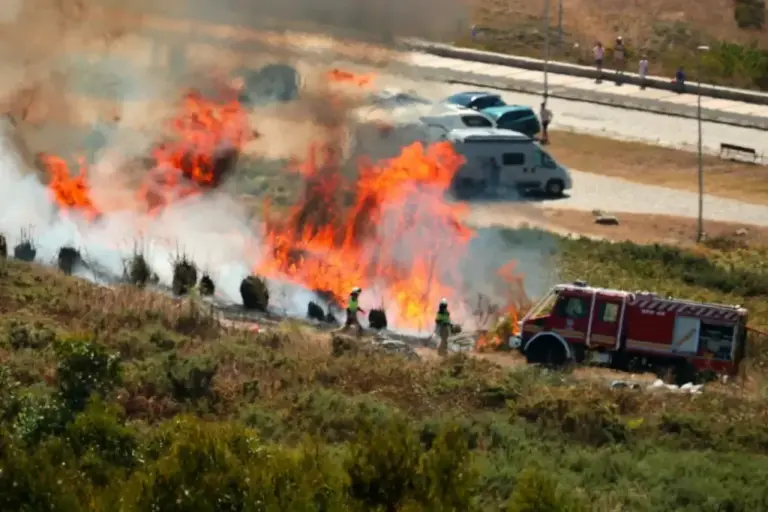
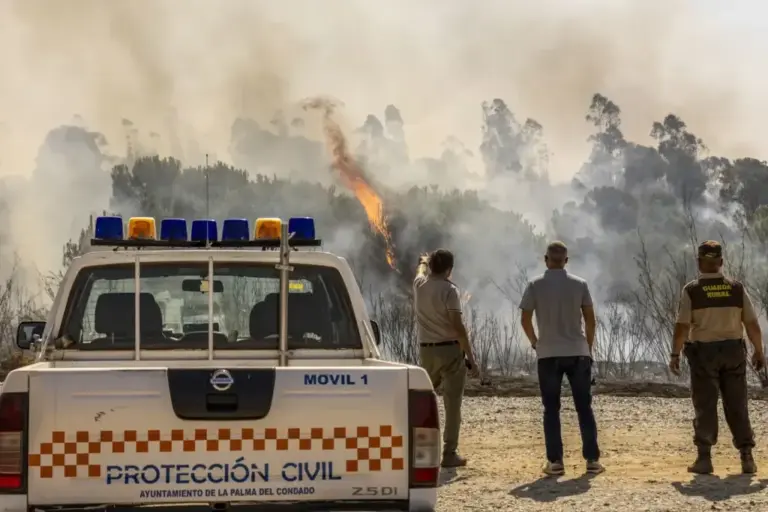
Fire extinguished in La Coruña, in the area from where the eclipse is seen
Firefighters extinguished the fire, which did not pose a direct danger to eclipse observers gathered in Monte de San Pedro park, in La Coruña. It will be the first time since 1905 that a total solar eclipse — a phenomenon in which the Moon comes between the Sun and the Earth — can be seen from Spain.
In the Getty image, the fire outbreak near the parking lot used by people who came to the place to see the eclipse can be seen.
Seven models of eclipse glasses withdrawn from the market due to risk of injury
Consumer authorities from several autonomous communities have already ordered the withdrawal from the market and product recall of seven models of eclipse glasses due to the risk of eye injuries.
These are glasses from the brands Lionstar, ECP Eye Care Professional, Pelispan, Homanaje, Orro, and Opticalia, with Mó (Multiópticas) added this Wednesday, according to the National Consumer Alert Network, a system for exchanging information between administrations to withdraw non-food products that pose a risk to citizen safety, reports Efe.
Queues on main exit roads from Madrid and Barcelona three hours before the eclipse
The main road exit routes from Madrid and Barcelona are experiencing queues around 16:30 this Wednesday, with just over three hours left before the start of the total solar eclipse.
Thus, there are traffic jams at Madrid exits on the A1 at Circuito del Jarama and Venturada, on the A3 near Rivas-Vaciamadrid, on the A6 at El Plantío, and on the M607 at Tres Cantos, according to the latest bulletin from the Directorate General of Traffic (DGT). Additionally, an accident on the A1 in Venturada complicates entry to the capital, causing one kilometer of slow traffic.
In Barcelona, there are also complications on the AP7 highway near Martorell, and on the A2 passing through Igualada, both heading outwards.
Andalusian roads also have complications, such as the A7 in Guadalcorte (Cádiz) heading towards Algeciras or on the same road in Fuengirola and Benalmádena towards Málaga.
In the bulletin, the DGT urged drivers to be especially cautious on this day and to avoid simultaneous returns after the eclipse, as this could cause traffic jams on secondary roads. Additionally, the DGT reminded that it is completely forbidden to stop vehicles on shoulders and roadways.
Greenpeace urges traveling by public transport and no fires to enjoy the eclipse “caring for the environment”
Greenpeace has called for traveling by public transport to see the eclipse on August 12 or, if not possible, carpooling. It also advised against making fires or using elements that could cause sparks. These are some of the recommendations issued by the environmental NGO in a decalogue distributed to enjoy this phenomenon “caring for the environment.”
Thus, the recommendations from the organization also include respecting trails and protected areas, as well as fauna and vegetation; avoiding single-use containers; and not forgetting bags to collect trash. “Don’t forget bags to take your trash, separate your waste correctly, and deposit it in the appropriate containers,” they emphasize.
Ministers and astronauts are already in Yebes
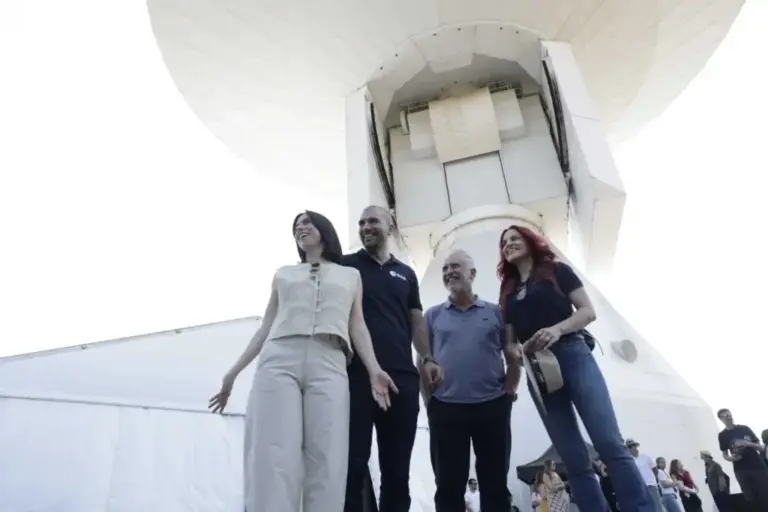
The Minister of Science and Innovation, Diana Morant, and the Minister of Territorial Policy, Ángel Víctor Torres, have already arrived at the Yebes Astronomical Observatory for the solar eclipse broadcast. Accompanied by astronauts Pablo Álvarez and Sara García, they posed for the media before the start of the scheduled conference program before the solar eclipse, reports Teresa Guerrero.
Four parking lots in the Serra de Tramuntana and several roads in Mallorca already closed
The parking lots of cala Banyalbufar, cala Estellencs, cala Tuent, and sa Calobra are already full and closed, and several roads on the island have also been closed earlier than planned, according to the Directorate General of Emergencies on social media, reports Europa Press.
Specifically, the Ma-10 is closed from Andratx to Valldemossa. This road was scheduled to close at 15:00, but before 13:00 it was already restricted to traffic due to the large influx of vehicles. Thus, access from Andratx to the Ma-10 is closed, and in Valldemossa traffic is diverted towards Sóller and Deià.
Vehicle exit from the Barcelona area increases by 7% coinciding with the eclipse
The exit of vehicles from the Barcelona metropolitan area has increased by 7% until noon this Wednesday compared to an equivalent day last year, coinciding with the greatest viewing of the solar eclipse in Tarragona and Lleida, reports Efe.
Specifically, this 7% increase in vehicle exit from the Barcelona ring was recorded between midnight yesterday and 12:00 today, according to sources from the Catalan Traffic Service (SCT) reported to EFE.
“This is like an astronomy World Cup, and Spain is playing the final today”
The Secretary of State for Science, Innovation and Universities, Juan Cruz Cigudosa, is already at the Yebes Astronomical Observatory, in the province of Guadalajara, from where the official monitoring of the solar eclipse by the Government will be carried out. “The D-day has arrived. You have heard me comment this week that this is like an astronomy World Cup. Today, Spain is playing the final,” said the Secretary of State, who detailed the security and coordination device deployed to ensure safety.
“There will be many millions of visitors observing the eclipse today, which has required extraordinary coordination by the government,” emphasized Juan Cruz, who asked to limit travel as much as possible. “If you are lucky enough to live in a place where it can be seen, use it. And if you are going to travel, do so well in advance.”
Cruz emphasized that “we are facing an astronomical phenomenon that we have to enjoy, it is a gift granted to us by the stars and a special moment for people to talk about science, to understand that we are a small point in the universe, that we are part of a much larger system and today we have a unique opportunity.”
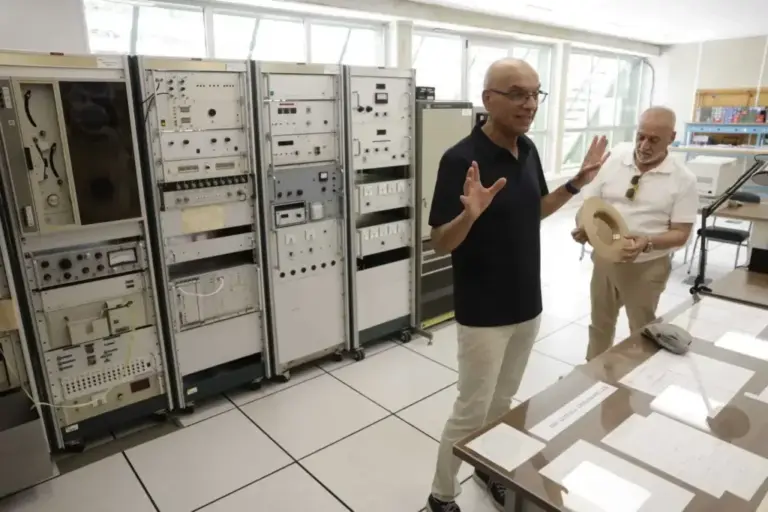
Together with the director of the Yebes Astronomical Observatory, Pablo de Vicente, they toured the facilities of this scientific infrastructure from which radio astronomy is conducted, and from which the Government will monitor the eclipse, reports Teresa Guerrero from the Yebes Observatory.
The Niebla fire, another difficult day due to wind and flight restrictions because of the eclipse
The device fighting the Niebla forest fire (Huelva) for five days, which has already affected 28,000 hectares, faces another day marked by complexity and wind changes, to which are added the restrictions imposed on aerial means due to the eclipse: “By order of AESA for all of Spain, aerial means can only be used until 19:30 due to the eclipse. It is a national measure that also affects us,” clarified the Minister of Presidency, Health, and Emergencies of the Junta de Andalucía, Antonio Sanz.
Mobility could double due to the eclipse with up to 1.5 million additional trips
Mobility on August 12 could increase between 30 and 100 percent from the partial eclipse zone to the totality zone.
These estimates indicate that there will be between 400,000 and 1.5 million additional trips from the partial eclipse zone to the totality zone, according to sources from the Ministry of Science, Innovation and Universities.
The Department led by Diana Morant expects a return movement of these trips after the total solar eclipse ends, around 20:30, although it could be somewhat less as some people will stay overnight where they have seen this historic event.
Therefore, the Ministry, which expects these trips to occur on “very specific” roads, recommends traveling “with a lot of planning” and not doing so if the total eclipse can already be enjoyed from the place where one is located.
The National Police deploys about 9,400 agents to guarantee the safety of event attendees
The National Police will deploy about 9,400 agents to guarantee the safety of attendees at the solar eclipse taking place this Wednesday, in a device organized under the coordination and direction of the General Commissariat of Citizen Security.
Each Superior Headquarters has developed its own device adapted to its territorial characteristics and specific needs to prevent the unusual influx of visitors and observers from causing incidents that could affect public safety. Thus, agents will be responsible for monitoring the main observation points, avoiding saturation or collapse at access points to viewpoints or elevated areas, as well as blocking emergency routes, reports Europa Press.
Additionally, presence will be prioritized in areas or places where a significant influx of visitors is expected, such as parking areas or transport nodes. The different established devices will mainly consist of citizen security agents specialized in maintaining public order, supported by other police specialties.
Regular sunglasses are not suitable as protection
Regular sunglasses are not suitable for observing the solar eclipse. Protection exists, is accessible, and effective, but must meet very specific requirements.
Elena Salobrar, professor in the Department of Immunology, Ophthalmology, and ENT and researcher at the Ramón Castroviejo Ophthalmological Research Institute of the Complutense University of Madrid, comments that the most common mistake is confusing “dark” glasses with “safe” glasses. Conventional sunglasses, even the darkest, block only between 70 and 90% of visible light, but allow much of the ultraviolet and infrared radiation to pass almost unfiltered.
“They are, in this context, useless and dangerous. That is why sunglasses should never be used to view an eclipse,” asserts the UCM professor.
Certified eclipse glasses must comply with the international standard ISO 12312-2, which establishes that transmittance — the amount of light passing through a material — cannot exceed 0.0032%. They block more than 100,000 times more light than regular sunglasses.
They are made with a black polymer filter or metallized Mylar sheets that absorb and reflect visible, ultraviolet, and infrared radiation equally.
United Kingdom, last-minute frenzy to get glasses to see the solar eclipse
The forecast of clear skies over much of the United Kingdom has sparked great interest in seeing this Wednesday’s solar eclipse, partial at these latitudes, with long last-minute queues to buy protective glasses in the few stores still in stock, as they are practically sold out.
The enthusiasm for this phenomenon is such that television networks broadcast news from Spain, where the eclipse can be observed at 100%, with statements from astronomers who have traveled to see the Sun’s occultation since in the UK it will only be seen at 90%.
In British territory, this will be the first major solar eclipse since 1999, and it can be seen after 18:00 GMT, something that will not be repeated with this magnitude until 2050.
Some people who have run out of glasses will opt for traditional homemade methods, such as projecting light through kitchen strainers or cardboard boxes onto the ground.
Last-minute distribution of glasses to see the eclipse
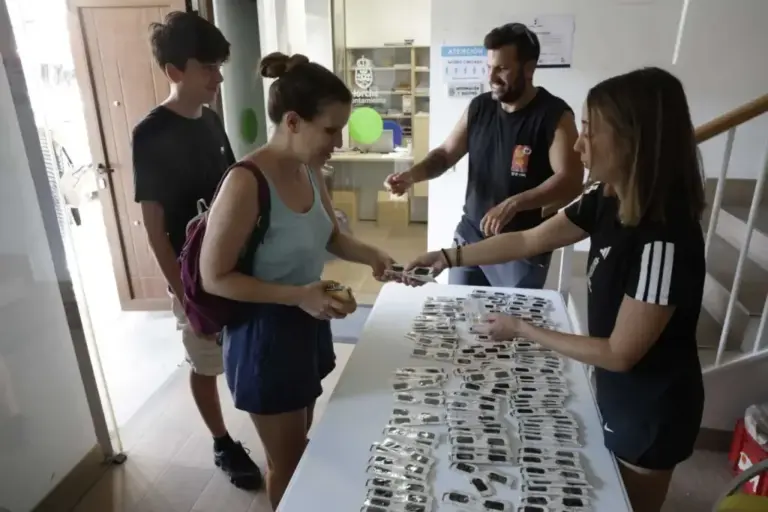
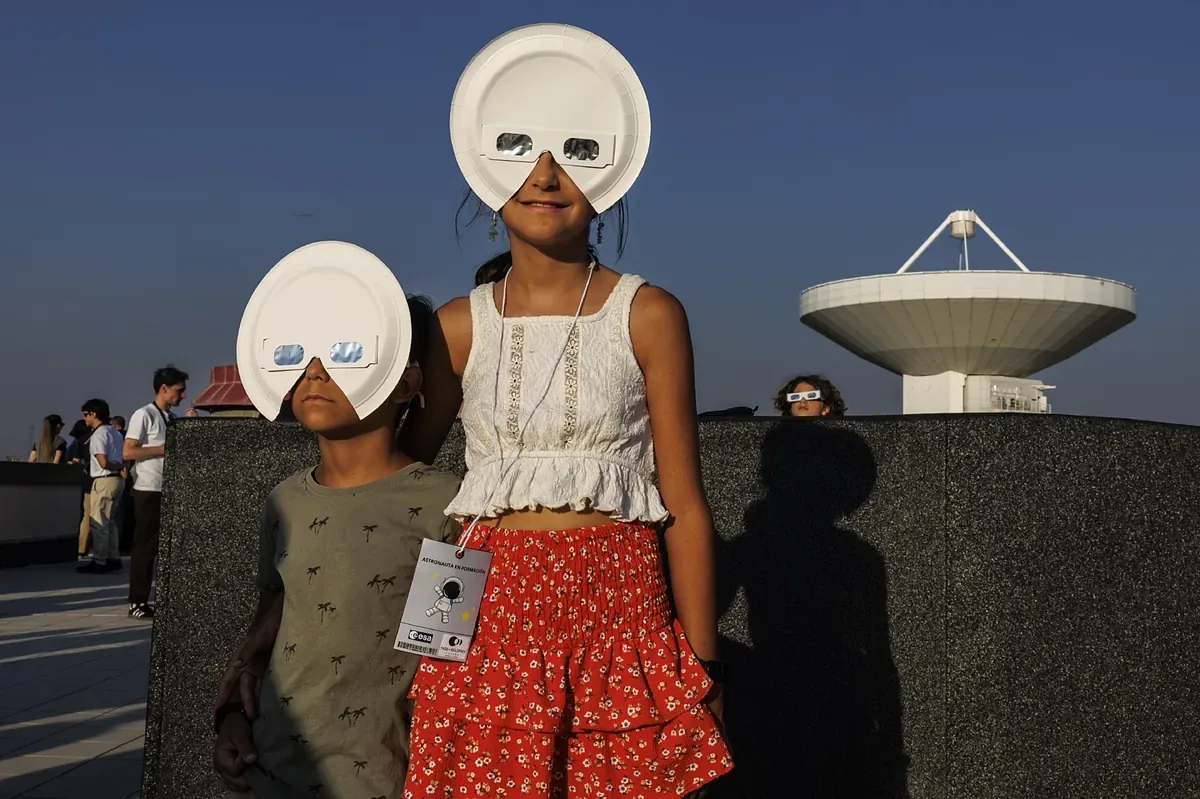
Some town councils in towns where the solar eclipse will be total are distributing special glasses so their residents can enjoy this astronomical spectacle at sunset. This is the case of the town of Horche, in the province of Guadalajara. In this municipality of 3,000 inhabitants, two glasses per family unit were distributed this morning at the Town Hall building.
Horche is located just six kilometers from the Yebes Astronomical Observatory, from where the Government will officially monitor the eclipse.
Information by Teresa Guerrero and photography by Carlos García Pozo.
AEMET publishes the latest report before the eclipse: Predominance of clear skies with clouds in the Cantabrian and Galician coast
The State Meteorological Agency (AEMET) has published the latest weather report before the eclipse this Wednesday, August 12. The day will be marked by stability in most of the country, with predominantly clear or slightly cloudy skies.
Only in the Cantabrian area and, to a lesser extent, in areas of the Galician, Valencian, and Alboran coasts are cloudy skies expected, mainly near the coast. However, during the afternoon, intervals of developing clouds will form in the northern mountains and the eastern third of the peninsula, which may locally interfere with eclipse viewing.
This cloudiness is more likely and could bring some storms or showers in areas of the eastern Pyrenees, Teruel Iberian System, eastern Castilla la Mancha, and eastern Betic Systems. Otherwise, according to AEMET, no precipitation is expected.
In the Canary Islands, cloudy or partly cloudy skies are expected on the northern slopes of the mountainous islands and clear skies elsewhere. Additionally, visibility could be reduced due to light haze in the Alboran Sea, southernmost Andalusia, Lanzarote, and Fuerteventura.
Four parking lots in the Serra de Tramuntana and several roads in Mallorca already closed due to the influx of people to watch the eclipse
The parking lots of cala Banyalbufar, cala Estellencs, cala Tuent, and sa Calobra are already full and closed, and several roads on the island have also been closed earlier than planned, according to the Directorate General of Emergencies on social media.
Specifically, the Ma-10 is closed from Andratx to Valldemossa. This road was scheduled to close at 15:00, but before 13:00 it was already restricted to traffic due to the large influx of vehicles.
Thus, access from Andratx to the Ma-10 is closed, and in Valldemossa traffic is diverted towards Sóller and Deià. Accesses to Cala Tuent and sa Calobra, whose parking lots are full, are also closed.
Likewise, accesses to Port des Canonge and Port de Valldemossa, as well as Cap de ses Salines, are closed. Roads from Andratx to Sant Elm, Puig de Randa, and the ses Salines road to the es Trenc parking lot are also closed.
In Calvià, the Town Hall has reported traffic closure from Sant Ponsa square to Lisboa street. A unit will remain at this point until the eclipse ends.
Cigudosa, president of the Eclipse Trio Commission: “It’s like a World Cup. We are ready”
The president of the Interministerial Commission for the Eclipse Trio and Secretary of State for Science, Innovation and Universities, Juan Cruz Cigudosa, has assured that Spain is “ready” for the total solar eclipse on August 12, an event that will cause millions of people to arrive in the areas within the path of totality.
“Spain is a country prepared to host major events. We have organized world-class events, such as World Cups or Olympics, and it is in that range. It is a prepared country,” said the Secretary of State in an interview with Europa Press.
The country has been preparing for the total solar eclipse for a year and a half, which will cross more than half the country this Wednesday. For this, the Interministerial Commission for the Eclipse Trio was established, chaired by Cigudosa and involving thirteen ministries, 17 autonomous communities, and the Spanish Federation of Municipalities and Provinces.
In this context, the ‘number 2’ of Science highlighted that, from the beginning, coordination has been “extraordinary”: “We all faced a phenomenon we know when it will happen, it is not random, so we could plan our options.”
To prepare for the eclipse arrival, he detailed that, among others, there is a working group dedicated to mobility and security; another to economic impact; another to civil protection and environmental risk; another to public health; and another to outreach. “Is this country ready? Yes, we are. Can we do it? Yes,” he concluded.
Regarding whether this event will cause greater interest in science among Spaniards, Cigudosa recalled that Spain’s World Cup final win made football fandom “greater” at all ages.
“This is similar, I like to compare what will happen this week to a World Cup final. You will live a moment closely related to science, and we did not choose the day or time, but it coincided with prime time and will be broadcast live by televisions worldwide from our country. I hope that afterward there will be a generation of girls who decide to become astronomers and astrophysicists,” he wished.
There are eclipses on Mars too, but its moons are too small to completely cover the Sun
There are also eclipses on Mars, although its two moons, called Phobos and Deimos, are too small to completely cover the Sun’s disk.
“On Earth, solar eclipses occur when the Moon passes in front of the Sun as seen from the ground. On Mars, sometimes one of its moons does the same, but they are too small to completely cover the Sun’s disk,” NASA said, also recalling that Perseverance captured an image of Phobos transiting the Sun in 2024.
Spain will be the best place in the world to witness this total solar eclipse on Wednesday, August 12, whose path of totality will cross thirteen autonomous communities (Galicia, Asturias, Cantabria, Castilla y León, La Rioja, Basque Country, Navarra, Aragón, Community of Madrid, Castilla-La Mancha, Catalonia, Valencian Community, and Balearic Islands).
Alert of extreme fire risk due to massive influx of people to see the eclipse
The Official College of Forestry Technical Engineers of the Community of Madrid has warned about the extreme risk of forest fires that the solar eclipse celebration will bring due to the large number of people going out to see it.
In statements to Europa Press Television, the territorial dean of the Official College of Forestry Technical Engineers of the Community of Madrid, Carlos Madrigal, emphasized that the danger is aggravated by current weather conditions, stating that “95% of forest fire causes are caused by human hand, either negligently or directly.”
He also warned that “we continue with very hot weather, with very low relative humidity, practically many areas of Spain have had three, four months without rain and the vegetation is very, very dry.” The forestry official highlighted the seriousness of the current situation with active fires, noting that “we are seeing the latest fires, a historic event.”
Regarding recommendations, Madrigal emphasized that “the main thing is that people are aware of the risk involved” in going to the mountains during these days, adding that “if a fire occurs, people should be very aware that the first thing is to call 112 or the authorities and the second is to know a bit about their exit route.”
He also recommended “trying to avoid going to the mountains, to a place where the administrations or devices do not know where they are,” as he warned that “we know that many people will improvise and go anywhere,” and “that is the risk we fear the most.”
A supercomputer in the Canary Islands predicts what the solar corona visible during the eclipse will be like
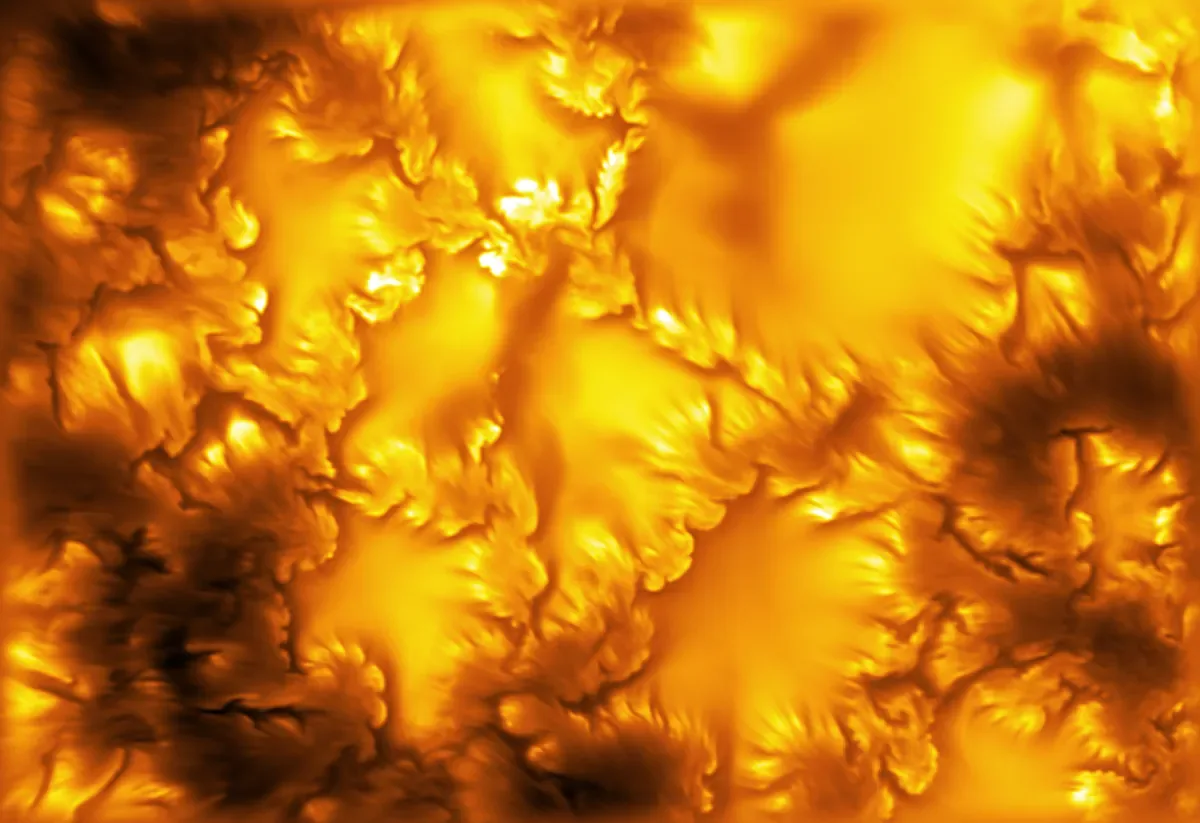
A scientific project led by the Instituto de Astrofísica de Canarias (IAC) simulates what the solar corona (the outermost part of the Sun) visible on August 12 in Palencia will be like, one of the best places to observe this phenomenon that has not occurred in peninsular Spain for more than a century.
Read the full information here, by Teresa Guerrero.
When to put on and take off glasses during today’s solar eclipse, August 12?
Before watching the eclipse, you must turn your back to the sun to put on certified glasses.
Read the full information here.
Seven models of eclipse glasses withdrawn from the market due to risk of injury
Consumer authorities from several autonomous communities have ordered the withdrawal from the market and product recall from consumers of seven models of solar eclipse glasses due to the risk of eye injuries.
These are glasses from the brands Lionstar, ECP Eye Care Professional, Pelispan, Homanaje, Orro, Opticalia, and Mó, according to the National Consumer Alert Network, a system for exchanging information between administrations to withdraw non-food products that pose a risk to citizen safety.
The risk description explains that when worn, the user only sees darkness, and the predictable reaction when facing the sun is to remove them briefly to frame the position, and in that unprotected interval, the eyes are directly exposed to direct solar radiation, causing chemical or thermal injury to the foveal cells of the retina.
The withdrawal of Mó brand eclipse glasses, model 2508-RS003, by Multiópticas, has been notified by the Directorate General of Benefits, Pharmacy, and Consumption of the Balearic Government.
In the case of Lionstar brand glasses, model LSP1, the product was notified by the Directorate General of Commerce, Consumption, and Services of the Community of Madrid, with marketing prohibition and immobilization of located units, as in the other notifications.
Castilla y León, the world epicenter for the eclipse
If a world epicenter had to be chosen for the 2026 eclipse, it would be Castilla y León. Its vast geography of plateau, with clear horizons and clear skies in summer makes it the number one technical and tourist destination in Europe to observe the phenomenon.
The path of totality will cross the heart of the community from northwest to southeast, covering a vast area. Monumental cities such as Burgos, Palencia, Valladolid, León, Zamora, and Soria will be plunged into sudden night.
This region is unique for its orography: the plains of Tierra de Campos will offer an unobstructed view of the eclipse, which will occur at a low altitude. Seeing the solar corona over cereal fields or silhouetting Gothic cathedrals will be the image that will go around the world.
An astronomer explains what will happen: “A ghostly breeze occurs and birds stop singing”
Pedro García Lario, an astronomer at the European Space Agency (ESA), has explained what happens during a total solar eclipse, like the one that will take place this August 12 in Spain.
“When a total solar eclipse occurs, the temperature drops drastically, several degrees almost suddenly. As a result of this temperature drop, a somewhat ghostly breeze occurs that we can feel on our body. It is not strange for the hairs to stand on end, and many people cannot hold back tears from the emotion of sharing such an experience,” García Lario said in an ESA briefing.
When this event occurs on August 12, the expert recommended focusing all attention on “feeling” the eclipse and observing what happens around.
For example, he detailed that “birds stop singing, hens go to their coop, and cows to the barn, and a few minutes later everything returns to normal.” “We will remember these approximately 100 seconds for the rest of our lives,” he assured.
For the ESA astronomer, enjoying a total solar eclipse “is an opportunity to feel belonging to the cosmos.” “It also speaks a little about our fragility, the desire to know, to explore, inherent to the human species. Moreover, the experience of observing a total solar eclipse is not only a visual experience but a sensory one,” he asserted.
More than 25,000 personnel deployed for the eclipse
Interior Minister Fernando Grande-Marlaska detailed this Wednesday that the security deployment for the eclipse will consist of 25,000 personnel, about 15,000 civil guards — including 2,500 from the Traffic unit — and nearly 10,000 national police officers. Additionally, the device will have 20 maritime means, including 11 patrol boats, and 99 aerial means, reports Marta Belver.
Read more From Rota, U.S. military: «Morocco used migration to assess how Spain would respond to an invasion»
DGT asks for “caution” at the wheel during the eclipse and to park in designated or permitted areas
The Directorate General of Traffic (DGT) has asked drivers to plan their trip, stagger their return, and be extremely cautious at the wheel due to the total solar eclipse on August 12, which could generate between 400,000 and 1.5 million additional trips to the totality zones.
This was indicated by the department led by Pere Navarro, which considers the eclipse a High Traffic Impact Event (EVAAT) and has designed a specific plan that includes continuous traffic monitoring from Traffic Management Centers, supported by the Aerial Means Unit to supervise traffic evolution from the air and transmit images to control centers.
The Civil Guard Traffic Group will reinforce surveillance on main routes to observation zones to “channel trips, avoid dangerous parking on shoulders and access points, manage traffic when necessary, and facilitate emergency services’ passage.” Preventive alcohol and drug controls will also be carried out at the highest concentration points.
Additionally, punctual traffic regulation measures, access limitations to certain locations, alternative detours, and capacity controls may be established. Variable message panels will inform at all times about incidents, restrictions, and recommendations for drivers.
Solaris Project: the emotion of the solar eclipse measured in the heartbeat and breathing of thousands of volunteers
This citizen science project promoted by the Generalitat of Catalonia, with the participation of the Institute of Space Studies of Catalonia and the Vall d’Hebron Research Institute (VHIR), assesses emotions around this phenomenon and how the body responds.
Read the full information here by Rocío R. García-Abadillo.
How to recognize certified eclipse glasses?
The ISO 12312-2 seal must appear printed on the arms. As a trick, through them, only the solar disk should be visible, nothing else: no lit lamps, no illuminated windows. If any other light source is seen, the filter is insufficient.
Other valid options for direct observation include solar filters for telescopes and binoculars, which must always be placed on the objective, never on the eyepiece, and the classic indirect projection with a pinhole box, which allows seeing the Sun’s image projected on a surface without exposing the eyes at any time.
“It can be anything from a kitchen skimmer or strainer to crossing fingers leaving small holes between them or the classic hole in a sheet with a pencil tip. In short, a tiny hole through which light can pass,” clarifies Elena Salobrar, professor in the Department of Immunology, Ophthalmology, and ENT and researcher at the Ramón Castroviejo Ophthalmological Research Institute of the Complutense University of Madrid.
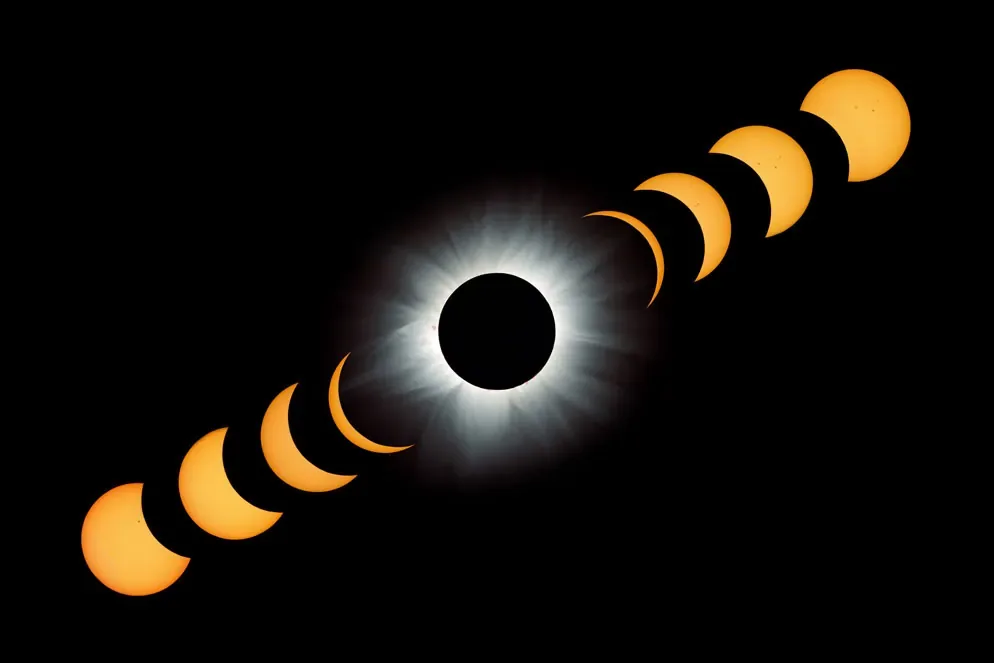
There is a brief and magical moment when glasses can be removed safely: during the totality phase of a total solar eclipse, when the lunar disk completely covers the solar disk.
At that moment, the solar corona, that faint and luminous outer atmosphere normally invisible, unfolds in the sky like a silver halo. “It is one of the most impressive spectacles nature offers and can be observed with the naked eye,” says the researcher.
However, the window is narrow and requires attention: as soon as the first flash of the Sun reappears at the edge of the Moon, glasses must be put back on immediately, as “that instant would be enough to cause damage.”
“The ancients, in their way, already understood that the Sun deserved special deference. We know today why: because our retina is delicate, because our eye acts like a magnifying glass, and because pain arrives too late when there is nothing to do. An eclipse is a unique opportunity to contemplate the cosmos with new eyes. The condition is precisely to keep them to continue enjoying it,” concludes the researcher.
Similarly, the director of the Retina and Vitreous unit at the Fernández-Vega Ophthalmological Institute, Álvaro Fernández-Vega, emphasizes that although observing this event “is a memorable experience, looking directly at the Sun without proper protection can cause serious and permanent eye damage.”
The danger of looking directly at the Sun is that its light can damage the retina. Within the retina, there is a particularly sensitive area called the fovea, responsible for the sharpest vision: thanks to it, we can read, distinguish small details, or correctly perceive colors.
“This area concentrates a large number of photoreceptor cells, responsible for transforming light into visual signals. Therefore, any injury to the fovea can cause significant or, in some cases, irreversible central vision loss,” warns Fernández-Vega.
Where to watch the 2026 solar eclipse on TV and online: schedules and programming today, August 12
The first total eclipse visible from the Peninsula in over a hundred years will not only revolutionize roads, hotels, and observatories: it has also triggered a television battle in which RTVE plays the big event card and private channels the current affairs card.
Read the full information here, by Esther Mucientes
Óscar, eclipse chaser: “After seeing 12 eclipses, I still get emotional. It’s a unique experience”
Óscar Martín, owner of the company Startrails, is one of more than 100 eclipse chasers in Spain. They are people passionate about these phenomena, not necessarily astronomers, who travel worldwide to see them in their entirety.
This expert has traveled thousands of kilometers worldwide to see up to twelve total solar eclipses in countries like Australia, China, Egypt, French Polynesia, Indonesia, Kenya, Argentina, or the United States.
He also enjoyed this unusual astronomical event over the North Atlantic in 2015. For this, he rented, along with other eclipse chasers, an Airbus 320 plane for about 6,000 euros per ticket, on a trip whose sole destination was to see a total solar eclipse.
“It’s incredible, after 12 eclipses I still get emotional and cry, tears fall from your eyes when it happens, it’s a big emotion, a unique experience in life. With the accumulation of emotions, you explode, get emotional, shout, and jump,” he told Europa Press in an interview, warning that “millions of foreigners will come to Spain.”
This emotion is something that can only be understood when one has seen a total solar eclipse, adds the expert, who recommends enjoying it “with family” because it is something “to share.” “Most people who go to see eclipses are normal people: families, couples, friends…,” he specified.
The eclipse chaser advises enjoying the eclipse in Spain on August 12 without taking photos because, in his words, “it’s very beautiful, very short, and any photo will be a waste because the photo won’t come out well.” “No photos or videos,” he concludes.
Morant rules out inviting Vox to see the eclipse: “A conversation between science and a charlatan is impossible”
The Minister of Science, Innovation and Universities, Diana Morant, has ruled out a hypothetical invitation to Vox leaders to see the total eclipse this Wednesday, August 12, from the Yebes Observatory in Guadalajara.
“No, no, no, they are impossible and will keep nagging,” responded the Science Minister in an interview on RNE collected by Europa Press. In her opinion, “a conversation between science and a charlatan is impossible.”
Morant emphasized the scientific importance of the eclipse because “humanity has always looked to the sky to explain things, and when science did not exist, it was thought that gods were punishing.” “Explanations were sought, and now we have explanations in science, and there is not one science that explains climate change and another that says there is no climate change.” According to the minister, “there is a science that says there is climate change and charlatanism.”
For this reason, she invited “those from Vox to try to learn a little.” “It’s a good moment,” she recommended to the leaders of Abascal’s party. She also ruled out that the Prime Minister, Pedro Sánchez, will go to the Guadalajara observatory to follow the eclipse’s evolution from there. “It was never planned, and I cannot say where the president will be, but not in Yebes,” she indicated.
A training ship will analyze the reaction of marine fauna to the eclipse in the Columbretes
The rise of zooplankton to the surface or birds seeking refuge thinking it is night could be some of the effects of the solar eclipse seen from the sea this Wednesday aboard the Training Ship Cervantes Saavedra, which is heading to the Columbretes Islands (Castellón) for this purpose.
The Camilo José Cela University, in collaboration with the Oceanogràfic Foundation and Oceanosophia, has organized the Eclipse 360 Crossing to a privileged observation destination, in the middle of the Mediterranean and with a completely clear horizon.
On this ship, about 30 people are making a journey to Formentera with a special stop at the Columbretes Islands, “a wonderful enclave” to enjoy the eclipse and observe the change in marine species behavior, as explained to EFE by Joan Montaner, biologist at the Oceanogràfic.
“All birds in the coastal area will be singing or flying, but when the moon moves in front of the sun, as they are regulated by their circadian rhythm, in their heads it will be like night, and they will seek refuge,” explains Montaner, team leader in the Tropical department.
However, when the eclipse passes and the sun comes out again, “all these birds will be disoriented and will take flight again, sing again, and do what they do at dawn.”
Similarly, when the sky darkens during the solar eclipse, zooplankton will perform its vertical migration and emerge to the sea surface, causing schools of fish or some mammals to also rise to feed, according to the biologist.
“There is also some bioluminescent plankton species. With some luck, we might see it too,” Montaner hopes.
From the wrath of the gods to Einstein’s relativity: five solar eclipses that changed human history
From the war between Medes and Lydians in the 6th century BC to the 1919 expeditions that tested Einstein’s discoveries, the brief moments of darkness during the day have been much more than a celestial show. We travel through the transformations they caused in our society.
Read the full information here, by Rafael Bachiller.
Sánchez will follow the solar eclipse from the official rest residence in Lanzarote
The Prime Minister, Pedro Sánchez, will follow the total solar eclipse this Wednesday, August 12, from the official residence of La Mareta, on the island of Lanzarote, and will not travel to the Iberian Peninsula to witness the astronomical phenomenon, according to government sources confirmed to Europa Press.
Spain will be the best place in the world to witness the solar eclipse, whose path of totality will cross thirteen autonomous communities. In the Canary Islands, specifically Lanzarote, where Sánchez is with his family on summer vacation, visibility will be around 75% and not total as in much of the Iberian Peninsula.
The Government has designated the Yebes Observatory (Guadalajara) as the official headquarters for monitoring the total solar eclipse, while Cerro Calderico in Consuegra (Toledo) will also host ministerial representation to witness the astronomical phenomenon this Wednesday.
The Yebes Observatory, the largest center of the National Geographic Institute (IGN) located at 930 meters altitude, will be the nerve center from where the live broadcast of the event will be made. The Minister of Science, Innovation and Universities, Diana Morant, will preside over the event at the observatory and will be accompanied by the Interior Minister, Fernando Grande-Marlaska, and the Minister for Digital Transformation and Public Function, Óscar López.
Can photos or videos of the eclipse be taken with a mobile or camera? Everything you need to know
The key is to place a solar filter on the lens. Otherwise, the camera sensor, whether from a mobile phone or a professional photography device, will be damaged.
José Luis Mur, expert and owner of Fotocasión, explains the essentials for a good snapshot on the big day. For him, a moment that requires effort to capture, but is worth it for the “satisfaction of the desired photo.”
Read the full information here.
Basques, privileged spectators of the solar eclipse, which will be total in most of Euskadi
The Basques will be privileged witnesses this Wednesday of the solar eclipse, which will be total in most of Euskadi, with Álava and its Rioja Alavesa leading in terms of duration of absolute darkness over a minute, although Biscay residents will also be fortunate spectators of the astronomical event, especially those in the Balmaseda and Karrantza areas. In Gipuzkoa, only the southern part will enjoy totality, although darkness will be deep throughout the territory.
Euskadi is already counting the hours to experience the solar eclipse this Wednesday. With full rural accommodations and certified glasses sold out, Basques are preparing to go up mountains and seek the best places to see this astronomical phenomenon.
On August 12, the eclipse will be seen throughout Euskadi but not with the same intensity. This special event will begin to be observed in the Basque Autonomous Community around 19:30 and will reach its peak around 20:30.
In most of Euskadi, the moon will almost completely cover the sun, but the phenomenon can be fully enjoyed especially in Álava, much of Biscay, and some points in Gipuzkoa.
A former Ciudadanos deputy, nearly blind from an eclipse at eight years old, asks not to look at it at all
“We started to see who could look at the sun the longest,” says Mercedes López Romero, accompanied by other children, including her sister two years younger.
Read the full story here.
About fifty public observations will have sonification spaces for blind people
About 55 public observations organized across the country will have eclipse sonification spaces as part of this project, which seeks to ensure that people with visual disabilities can experience this cosmic phenomenon.
The total solar eclipse crossing Spain on August 12 can also be experienced through sound thanks to the Inclusive Eclipse project of the Institute of Space Sciences (ICE-CSIC).
Inclusive Eclipse provides event organizers of total solar eclipse observation with LightSound devices free of charge: a tool that converts solar light variations into sound in real time. The project has received about 100 requests for observation events held in localities located in the eclipse’s path of totality.
In these sonification spaces, anyone can enjoy the eclipse through the sound generated in real time by the LightSound devices. This experience allows perceiving the phenomenon’s evolution through sound variations that reflect changes in sunlight, offering a new way to experience the eclipse that, besides enabling participation of visually impaired people, invites any attendee to discover the phenomenon from a different and immersive perspective.
“Access to a total eclipse should not depend on the ability to see. Having accessible tools like LightSound devices allows visually impaired people to be protagonists of their own experience, directly perceiving the phenomenon’s evolution without needing someone else to interpret it,” says the coordinator of the Inclusive Eclipse project, Jorge Rivero.
Eclipses in culture: from Stephen King to Kubrick passing through Virginia Woolf, Kahlo, Bonnie Tyler, or Rubens
Spain will become this August 12 the best place in the world to enjoy a historic total solar eclipse, the first of its kind in the Iberian Peninsula in over 100 years, specifically since 1912. In any case, in culture, this phenomenon has been the protagonist of fiction, literature, painting, or music.
Beyond scientific interest, the momentary disappearance of the Sun has served Stephen King, Stanley Kubrick, Virginia Woolf, Bonnie Tyler, or Pink Floyd, among others, as a narrative engine to save lives, commit unpunished crimes, or articulate metaphors about the human condition and the passage of time.
In classic literature, Mark Twain turned the phenomenon into a survival trick in ‘A Yankee in King Arthur’s Court,’ where the protagonist avoids the stake by pretending to control the Sun thanks to prior knowledge of the astronomical event.
This same premise of using astronomy as a salvation resource was adopted by Belgian author Hergé in the comic ‘The Adventures of Tintin: The Temple of the Sun,’ where the famous reporter saves his companions from being sacrificed by an Inca tribe.
This phenomenon has also served to frame darker stories, such as that of American writer Stephen King in his novel ‘Dolores Claiborne,’ where the protagonist takes advantage of the darkness and confusion of a solar eclipse to get rid of her abusive husband.
Connected with this novel, King also published ‘Gerald’s Game,’ in which the protagonist experiences a traumatic vision that occurs exactly during the 1963 solar eclipse.
Several Leonese municipalities ban camping due to the solar eclipse and fire risk
Several town councils in the province of León have approved extraordinary decrees to temporarily ban camping and strengthen prevention measures due to the massive influx of visitors expected for the total solar eclipse this Wednesday, on a day also marked by very high or extreme forest fire risk.
Municipalities such as Bembibre, Camponaraya, Carracedelo, La Pola de Gordón, and Priaranza del Bierzo have published civil protection resolutions limiting free camping between the days before and after the astronomical phenomenon.
They do so considering that a disorderly concentration of people and vehicles in natural spaces could compromise both visitor safety and emergency services’ response capacity.
The councils justify these measures due to the coincidence of two exceptional factors: the total solar eclipse visible from Castilla y León and the high forest fire danger situation in the community since June, aggravated by high temperatures and extreme vegetation dryness.
Besides the camping ban, the councils prohibit lighting fires in open spaces, using barbecues, stoves, candles, or torches, launching fireworks, or parking vehicles on grasslands or dry vegetation.
They also warn of possible administrative sanctions and even criminal liability in case of causing forest fires.
Eclipses, an opportunity to unravel the mysteries of the Sun
Fascinating to the general public, solar eclipses are an exceptional opportunity for scientists to deepen knowledge of the universe. More than a century ago, for example, one of these phenomena confirmed Einstein’s theory of relativity.
When the Moon covers the Sun this Wednesday and darkens part of Spain, experts will take the opportunity to study the magnetic field of our star, its atmosphere, and its climate, which sometimes causes disturbances on Earth.
The history of the scientific use of these phenomena is long. One of its most notable contributions was confirming Albert Einstein’s general relativity theory in 1919.
This was done by British astronomer Arthur Eddington during one of these events on the island of Príncipe, in West Africa, which became known as “the Epstein eclipse.”
Just when the Sun’s glare was hidden by the Moon, Eddington managed to observe the deflection of visible star light, a phenomenon known as gravitational lensing.
These observations confirmed Einstein’s calculations that the mass of large celestial objects deforms the fabric of space-time and bends the path of light.
More than a hundred years later, it will be in Spain, in a path from the northwest coast to the Balearic Islands, where scientists will be able to observe the total occultation of the Sun.
They will have one minute and 40 seconds to gather as much information as possible.
How nature will react: Birds to their roosts, insects change activity, and flowers close
SEO/BirdLife has explained that during a total solar eclipse, birds will be seen heading to their roosts, insects modify their activity, and flowers close prematurely.
This August 12, the Peninsula will be the scene of one of the “most important and unique” astronomical events of the century: a total solar eclipse visible from a significant part of the country.
It has been more than a century since this exceptional phenomenon was observed in Spain and will attract thousands of people, offering a unique opportunity to enjoy a natural spectacle of “enormous scientific and educational value.”
Beyond its beauty, the solar eclipse will be an opportunity to observe how nature responds to such a sudden change in light, a fleeting phenomenon that invites looking at the sky and discovering how life reacts to an imposted night at the end of the afternoon.
After analyzing the total eclipse of 2024 that took place in North America, scientists documented how birds changed behavior, many species stopped singing and adopted behaviors typical of nightfall, such as reducing activity or preparing to rest. However, the intensity of these responses varied depending on species and habitat.
Thus, data collection at the time of the eclipse is an opportunity to understand how species respond to this phenomenon.
Observing the eclipse without proper protection can cause irreversible damage: Why not just any glasses will do
This August 12, Spain will experience a total solar eclipse that can be observed at sunset and that, without using proper protection, can cause irreversible eye damage.
In this context, Elena Salobrar, professor in the Department of Immunology, Ophthalmology, and ENT and researcher at the Ramón Castroviejo Ophthalmological Research Institute of the Complutense University of Madrid, explains that the human eye is “an extraordinary optical instrument, capable of adapting to very different light conditions, from the dimness of a dark night to summer midday.” However, there is a light source for which it was not designed: looking directly at the Sun.
“The reason lies in our own anatomy. Our eye lens system, formed by the cornea and the crystalline lens, is designed to focus the image on the retina acting as a natural magnifying glass. When we look at the Sun, all the luminous and thermal energy concentrates on a tiny point of the retina, the area called the fovea, which is precisely where our vision is sharpest. The result is devastatingly simple: an irreversible burn localized in the most precious tissue of our visual system,” she warns.
What aggravates the danger is that the retina lacks pain receptors, so there is no warning, no burning or pain. The person can be damaging the retina irreversibly without feeling anything at the moment.
Under normal conditions, the researcher recalls that looking directly at the Sun is “unbearable” in fractions of a second: glare, the reflex to look away, and pupil constriction act as defense mechanisms.
But during a partial eclipse or the moments before and after totality, something paradoxical happens, as “the reduction in ambient light deceives the brain.” The scene darkens, the pupil dilates seeking more light, and the person feels they “can” look without discomfort.
However, the radiation still arriving, especially that which is not visible but is tremendously harmful, ultraviolet and infrared, does not decrease in the same proportion as visible light. “The eye is now more open and exposed, just when its guard is down,” warns the expert.
This phenomenon is called solar retinopathy, and its mechanism is twofold. On one hand, ultraviolet radiation generates free radicals that damage photoreceptor cells (cones and rods). On the other, infrared energy produces a direct thermal effect, literally cooking retinal tissue at the microscopic level.
The symptoms of solar retinopathy are not always immediate. They can appear hours after exposure, leading many affected people not to associate cause and effect.
Among the most frequent manifestations are blurred or distorted vision, especially in the center of the visual field; central scotoma: a permanent dark or gray spot right at the point of greatest visual acuity; metamorphopsia: distorted perception of shapes, as if straight lines were curved; and increased light sensitivity (photophobia) and headache.
“In mild cases, part of the damage may recover over time, as some photoreceptor cells have some regenerative capacity. But in prolonged or repeated exposures, lesions are permanent. There is no surgical or pharmacological treatment to repair a burned fovea. Medicine here can only observe,” Salobrar clarifies.
Spain, the best place in the world to witness the eclipse
Spain is the best place in the world to witness this Wednesday, August 12, the total solar eclipse, whose path of totality will cross thirteen autonomous communities (Galicia, Asturias, Cantabria, Castilla y León, La Rioja, Basque Country, Navarra, Aragón, Community of Madrid, Castilla-La Mancha, Catalonia, Valencian Community, and Balearic Islands).
This phenomenon will attract the attention of the national and international scientific community, media from around the world, and people who will travel to witness this historic event.
Spain will witness this Wednesday a total solar eclipse again, the first visible from the Iberian Peninsula since 1912 and which will mark the start of the Eclipse Trio (2026-2027-2028), an exceptional sequence that will place the country at the center of world astronomy for the next three years.
The planning of this event has been developed through the Interministerial Commission for the Eclipse Trio, formed by thirteen ministries and created by the Council of Ministers in July 2025 to coordinate an astronomical phenomenon of this nature.
Read more “I’m very scared”: the woman who moved Robles in his tense reception in Ceuta