





Seneca said that when the Sun is eclipsed to disappear, its greatness is seen better. Two millennia later, millions of people were able to experience yesterday what the Hispano-Roman philosopher felt when witnessing an astronomical phenomenon that, despite centuries of technological advances, still leaves us speechless. The total solar eclipse that darkened the day in the middle of the afternoon overwhelmed half of Spain.
Many places in northern Spain were ideal to enjoy the eclipse in all its splendor, from Galicia to the Balearic Islands. It was seen in provincial capitals, but it was the landscapes of towns in emptied Spain such as those in the province of Guadalajara, with their threshing floors, hermitages, and fields, that became the perfect set to contemplate it.
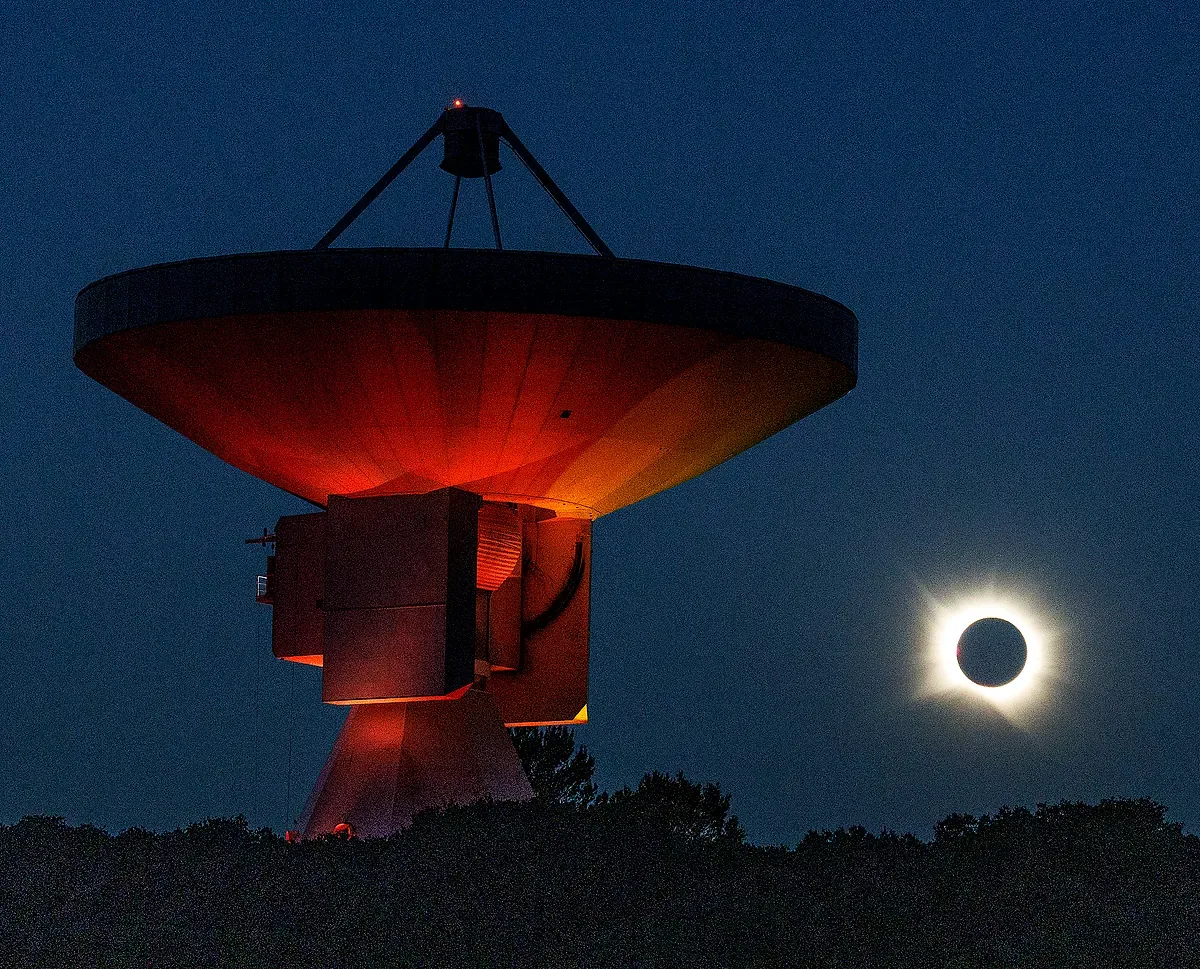
The town of Yebes, with about 5,600 inhabitants and located 80 kilometers from Madrid, was chosen by the Government to carry out the official monitoring of the first eclipse we have seen on the Peninsula since 1912. At 930 meters altitude is the Yebes Astronomical Observatory, the largest in the network of the National Geographic Institute (IGN). The imposing 40-meter radio telescope, “the crown jewel of the observatory”, in the words of its director, Pablo de Vicente, presided over the site where a stage and tents were set up to celebrate the highly anticipated eclipse. An event whose significance was compared by the Secretary of State for Science, Innovation and Universities, Juan Cruz Cigudosa, to “a Football World Cup of astronomy” in which Spain plays and wins the Final.
How to photograph the solar eclipse and other ‘unreal’ light ‘atmospheres’
- Editorial: CARLOS GARCÍA POZO Madrid
The total solar eclipse turns Spain into a great laboratory: these are the experiments that will be done on August 12
- Editorial: RAFAEL BACHILLER
It was a very hot day, with the thermometer marking 36 infernal degrees that gently dropped when the magic hour of the eclipse arrived. But before that, there were many hours of waiting lived with anticipation.
Access to the observatory from the town of Yebes was cut off for security and it was only possible to reach it by shuttle buses that throughout the day were bringing authorities, journalists, workers, and guests. Paella was eaten and, during the after-meal, the Minister of Science and Innovation, Diana Morant, arrived, later joined by the Minister of Territorial Policy, Ángel Víctor Torres, and well into the afternoon, the Minister of the Interior, Fernando Grande-Marlaska, and the Minister of Digital Transformation, Oscar López.
“Today science will prevail,” Morant assured. “We are going to experience the eclipse with many boys and girls on whom the future of our country and humanity depends. They are the ones who will end up landing on Mars and discovering vaccines against cancer, so let’s take advantage to awaken scientific vocations especially in girls, as we still have a very significant gender gap,” she emphasized.
There is an estimate that says only one person out of every 10,000 will see a total solar eclipse in their lifetime, but among the attendees at the Yebes event, many of them astronomers or scientists from the space sector, the percentage of guests who had witnessed one or several total solar eclipses was much higher than average. With their descriptions of what we would see at sunset, we were eager for the time to come. And also for the announced sharp drop in temperatures on this scorching August day. Would it be that much?
It was the first time for our two astronauts, Sara García and Pablo Álvarez, very excited to witness this event. “It is a unique opportunity. Enjoying a phenomenon like this that nature gives us, probably with our loved ones and friends, is a privilege,” said Sara García, who recommended forgetting the mobile phone to experience this spectacle with all the senses.
“I think one of the things that this solar eclipse will give us is perspective. It is a feeling very similar to what my colleagues who have flown to space tell me when they are able to see the Earth, the Moon, and the Sun from outside. It is a feeling of fragility and of better understanding what our place in the cosmos is,” reflected Pablo Álvarez, who interrupted his vacation to participate in several events about the eclipse.
An hour before totality, the spectators in Yebes went up to the terraces of the observatory to, at exactly 19:36, see the start of the partial eclipse. Although there was some haze in the sky, the forecast pointed to a good observation. There was not a trace of clouds.
Read more These are the seven models of glasses recalled for the solar eclipse
Some of the attendees dressed in red, green, and blue were able to notice the Purkinje effect: during the 10 minutes before totality, the sharp drop in light changed our perception of colors. The blues and greens shone and the reds became a little darker, although less than expected. It was as if someone lowered the light intensity. An almost unreal atmosphere blurred the day and, at 20:31, the day went dark. The silence was interrupted by shouts, then returned to silence, and then everyone applauded. In our area, they say the totality lasted 61 seconds, but to many of us it seemed less time. “Impressive,” “It has been total madness,” were some of the repeated phrases. The Secretary General of Innovation, Teresa Riesgo, was moved to tears.
After that magical minute, the day lit up again and at 21:15 the eclipse ended and a party began that would be accompanied by The Perseids, as the eclipse coincided with the day of maximum activity of the meteor shower.
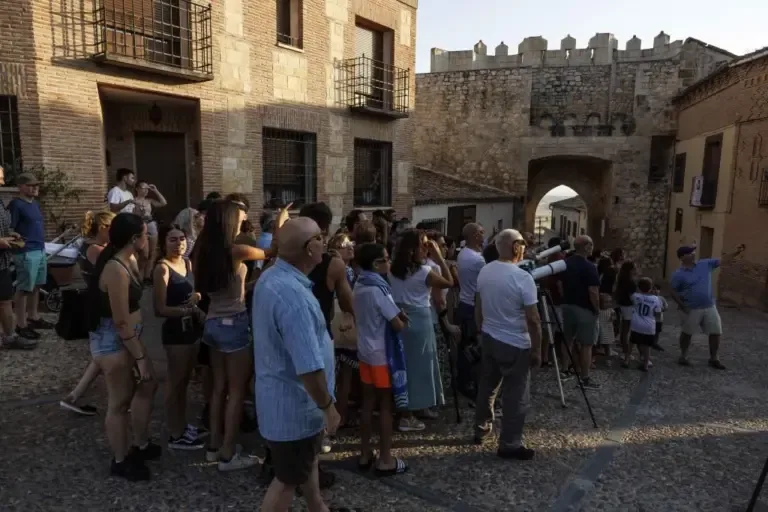
Meanwhile, thousands of neighbors gathered in nearby towns, which between Tuesday and Wednesday hosted an unusual number of visitors. This is the case of Horche, a town of 3,000 inhabitants that, besides being one of the places where the eclipse was seen at 100%, is only six kilometers from Yebes.
Although the La Cañada Hotel had its 50 rooms booked for these two days for weeks, they have continued receiving calls trying to get a reservation: “Normally at this time of year we would have half the rooms occupied, as we also accommodate workers from the area,” says Ramón Moya, hotel manager, who admits he did not know there would be an eclipse until last February, when the Civil Guard inquired about the reservations he was receiving. “Now it has gotten crazy and it seems like the world is ending tomorrow [yesterday],” he says laughing.
On Wednesday morning the Horche City Council distributed sunglasses to its residents – two per family – so they could follow the eclipse. The night before, this was the topic of conversation among neighbors who were cooling off in the streets of the town and on the terraces of the bars. At the El Bodegón restaurant, we talked with four friends aged between 18 and 37 with different views about the eclipse. While María, Ángela, and Ander were clear they were going to see it although they doubted whether to stay in Horche or go to Yebes, Adrián admitted he didn’t care much.
With the start of the so-called eclipse trio, the sharp drought of total solar eclipses we have suffered for more than a century comes to an end. We can say that the August 12 eclipse has been historic, but we cannot call it the eclipse of the century because on August 2, 2027, Spain will again be the perfect set to see another total solar eclipse that, moreover, will be longer – almost five minutes – and will occur in the morning, around 10:50, which will facilitate its observation. It will be seen in all its splendor in another geographic area – in the south of the Peninsula and in the autonomous cities of Ceuta and Melilla. And on January 26, 2028, we will have an annular eclipse.
For this reason, for the astronomer Rafael Bachiller, head of the National Astronomy Commission established in 2023 to manage the eclipse trio, he is satisfied with the success of today’s event, but aware that two more appointments remain ahead.
“It has been intense work, but very rewarding. We have promoted educational and outreach initiatives, observation campaigns and citizen science, recommendations for safe observation, and numerous activities in coordination with observatories, universities, astronomical associations, etc. We have also advised administrations, always with the aim that these three eclipses leave much more than the memory of a memorable observation,” summarizes the director of the National Astronomical Observatory (IGN) as well: “We would like them to leave us more interest in astronomy, more scientific vocations, a stimulus for astrotourism, and greater awareness about the importance of preserving our dark skies.”