




The shame of the Sun. That was what was happening. At least that’s how it was told more than 3,000 years ago. On a clay tablet found in the ancient port city of Ugarit, in present-day Syria, one of the oldest testimonies of an eclipse was recorded: “On the new moon day of the month of Hiyar, the Sun was ashamed and hid during the day, in the presence of Mars.” For those who wrote it, it was not a matter of orbits, distances, and celestial bodies. It was something else. It was the Sun feeling modesty, anger, sadness. It was the sky speaking.
Read more Childhood accuses the PP communities of boycotting the debate on migrant minors in Ceuta
This Wednesday, in the Meadow of Dehesilla in Collado Mediano, hundreds of people looked up at the sky again. This time they knew exactly what was happening. They knew it was not that the Sun was angry. They knew the Moon would come between it and the Earth. They knew how long it would last, how to protect themselves, and when they could take off their glasses. But for a few moments, when darkness swallowed the day, knowing it didn’t help much.
Because there are things that science explains and yet still move us as if they had no explanation.
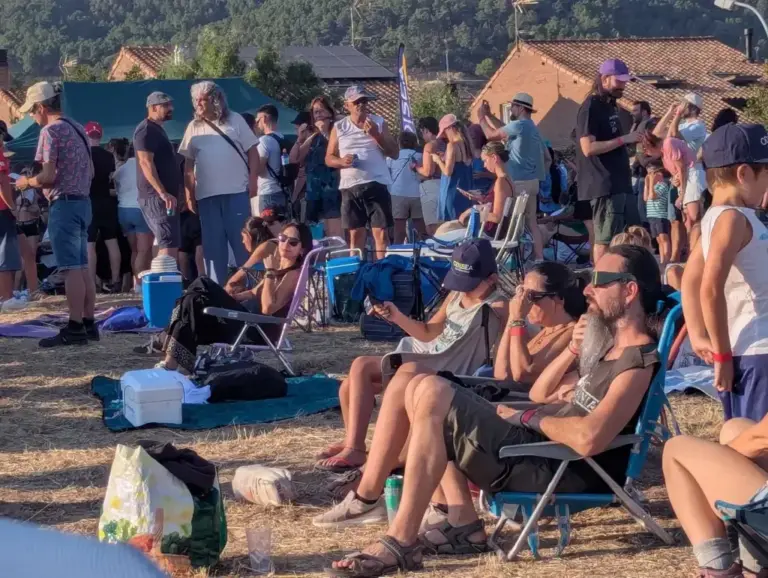
The meadow, prepared to experience the eclipse thanks to AMC+’s Odisea channel, became long before the big moment a small astronomical city. Entire families, friends, children, grandparents. Babies just a few months old and people over 80 years old. People from Toulouse and even New York. Umbrellas, blankets, water, beer, soft drinks, food, workshops, face painting, bracelets, telluriums, and cardboard turned into makeshift masks to ensure the little ones didn’t take off their glasses or look at the Sun from above or below.
A festival. But one where the stage was 150 million kilometers away.
“It’s a unique moment to live it in a unique way, but with all safety measures,” explained the mayor of Collado Mediano. And the children seemed to have taken the matter very seriously. They knew more than many adults about what was about to happen.
Rodrigo and Patricia, nine and seven years old, had arrived with their parents and grandparents. Patricia didn’t take off her glasses even to breathe. So much so that, according to her brother, she had already fallen twice with them on. The wounds, she said while showing them, were “as round as the eclipse.” Both knew when it would start, how long it would last, and what they had to do.
Rodrigo also had his own historical theory: “The same year we won the World Cup there is an eclipse. Not even on purpose.”
A few meters away, Sergio, 11 years old, found a much simpler comparison to explain what he was seeing: “It looks like a bite out of a cookie.” His sister immediately corrected him: “It’s like the Apple logo.”
And then it began.
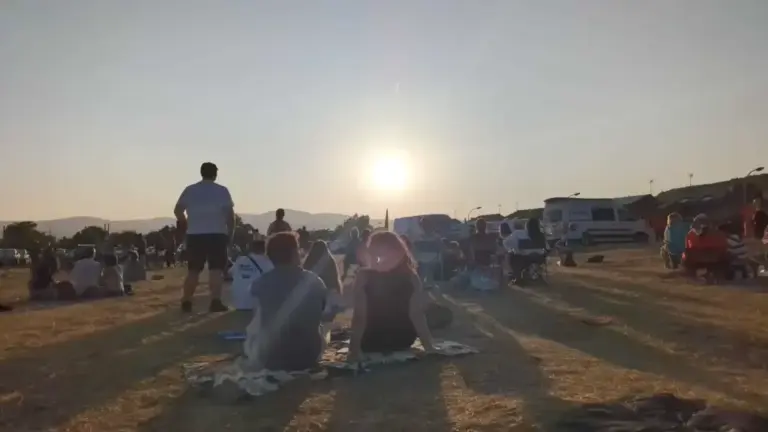
One minute before the partial eclipse started, the entire meadow broke into applause. “It’s starting, it’s starting, it’s starting!” people shouted. The Moon began to bite the Sun and, suddenly, hundreds of people who until that moment were talking, eating, playing, or taking photos had their eyes fixed on the sky.
In the background, Hombres G and their Voy a pasármelo bien played.
It was hard to find a more earthly soundtrack for such an extraordinary phenomenon.
Some followed the eclipse on the giant screen installed by Odisea. Others looked directly at the sky protected by their glasses. Others had stopped talking. And there was a woman holding a rosary in her hands.
It was not known if behind that rosary there was a promise, an omen, a custom, or simply the need to hold on to something. Perhaps because, for some, this eclipse was the closest they would ever be in their life to looking at something resembling God.
Read more The PP challenges the PSOE to summon the Moroccan ambassador for consultations
Then came the descent of the light.
First it was the temperature. Then the colors. The world began to take on metallic tones, as if someone had suddenly aged the film being projected in front of everyone. The meadow no longer looked the same. Neither did the sky. The afternoon became something else.
Mario, from Nocturnario, was the master of ceremonies. The man who had explained for hours what was going to happen was now preparing for the moment everyone had been waiting for.
“When the total eclipse occurs, anyone who wants can take off their glasses. It’s only 15 seconds, so I will shout: ‘Off, off, off!’ so you can take them off. And when the Moon continues its path, I will shout: ‘Glasses, glasses, glasses!’ and you will have to put them back on.”
And boy, did he do it.
But during those 15 seconds something happened that no script could have foreseen.
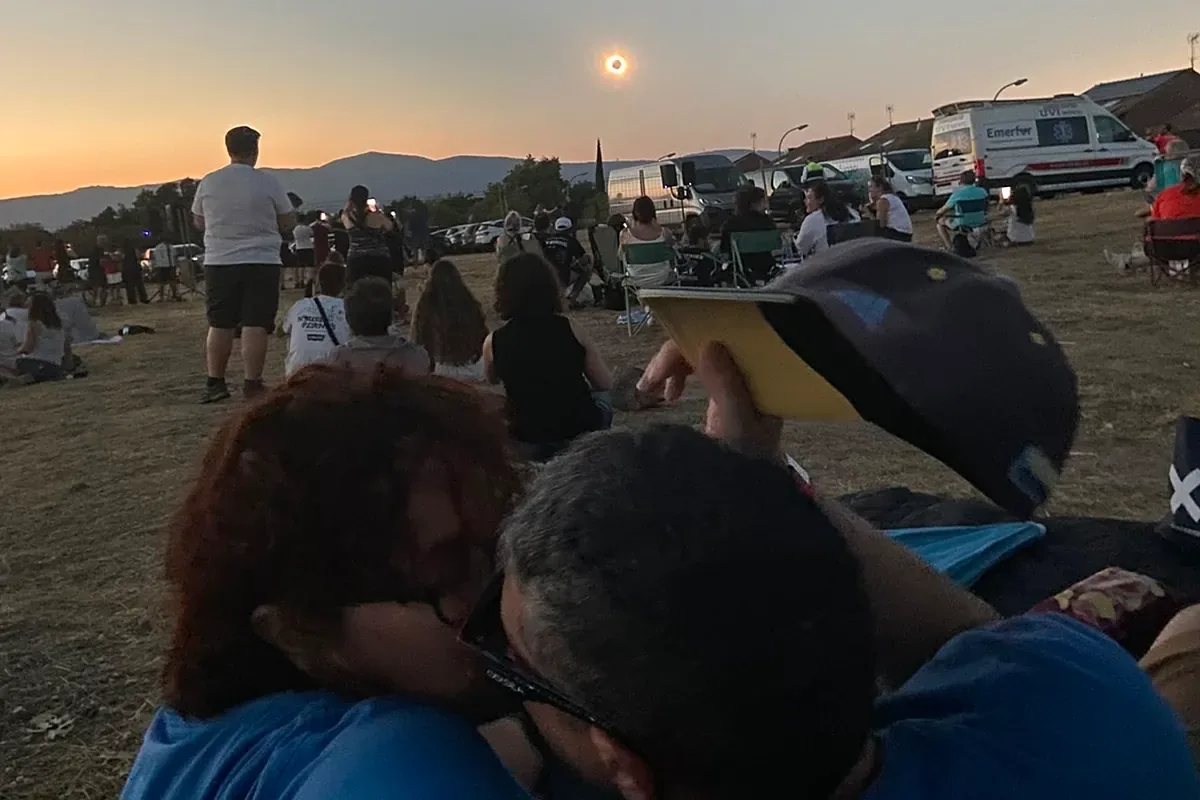
Mario shouted “off, off, off!”. The glasses disappeared from faces. And the sky appeared.
A shout pierced the meadow. Then another. And another. The applause grew. Parents hugged their children. Children looked for their parents. There were kisses prepared for that moment and kisses stolen from time. People who had been together for hours and who, without knowing each other, ended up hugging.
Only the applause, the hugs, and the emotion were able to put Mario on mute.
Even the rosary was still there.
It is often said that the hairs stand on end. This Wednesday, in Collado Mediano, the hairs turned into nails.
For less than an hour, while the Sun, the Moon, and the Earth aligned, everything else disappeared. Phones, food, conversations, rush, age differences. A family from New York shared the sky with another from Toulouse. Erik had taken advantage of the eclipse to visit his Madrid family after four years without seeing them. “It’s not just seeing them after so long, but also that I’m going to share the eclipse with them,” he said as his family applauded him.
And then, for a few seconds, everyone looked at the same thing.
María had her baby in her arms. A tear escaped her. “So much emotion, too much. It’s not just a unique moment, it’s much more,” she said.
It was.
Because eclipses can be calculated. It can be known where they will occur, what time they will start, how long they will last, and what path the Moon will follow. Telescopes, screens, glasses, apps, and maps can be built. It can be explained with mathematical precision why the Sun disappears.
But no one can exactly calculate what happens to a person when, for a few seconds, they see the day disappear.
The ancients wrote about the Sun being ashamed on a clay tablet. This Wednesday, in Collado Mediano, hundreds of people wrote their own version on a much more modern tablet: the screen of their phones.
Only that, for 15 seconds, almost no one wanted to look at the screen.
They wanted to look up.