




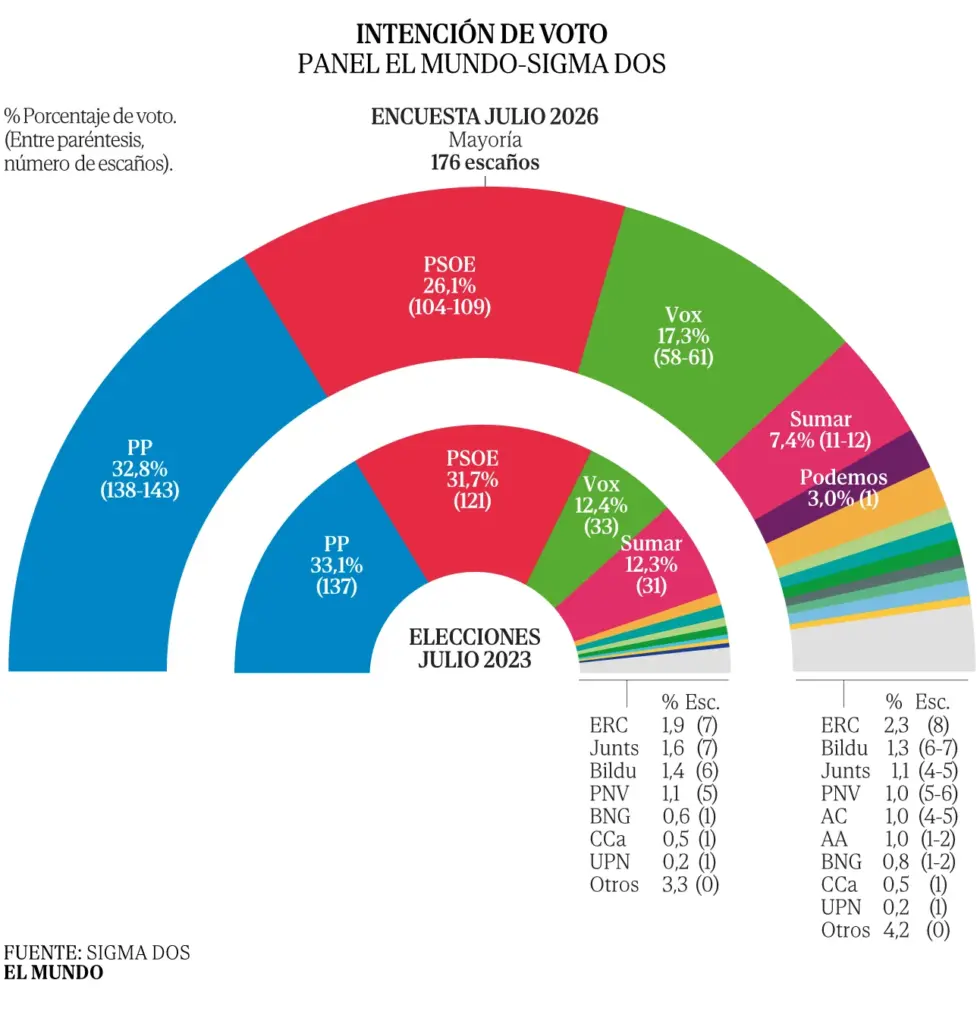
Practically since the legislature began, Sigma Dos polls for EL MUNDO have predicted that the right could add up to govern. That the deputies obtained by PP and Vox increasingly exceed those that the left would gather with the nationalists. The key to that supermajority, which today ranges between 196 and 204 seats – the absolute majority is reached with 176 seats -, lies in how it is structured, in how the parliamentarians are distributed province by province. Because it is the fight for the last seat in each constituency that keeps the right skyrocketing today, but it was also what left it five seats short of governing in 2023. Today, at most a year from the ballot box date, Vox scrapes practically all the remains and pushes the left away from La Moncloa.
Tomorrow marks three years since the constitution of the Cortes for the XV legislature. The day when 350 people went to the Congress to collect the deputy certificate that belonged to them for having been elected representatives of one of the 50 provinces, Ceuta or Melilla. That August 17, 2023, in the seats corresponding to 28 constituencies, the right seated more deputies than the left. In another ten provinces, the opposite happened, while conservatives and progressives had equal representation in the remaining 12 territories. Today, that imbalance would be maximized: the right would win in 38 provinces, compared to eight for the left. There would be a tie in Soria and the result by blocs is still open in La Rioja, Valencia, and Seville, according to the Sigma Dos poll for EL MUNDO.
That the PP-Vox sum is hegemonic at the national level today is explained, then, because it is also so in at least 38 of the 50 provinces – 76%, when in 2023 it was 56%. The parties that formed the investiture bloc three years ago only surpass the sum of the right in the constituencies of those communities with a strong nationalist presence: Catalonia, Basque Country, and Navarre. Because it is these nationalist formations that resist, while the state left dissolves. Sumar does so in the form of a hemorrhage and so does the PSOE by failing to absorb that collapse.
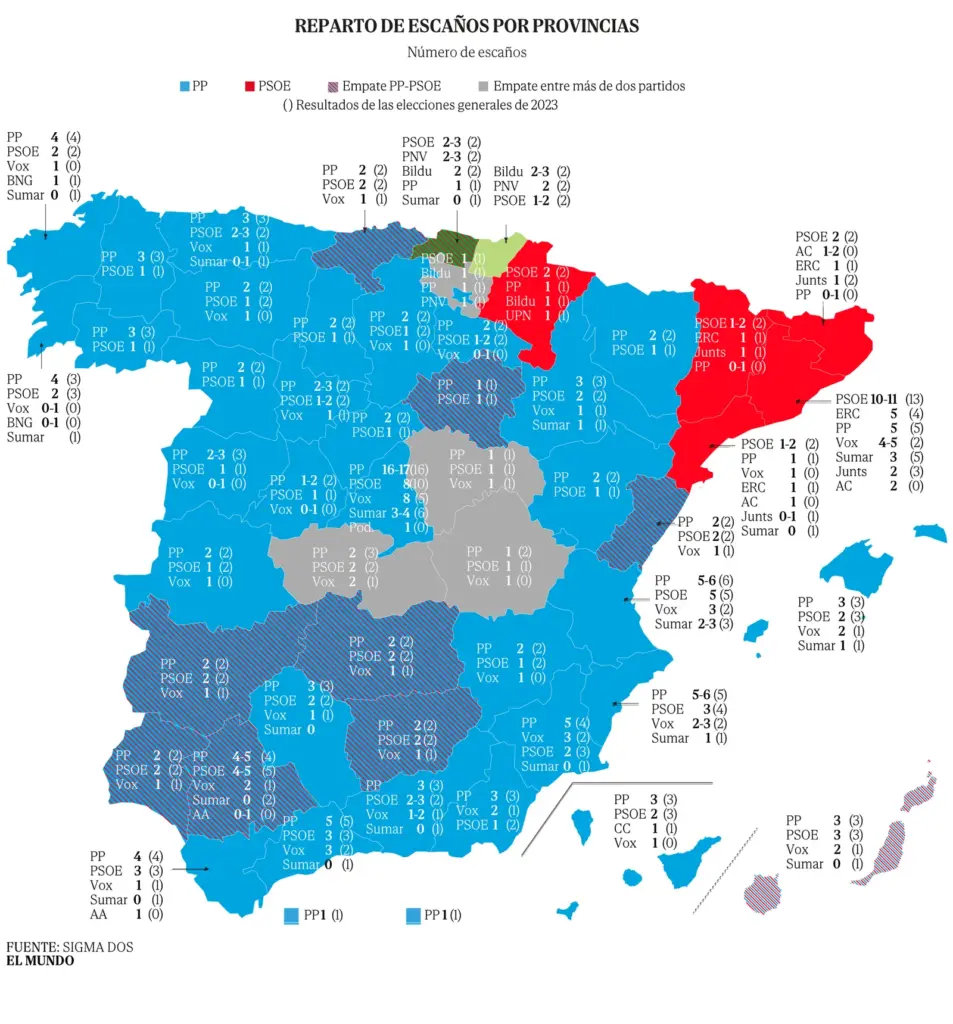
If the polls opened today, Pedro Sánchez would only be guaranteed to be the leading force alone – more seats than any other party – in two provinces, Navarre and Barcelona, when in 2023 he did so in five – these plus Tarragona, Lleida, and Seville. Now, however, the socialists still debate between victory alone or a tie at the top in five more: the three remaining Catalan regions, Biscay – in competition with the PNV – and Seville – fighting the last seat with the PP. At the same time, in 17 territories, the PSOE ties (11) or could tie (six) the PP at the head in deputies. In 2023, Sánchez tied as the leading force in 23 – with the PP in 19 -.
If this balance already shows greater imbalance than three years ago, it increases when observing how the number of seats is distributed: the PSOE would obtain today fewer seats than in 2023 in 12 provinces, and in another six it is at risk of doing so. In total, it would lose between 12 and 17 deputies, while the PP would gain between one and six: it falls or could fall in five constituencies, but at the same time rises or could do so in nine. On the other hand, Sánchez is only in a position to grow in Asturias, Biscay, and Granada. This dilutes the regional power of the socialists, whom Vox eats ground across the map.
So much so that if at the national level Santiago Abascal’s party seems demographically consolidated as the third force with 17.3% of the vote, on a smaller scale its moment is even better: it fights for second place in 17 of the 50 provinces, and in two others it has won that battle. Or, in other words, the PSOE already risks being tied or surpassed by Vox in 19 constituencies, 38% of the total. The socialists, who nationally hold second place with 26.1% support, however see their territorial dominance cracking. And all on the eve of the regional and municipal elections next May.
In the 2023 polls, Vox only matched the seats obtained by the PSOE in one province, Guadalajara, where there was a three-way tie: one seat for each, also for the PP. Now, according to the poll, Abascal and Sánchez would gather the same number of seats in 10 constituencies: Guadalajara (1), Cuenca (1), Toledo (2), Albacete (1), Cáceres (1), León (1), Burgos (1), Balearic Islands (2), Málaga (3), and Madrid (8). Especially striking are the last two, as they are provinces that distribute a large number of seats and where differences are usually greater. In addition, there are seven other constituencies where Vox has chances to match the PSOE, although the poll still leaves the door open for it not to happen. What the barometer does make clear is that the right’s overtaking of the socialists would today be a fact in two provinces: Murcia, which would give three seats to Vox and two to the PSOE, and Almería, with two for Abascal and one for Sánchez. It was the opposite in both in 2023.
If three years ago Vox did not obtain seats in 26 provinces, now it would only do so in between 14 and 18 – several of them in Galicia, Basque Country, and Catalonia -, which shows Abascal’s territorial expansion, which occurs mainly at the expense of the left – it only takes between two and five of the 25 to 28 that the PP would win. The same does not happen on the opposite bench.
PSOE and Sumar lose between 31 and 37 seats of the 152 they gathered in 2023. The hemorrhage is especially signed by the alternative left coalition, which goes from achieving representation in 19 provinces to doing so in six or seven. In addition, it happens that it only resists where there are regionalist political forces that ran in 2023 under the Sumar umbrella but have their own territorial implantation and might not join this time the new formula presented by the space. Sumar, if it runs today with the same parties as three years ago, would get seats in Valencia and Alicante (by Compromís), Zaragoza (Chunta), Barcelona (Comunes), Madrid (Más Madrid), Balearic Islands (Més), and maybe Asturias. On the other hand, it is left out in the Galician provinces – the BNG barely has a chance to take one of the two seats that Sumar loses – and Andalusian provinces – Adelante could scrape up to two, but Yolanda Díaz got six in 2023 -.
Read more «You’re going to make it»: the four words that changed the way I look at the future
Thus, it deepens the imbalance between blocs that, although the seats the PP loses end up with Vox, those lost by the alternative left mostly do as well. The PSOE could only claim three of the 19 or 20 seats that Sumar loses: that of Granada – in competition with Vox -, that of Biscay – fought with the PNV – and that of Asturias, which the magenta formation can still keep. The lefts of Sánchez and Díaz lose deputies simultaneously in up to six provinces, which ends up consolidating the territorial hegemony of the right.
All in all, the back-and-forth of deputies is the norm a year from the polls – only Aragon and Navarre remain -, and thus the scenario is still open: the dominance of the right on the map lies in Vox scraping almost all the last seats. But, if the course of that fight province by province changes, the final framework will be different.
Technical Sheet
Reference population and geographic scope: People aged 18 and over residing in Spain with the right to vote.
Information collection technique: Through the Sigma Dos Panel by Trust Survey. Mixed telephone (CATI) / online (CAWI) methodology.
Sample sizes: 3,690 interviews.
Selection of sample units: In the telephone interview by random household selection and application of sex and age quotas in the selection of the last unit. In the case of the panel, proportional assignment by sex and age group has been applied. The sample distribution has been proportional by autonomous community in both samples.
Margin of error: The absolute sampling error can be limited to ±2.3% for a confidence level of 95.5%, and assuming variables with two equally distributed categories.
Data analysis and representation estimation by constituency: Results of 30,400 interviews conducted from May 4, 2026, to July 21, 2026, have been analyzed. Distributed non-proportionally in each autonomous community to achieve a minimum necessary for seat estimation at the constituency level.
Fieldwork date: From July 6 to 20, 2026.
Conducted by: SIGMA DOS SL. Calle Velázquez 50, 2nd Floor (28001-Madrid).
Technical direction: José Luis Rojo Gil / Ignacio Javier Clemente Sierro.