









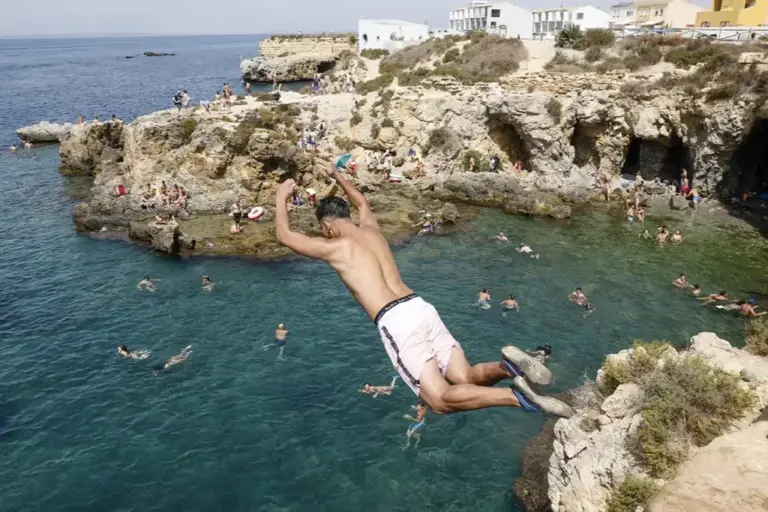
Look around you. Surely sweat is rolling down your forehead at these scorching hours of the day (actually, the time doesn’t matter) and you no longer know what to do to try to isolate yourself from the world. The mosquito is especially annoying today. Just when it seems it has finally moved away from your ear (to bite your leg, of course), a wasp appears on the horizon threatening to land on the lunchbox. The fan stirs hot air and in your mind you only wish that child with the little ball were far away. What was going to be the summer of your life is the summer of a lifetime. Don’t blame yourself if you end up fantasizing about a strategy to escape these hellish holidays, because even in paradise it’s tough.
Because now imagine walking around what is your island (to be honest, shared with 59 people). You have decided to have your morning coffee watching the sunrise in a cove where the sea gently breaks against the rocks. You look to one side and the other and see no one. And you think the world is just for you. The squawk of a seagull brings you back to reality, but that reality remains the same. You and paradise, which is a little piece of land bathed by the Mediterranean where time seems to have stopped.
But no. We said every paradise has its bitter side, and this one is no exception. It’s 10 in the morning and a horde of tourists is ready to colonize the space. And not exactly quietly. It’s not quite clear why, but visitors usually break into applause when they spot the silhouette of the island from the boat. It’s time to make plans:
Beach party, right?
Yessss!
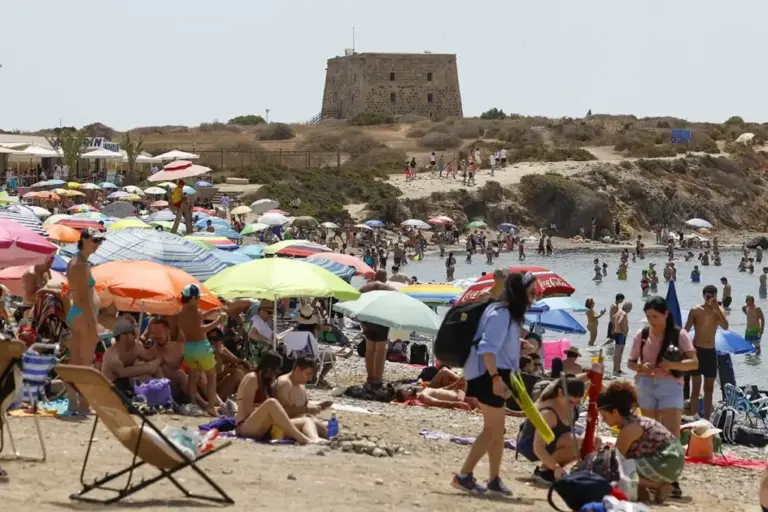
Welcome to Tabarca, the smallest inhabited island in Spain where only the first boat of the day lands at 10 o’clock. It will be the first of many. Considering that up to 250 people can fit on one of these tabarqueras—the name given to the famous catamarans that depart for the island from the port of Santa Pola (Alicante)—it’s easy to imagine the thousands of tourists that can crowd Tabarca in a single day. The residents of Tabarca have counted a maximum of 7,000 on any given day in August. Like today.
The pursuit of well-being boosts silent retreats: “People are increasingly lost and disconnected from themselves”
- Writing: REBECA YANKE (Text)Madrid
- Writing: JORGE ARMESTAR (Photographs)Cáceres
Skyscrapers, luxury cars, and XXL logos: how Andorra became the ‘little Dubai’ of the Pyrenees
- Writing: LUIS ALEMANY Andorra La Vella
To understand what this figure implies, just think that there are 60 registered residents in Tabarca. This means that in summer, the island’s population can multiply by… 116! Hence the islanders have undertaken a task that does not seem easy: to make the island an entity independent from the Alicante City Council, the municipality that currently governs Tabarca as any other neighborhood of the Alicante capital.
«Please, let it be clear that we do not want independence, because then people get upset and don’t take us seriously», clarifies the president of the Tabarca Isla Plana Neighborhood Association, Carmen Martí. To avoid hurting sensitivities, it is said that the residents of Tabarca are not separatists, although they want the island to be recognized as a minor local entity with autonomy from a council that, they say, does not solve their problems. And there are many, ranging from lack of cleanliness to tourist overcrowding.
Let’s start at the beginning. Anyone who doesn’t know Tabarca should know it is 450 meters wide and 1.8 kilometers long. For example, if you feel like walking across the island from the cove known as Cala Falcón, at one end, to the door of La Trancada or San Gabriel, at the other end, it will take you no more than exactly 24 minutes. On the way, you will have time to cross the urban area from end to end.
There is no getting lost, because the main or central street is called carrer d’Enmig (middle street, in Valencian). «We have five streets and the perpendicular ones. It doesn’t seem so hard to take on that task», the residents expressed in a letter to the mayor of Alicante to request, among other things, «effective cleaning on the island», including street sweeping and washing or door-to-door garbage collection. In total, 30 hectares of land make Isla Plana the largest of the tiny archipelago made up of four islets, about 8 kilometers from the port of Santa Pola.
A peculiarity of the residents of Tabarca is that many of their surnames are of Italian origin, as they are descendants of Genoese. Their ancestors were Genoese fishermen and merchants who first settled on the Tunisian island of Tabarka. Hence Tabarca was then baptized as New Tabarca. It was King Charles III who, in the 18th century, ordered the construction of the walled urban area to house these families, which today is classified as a historic-artistic ensemble. Tabarca was also declared Spain’s first marine reserve in 1986 due to its valuable Posidonia Oceanica meadow.
But Tabarca is also the island where the grandmother’s house is known as the grandmother’s house (ca la iaia, in Valencian), where at 11 in the morning it already smells like fried fish, where Captain Suerte sells lottery tickets to tourists riding his minibike, where T-shirts as souvenirs promote the Tabarca skyline in Carloforte square (it’s a lie, there isn’t one), where vacationers are warned that «one person, one sunbed» («for your safety») or where you will regret not having stopped by a tobacco shop on the mainland first.
Where can I buy tobacco?
Complicated.
Why?
Because there isn’t any here.
What you can do is enjoy a «pirate dinner» in one of its restaurants (watch out, the best costume wins a meal for two) or show off your happiness on Instagram leaning casually against a white wall with a blue window that reads: «Welcome to the corner where the sea kisses the calm».
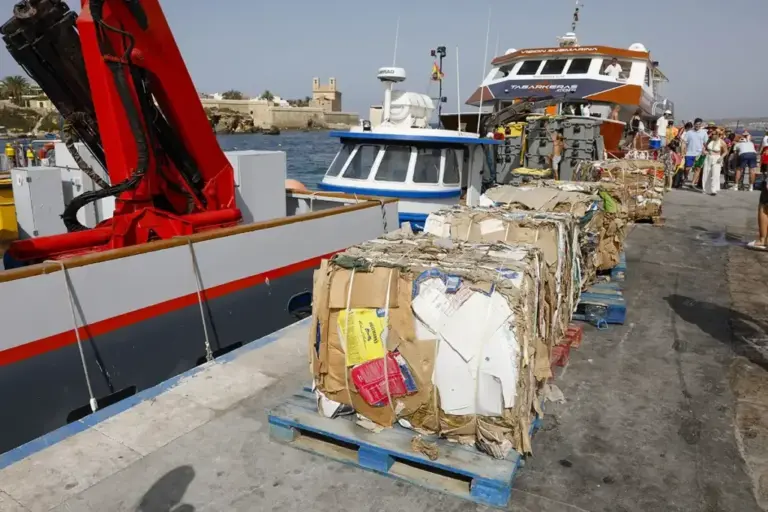
That said, an hour earlier you will have had to come out victorious from the great battle at the port of Santa Pola. It’s 9 in the morning, the sun is blazing, and you have to watch out that no one pokes you in the eye with a fishing rod or the handle of an umbrella. You have to dodge tables and beach chairs, food bags, and coolers big enough to hold an entire summer. And once the area is inspected, it’s time to face the vendors who shout at each other competing to sell the best seat on the best tabarquera.
Family, family! Hello! Boat without lines?
Here, here! Buy your ticket, the boat is leaving now!
Reserve on the best tabarquera! The real one!
For 10 euros you have a round-trip ticket to Tabarca. Camelia, Pepa, and Margarita can attest to that. These three retired women from Bigastro, Alicante, set off for Tabarca with their wide-brimmed hats, colorful sunglasses, and printed scarves tied under their chins. The barely half-hour trip on the tabarquera has nothing to do with a trip along the French Riviera, but it could well be.
Read more Massive desertion in the PSOE of Huelva, the socialist stronghold that seemed impregnable
Why do they go to Tabarca? It’s very simple: «To spend the day together, to laugh a little, and to get on this little boat, which we love». Regulars of summer plans on the island for years, this group of friends is the first to open the topic. «There are more and more tourists. It’s too much. They should restrict access so those of us who go can enjoy it, because many times you can’t even move because of the crowd».
They are not the only ones who think so. Carolina is another early boat passenger who points to the island’s summer overcrowding. In her case, she goes to Tabarca with her partner and children to celebrate the little one’s birthday. «If it weren’t because she wanted to celebrate her birthday in Tabarca, we wouldn’t go on weekends», she says. She knows what she’s talking about because the trip to Tabarca for the day is a whole «family tradition». «My grandparents came, my parents came… and now we do», she explains. «There has always been tourism. When I was little, I already remember coming on the boat packed in».
The tourist avalanche is one of the problems the neighborhood association chaired by Carmen Martí tries to face. «All those people obviously make a mess. A lot of people come here for the price of two beers and we don’t even have public restrooms. Only those on the beach», she laments.
The residents of Tabarca don’t even have public transport. They depend on the companies that manage the tourist tabarqueras to go to work in Alicante, Santa Pola, or Elche and to return to their island. If insularity were applied to them—as it is to the Canary Islands and Balearics—Martí says, for example, they would be entitled to a 75% discount on the transport ticket. «We pay our taxes like any resident and demand to be able to live with the same quality of life as in the other neighborhoods of Alicante».
With this demand, 13 women took the step 11 years ago to form a neighborhood association. These pioneering women made the decision when the Alicante City Council decided to eliminate the figure of the local mayor. Currently, they have about a hundred families from the island as members. «We said: something has to be done. And we are serious, although at first they took us a bit as a joke because we are already older ladies. Where are these going?, they said. But we have worked hard to earn everyone’s respect».
Martí, a retired nurse aged 71, is actually an «outsider», because her family is not originally from Tabarca. She arrived on the island with her husband in 1985 and never left. «When I met the island I fell in love. It was like love at first sight. My children were raised here and now my grandchildren. It has the charm of a small village from when the last tabarquera leaves at night until the first arrives in the morning with tourists. But before this was another world».
Gertru Chacopino confirms it. Her surname gives her away, as her family has been from Tabarca all their lives: «I’m not registered because there are no services here, but I have always liked the essence of the island. I remember seeing my grandmother take out the bucket to wash the street so no dust would rise. It had its charm, because today everything is overcrowded. Before, the last boat left at eight and now during festivals they leave until four in the morning. At night it’s like being at a party in Alicante».
Tabarca once had two schools: one for boys and one for girls. «Today there is no school because there are no children, but if we manage to become a minor local entity, I am convinced the registry will increase because more people will be encouraged to register», Martí insists. Currently, a registered resident in Tabarca must go to the doctor in Elche, which is not always easy. Mass is only held on Sundays in summer, and the cemetery expansion was not achieved until the women stood their ground at the cemetery shouting «we want niches». «There are two niches left and we have many candidates», Martí jokes.
The Local Regime Law of the Valencian Community allows population centers with peculiar characteristics and territorially separated from the municipality to which they belong, as is the case of Tabarca, to become minor local entities. In this way, they can have legal personality and capacity to exercise their own powers. The neighborhood association has already started the procedures to obtain that status, although the Alicante City Council has not yet commented on the matter. However, the final word on this issue lies with the Valencian Government.
As a minor local entity, Tabarca would have greater autonomy to manage its own budget and policies such as cleaning. According to Martí, «deep down, it would be a relief for the City Council, because cleaning is better controlled from the island than from an office».
«We have been asking for things for years and have gotten nothing. So there comes a time when you say: enough is enough», says the president of the association. And that moment, she says, has arrived. That said, Martí confesses they are already preparing the leadership change in the neighborhood association. «We have to make way for the young people. We have to retire, it’s time. We have fought enough and now we want to enjoy this wonderful island».
Read more Junts intensifies the battle with Aliança over the immigrant crisis in Ceuta


