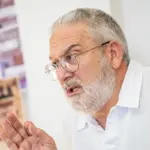
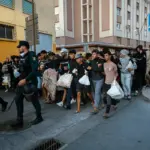






Melchor León, PSOE deputy from Ceuta, defined the migration problem as an “opportunity” and called the immigrants who crossed the border in September 2024 “children.” At that time, reports spoke of a “collapse” and an increase in irregular entries into Spain due to the massive spread “of messages encouraging hundreds of people to cross from Morocco.” León, on the RTVE program La noche en 24 horas, stated: “It is not a problem. It can be an opportunity. They are children, after all, who are arriving on our shores.”
He is now known as the rebellious PSOE deputy. Since July 31, when 80,000 people stormed the border from Morocco into Ceuta, he has been countering the explanations given by the Prime Minister and secretary general of his party, Pedro Sánchez, whom he supported in the 2017 primaries, about what happened. His career in the Ferraz party is more than in question.
What has happened in this time? Are those who have made this irregular entry no longer children? Has the naivety died?

Science, the new weapon of mass polarization: “They want to end the entire cognitive system, the progressive elites, and the university”
- Writing: RICARDO F. COLMENERO (Text)
- Writing: JOSETXU L. PIÑEIRO (Illustration)
Guy Standing, the economist who warns of the rigging of the system in favor of the elites: “The current far right is a smokescreen for plutocracy”
- Writing: JUAN DIEGO MADUEÑO
León thinks for a moment on the other end of the phone: “Ceuta is supportive of immigration, but this time it has been an invasion. It must be called that in all letters. There is no naivety here. It is evident that the citizens are tired, without falling into ideologies. All those who have invaded us must leave.”
Logically, the Ceuta deputy is in high demand. All the televisions want the testimony of the politician who fell off the horse. His testimony sounds refreshing. He agrees to talk in the 10 minutes he has between one connection and another. “It is very easy to give solutions from an armchair. Take a walk from the government delegation and leave an hour later and say everything is resolved. It is important to call things by their name. It was an invasion. Even if these positions leave me without a job, I can go out on the street. Others, like the government delegate, cannot go out,” he argues.
It was in 2017 when the RAE included “buenismo” in the dictionary, defined as the “attitude of someone who downplays the severity of conflicts, yields benevolently, or acts with excessive tolerance.” It aimed to categorize a premeditated political naivety. Not only with immigration. It has also been observed until just yesterday in the perception of the fight against drug trafficking in the Strait, while drug speedboats ram (sometimes with lethal results) Civil Guard boats. Or in the processing of golden visas, which until last year allowed buying a residence permit in the EU in exchange for a real estate investment.
“Banality begins in language. The way the government talks about immigrant camps: provisional humanitarian devices. If so much is said about provisionality or temporality, it is because it will not be temporary. The camps will become stable and chronic. If you have more than 2,000 kids on the streets, wandering… Human beings tend toward delinquency in these circumstances. No one has sought the slightest solution. Everything has been addressed with very pompous issues, like resilience. Ministers have gone to Ceuta to take photos,” says philosopher Jorge Freire, author of The Banality of Good (Páginas de Espuma).
“Good has been confused with capital B Good with goods sold by weight,” Freire seeks an explanation for the phenomenon. The first time buenismo was used was in 2000, according to the Observatori de la Neologia, of Pompeu Fabra University, to indicate naivety in public conversation. “Philanthropic jargon has flooded everything. It is a moral superiority that serves to dazzle others. I differentiate between values and virtues. Virtues and principles demand of you. Principles elevate you. The pondus in altum of Saint Augustine of Hippo, a gravity in reverse. They demand that you behave well. If you have values, just say so,” reflects the thinker.
Freire considers the crisis unleashed in Ceuta as proof of what he says. “The Minister of Health, at a time when it is already known that overcrowding causes scabies, a disease that proliferates in overcrowding, goes to Ceuta and calls her neighbors xenophobes instead of bringing more health workers. On the other hand, if she sympathizes with immigrants, instead of passing the buck, she could offer practical solutions. Luis Miller wrote it: the left does not seek to improve reality but to justify it.”
Melchor León is not the first politician to change his discourse. Mette Frederiksen, the Prime Minister of Denmark, signed a letter last August along with Giorgia Meloni, her Italian counterpart, linking “uncontrolled immigration” with crime. The then twenty-something Frederiksen warned in the early 2000s that one could not be populist on migration issues. “They can always take one step further to the right.” Now, page 118 of the study Immigrants in Denmark 2025 – published by the Danish Statistical Institute – analyzes the male index for violent crimes. Male descendants from non-Western countries exceed the average by almost three times. Non-Western male immigrants present an index 52% above the average.
The child Aylan who died on a beach in the Aegean Sea when his family fled the Syrian war became an icon. It was September 2015. The European Union decided to apply an open-door policy. In barely a decade, several factors have undermined naive positions. Chapel Hill Expert Survey, the international database that measures the ideological position of political parties, confirms the change. From 2014 to 2024, parties with a “restrictive” position on immigration have increased. Like the Moderate Party of Sweden, of a liberal character. On the scale – where 0 is liberal and 10 restrictive – it has gone from 2.8 to 8.3.
Read more New normal… against the CNI
“The problem is not political. When someone talks about naivety, they seek that we do not have a humanitarian reaction”
Victoria Camps, permanent counselor of the Council of State
Immigration is the problem that gauges the abandonment of the trenches of naivety. In Spain, the Qualitative study on citizen perception regarding the Basque socio-political situation and evolution, of 2024, points out that “the Basque citizens associate the increase in citizen insecurity with a specific profile of migrant people.” New generations also do not apply the well-thinking doctrine. The study Young Spaniards 2026, published by the SM Foundation, considers that young people support “the reduction of immigration and in percentages around 9% as first, second, and third priority.”
Politicians like Donald Trump or Javier Milei have used the excesses of naivety as a springboard to carry out a confrontational policy and have influenced the tide change of public conversation. Naivety prevented for a time asking questions: Does Latin American immigration increase pressure on housing in Madrid? Are some men more prone to rape? “Naivety can be very dangerous when it comes to waterproofing dissent in debate. Thinking that there are ideas before which you must hermetically ensure consensus is dangerous. It is a large-scale parental pin. Consensus, so to speak, is made so that there are some topics that are better not to address,” adds Freire.
Maybe José Luis Rodríguez Zapatero, charged with receiving commissions, was the captain of naivety. That political position was summarized in his favorite word: “Talante” (Disposition). It was perhaps too tolerant. Can a society be too tolerant? “I think so,” warns Victoria Camps, professor of Ethics and permanent counselor of the Council of State. “It is not enough to propose it but to be it. It is the subject who must set limits. It is difficult to say that society cannot be tolerant of speeches protected by freedom of expression, but first, you have to define what society is.”
Javier Sádaba relates naivety as the detritus of humanism, the philosophical current on which he has based part of his work. “There are signs of a tremendous change,” adds the honorary professor of the Autonomous University of Madrid. “I do not want to sound apocalyptic, it is an idea increasingly shared by not frivolous people. Going to human rights and humanism has a lot of smooth talk. It is a weak discourse. When there is nothing to say and theoretical rigor has been lost, one can fall into naivety. One thing is that you have to be human in psychological terms, but from there to become an NGO, no. You cannot confuse that with what the left needs. It falls into a very weak social democracy. Naivety is a secularized religion, a way to avoid the big questions.” Sádaba considers it something typical of conservatism. “It is more conservative than it may seem. The real, emancipatory, tough left, which links with the classics, has little naivety. It has quite a bit of degeneration of the good.”
The Saber vivir (1984) ruling directly solves the problems derived from the situation suffered by Ceuta. “If there is an emergency, you have to give it first to the one who needs it, whether a child from Jupiter or Pakistan. That is not talked about.” Sádaba visualizes the chaos in the autonomous city. “There is governmental incompetence. There is no seriousness. You cannot label the demands of the people of Ceuta who have needs as hate speech. They are not fascists or racists. We need to take immigration seriously. And laws are not enforced. If laws are not enforced, remove them. A state without borders is not a state,” he criticizes.
Victoria Camps sees it differently. Maybe when the youtuber Xokas criticizes naivety, he does not do it to change the conversation but to close it. “From my point of view, naivety is used derogatorily to accuse someone who empathizes. It is the most emotionally appropriate reaction. Talking about naivety avoids the important issue. It wants us not to sympathize.” In one of his videos, titled Disagreeing with the left and the right, the Galician influencer argues that it is “dangerous to give voice to certain speeches.” Camps places the problem outside politics. “The problem is not political. When someone talks about naivety, they seek that we do not have that humanitarian reaction. From that position, nothing is done. In these types of debates, arguments should be better, not close discussions by labeling the other’s discourse as naivety,” she reflects. “Empathy does not deserve that contempt.”
And she rejects a practical approach to a crisis like Ceuta’s. “It is another wrong way to delegitimize a discourse. Saying that the moral and humanitarian reaction is not realistic and discarding it for that reason is nonsense. Morality does not speak of what happens, but of what should happen. It is never real. There is no morally mature look. When these things happen, it is very easy to say my position is this. There is something more urgent: to welcome minors and children. That must be resolved. Just like being alongside the president of Ceuta,” she warns.
Melchor León, however, embraces pragmatism. “We want to recover our life. Return to the situation before July 30. That’s it.”


