



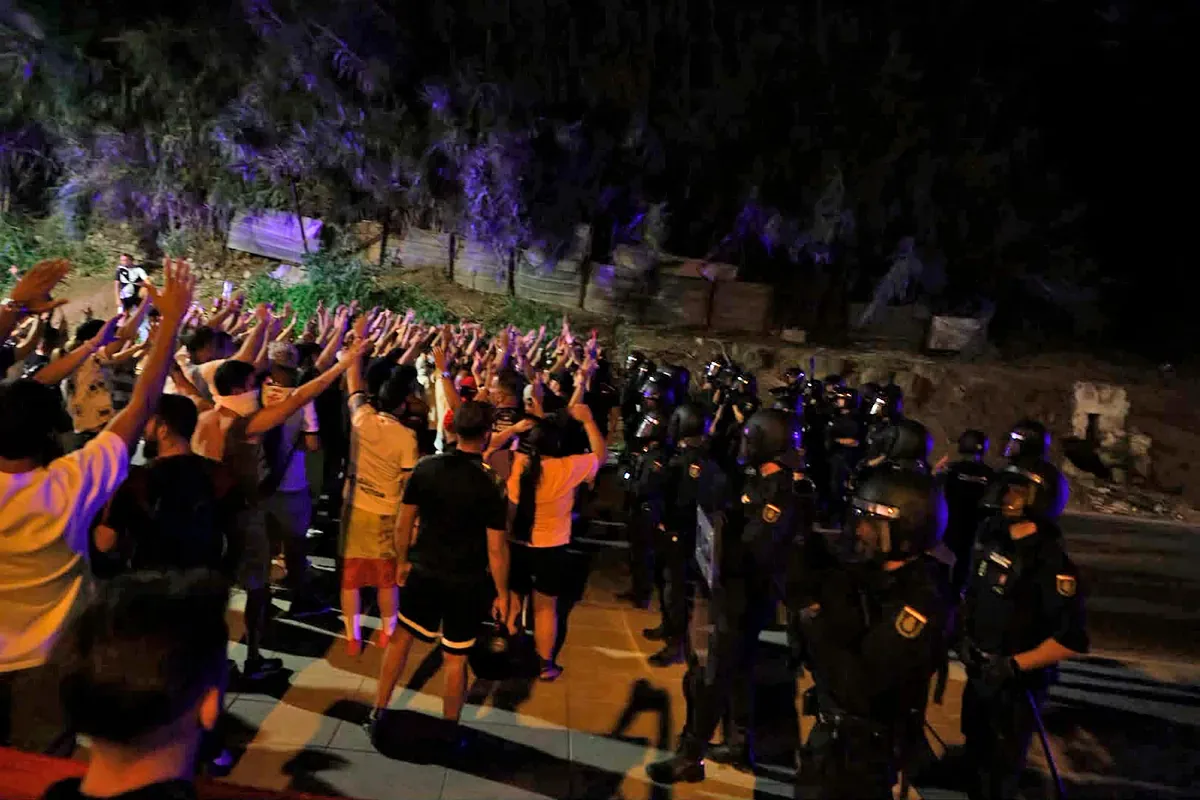
The Ministry of Defense has confirmed that during the night 12 migrants were arrested for stoning a military vehicle. The detainees are said to have participated in an ambush against the forces deployed in the area and reportedly threw stones and sticks, as well as using knives, according to sources familiar with the incident.
Read more Sánchez now opts for the most “tough and restrictive” line of the European migration and asylum pact
The events occurred around 5:30 a.m., when four soldiers were traveling in an unarmored vehicle to carry out surveillance duties in the Benzú area. According to a soldier stationed there who spoke to EL MUNDO, the forces were surrounded by “many immigrants,” between 30 and 40 people, who began throwing “large stones” at them.
Due to the intensity of the attack, the four soldiers had to abandon the vehicle and flee on foot to safety. The migrants continued to follow them and throw stones during the escape, according to testimony collected by EL MUNDO. The Superior Police Headquarters has confirmed that the forces suffered various injuries and bruises during the chase.
The soldiers managed to alert emergency services through 112, which allowed the activation of a device involving agents from the National Police and the Civil Guard. The situation reached such a level of tension that the intervention of agents from the Police Intervention Unit (UIP), the National Police riot police, was also necessary to support the military forces.
Upon the arrival of the first patrols, the alleged aggressors fled towards Benzú. The security forces then launched a search operation that ended with the arrest of twelve people, all of Moroccan nationality. Some of those involved tried to escape by jumping into the sea, so the Civil Guard Maritime Service maintained search efforts in the area.
The four soldiers were later taken to a healthcare center to receive medical assistance for the injuries sustained during the attack.
The Spanish Troop and Navy Association, for its part, denounces that the soldiers were unarmed and lacked adequate protective equipment. They had to be assisted by the National Police, Civil Guard, and the Maritime Service.
The second vice president of Ceuta and Minister of Finance, Economic Transition and Digital Transformation, Kissy Chandiramani, reported that around 5:00 a.m. “an incident” had been reported in the Benzú neighborhood “involving some immigrants and also soldiers.”
Chandiramani has asked the people of Ceuta to avoid violence in protests and to show “unity” in the legitimacy of taking to the streets “but always in an atmosphere of calm because such high tension leads nowhere.” “The tension in the city of Ceuta is very high and I believe that all of us as political entities, institutions, and media must call for calm because this tension can take us to places no one wants to be,” she emphasized in an interview with Cadena SER, reported by Europa Press.
The second vice president stated that she understands the population is “tired” and needs “answers” because “patience has a limit” and “feelings are running high” due to the lack of solutions from the central government. She also acknowledged that the massive influx at the end of July “was overwhelming for the administrations” and that the response was “very late.”
The Troop Military Union (UMT) has expressed its “strongest rejection and indignation” at the “ambush suffered by military personnel deployed in Ceuta.” The association has denounced that the forces were “stoned and violently attacked while carrying out their mission.”
The organization considers the situation of “operational and legal defenselessness” to which, in its opinion, members of the Armed Forces are subjected as “unacceptable.” In this regard, it denounces the absence of a “clear regulatory framework” and rules of engagement that guarantee their physical safety and a proportional response capacity to attacks of this severity.
The UMT also states that it had been formally warning for more than ten days about the “real risk” to which the units deployed in the area were exposed. The association holds the “inaction of the Ministry of Defense” and “lack of foresight” responsible for what happened and maintains that the attack “could and should have been prevented.”
Therefore, it demands from the department led by Margarita Robles an “immediate and urgent review” of security protocols and the legal framework for the Armed Forces’ actions. “Those entrusted with the protection of the State cannot remain unprotected by their own administration,” the statement concludes.
The investigation remains open to identify and locate the other participants in the attack.
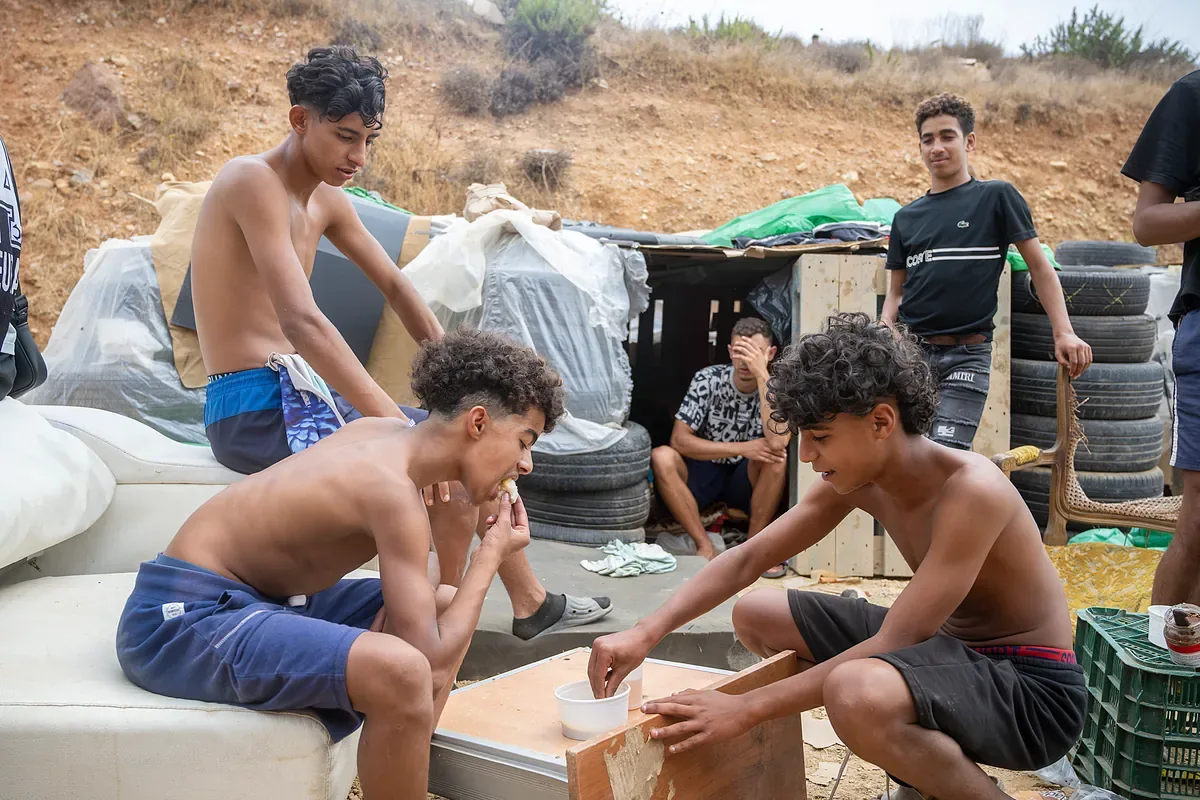
Government and Autonomous Communities meet regarding minors
The Ministry of Youth and Childhood meets this Thursday with the autonomous communities in a sectoral conference where the transfer of 25 million euros to Ceuta will be voted on to care for the minors who remain in the autonomous city after the massive influx on July 30 and 31.
The Government estimates 1,500 minors identified so far in Ceuta and is working on a plan for the urgent transfer of 500 girls to other autonomous communities, reports EFE.
The meeting this Thursday is expected to be tense, given the political atmosphere these days, and Aragón, Castilla y León, and Extremadura, where Childhood policies are in the hands of Vox in governments led by the PP, will not attend, as they did not attend the commission a few weeks ago, which was attended by the rest of the autonomies governed by the ‘popular’ parties.
In letters addressed to the Minister of Youth and Childhood, Sira Rego, the Vox councilors confirmed their boycott of the Government and announced they will legally challenge possible transfers of minors from Ceuta.
A decision in which the minister sees how the three regional presidents, from the PP, “choose Vox and abandon Ceuta and its president (Juan Jesús) Vivas,” by opposing that 25 million credit.
Childhood works so that each of the migrant children who are alone in Spain and for whom family reunification is not possible are cared for with all guarantees and stresses that the communities must comply with the law, according to Ministry sources.