



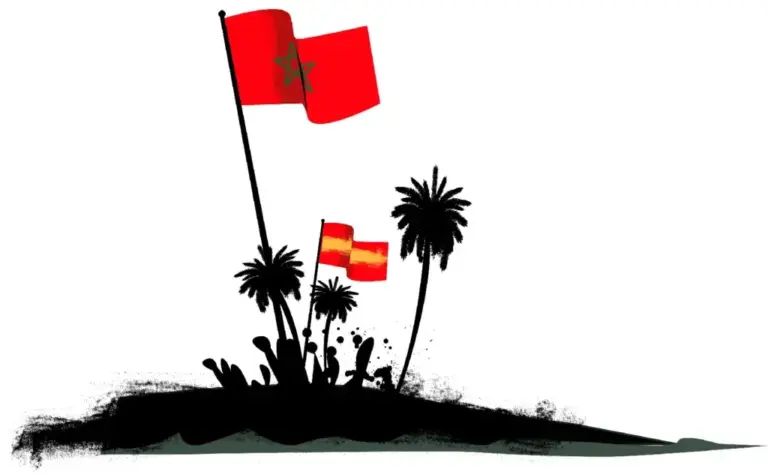
Spain faces its History in the Ceuta crisis. It has been a month since the massive and unprecedented entry of 72,000 people from Morocco through the border of the Spanish autonomous city. What the Prime Minister called an «attack against territorial integrity» has resulted in the collapse of daily life in the city of Ceuta, with public order problems.
Between 5,000 and 8,000 immigrants, the Government does not know how many, wander the streets, squares, and beaches, making daily life impossible for its inhabitants. The despair of the people of Ceuta has grown this month alongside the astonishment, confusion, and disbelief of a Government stunned by what was happening. Three weeks after the massive arrival, Pedro Sánchez decreed the sole command that President Juan Jesús Vivas had requested on the first day. Moncloa has been making decisions that meant a full correction of the initial reaction. The relief at the return of the vast majority of those who arrived confused the Executive, which did not pay attention to those who had stayed, and to the consequences of having nowhere to house them.
«It is not only the worst crisis the Government has faced throughout the legislature. It is a State crisis in which the State has not been able to deploy all its resources to recover the severely disrupted life in a city historically threatened by Morocco. It caught us at an electoral moment, the worst to face such a serious situation for which there are no magical solutions. A State crisis would require State responsibility, first from the Government, and then from all institutions; unfortunately, in today’s Spain there is no possibility of understanding or generosity from either the Government or the opposition. No one wants to rise above the electoral fight. The Government is caught weak and the PP eager to deliver the final blow to Pedro Sánchez. The result is the image of an apparently powerless State to restore normality in Ceuta and manage relations with Morocco intelligently, which have always been difficult.» This is how current political leaders and former high State officials summarize the challenge our country faces in Ceuta. «With hints of a small 98 of the 78 regime,» sums up a good connoisseur of the functioning of the State.
«The Prime Minister has been silent for a month, we do not know what he will say in his interview on Monday on Ser and later in his appearance in Congress. The Government has offered a pitiful image of impotence, the PSOE is completely blocked and the brand at a minimum. A plan is necessary to return all those who entered on July 30. Morocco has shown that it can occupy the city of Ceuta without firing a single shot or sending the Army. Deep down, this crisis has also put the Government’s diplomatic skill in its relations with the Moroccan regime in a bad light. They provoke little by little, and if you are not attentive and do not perceive it, in the end, they end up causing you a big mess. They have always done it. Never as seriously as the entry of 72,000 people at once. Spain must have guarantees that this will not happen again,» say socialist sources and former high PSOE officials consulted.
Waiting to see what Pedro Sánchez says, the strategy of sending ministers to Parliament to replace the president’s absence has not gone very well. It was «like a funeral,» says a parliamentarian. The discrepancy in versions between the Minister of Defense, Margarita Robles, who firmly stated that the CNI had warned the Security Forces of an increase in arrivals in Ceuta in the days before the great avalanche, and the Minister of the Interior, Fernando Grande-Marlaska, who denied having received those warnings, dominated the political news for days. «It is not the best that two State ministers maintain such opposing versions. And it is very striking that the president and the rest of the Government members have aligned with Marlaska and left Robles in an uncomfortable position.»
The Minister of Defense – who is not a PSOE member – has defended her autonomy, has been the only one to apologize for not having reacted more quickly and has outlined a measured criticism of the Moroccan action.
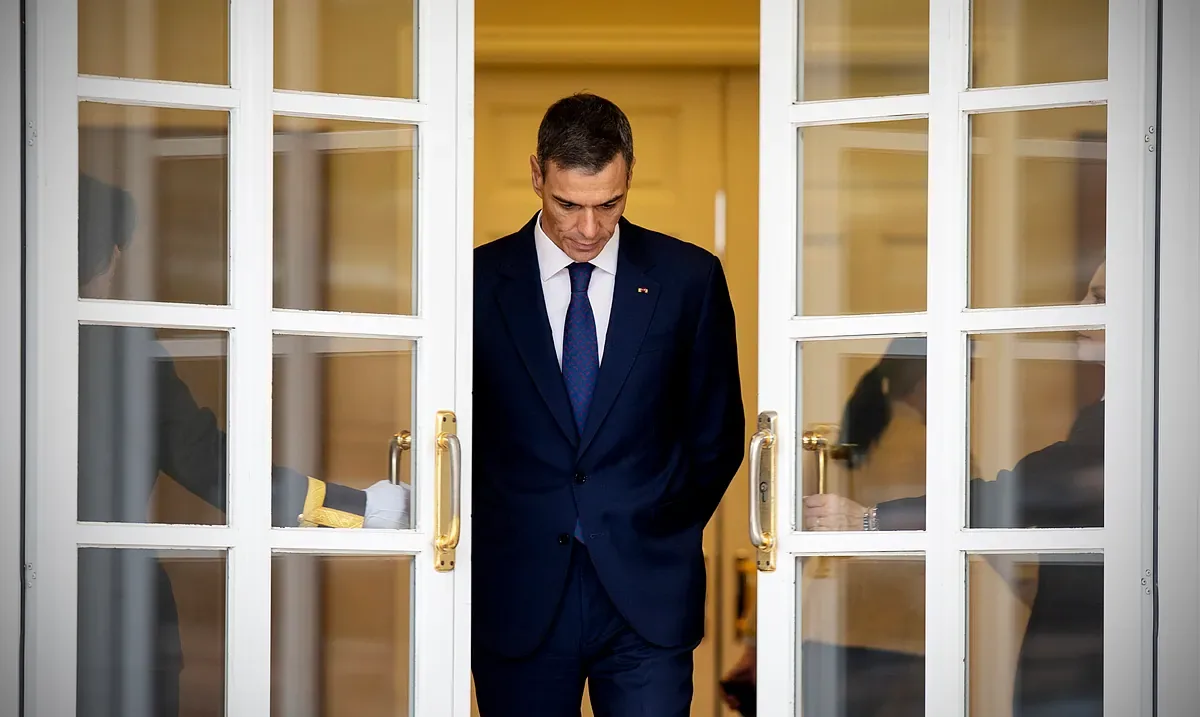
Socialist sources point out that the scattered action of the Government and the lack of reflexes of President Sánchez to realize that he had to act quickly are also consequences of how he configured the Government and the criteria when making appointments. They cite, in this regard, the mistake of dispensing with a First Vice Presidency with political weight – Vice President Carlos Cuerpo has only an economic profile – and the maximum concentration of all decision-making power in the figure of the president. «That way of exercising power has consequences. He is the party and the Government. When things go wrong, only he is looked at. Ministers have very relative authority,» say PSOE sources.
That only Pedro Sánchez is looked at is complained about by the Government and its collaborators. «We are aware that the situation in Ceuta is tense. The public has a feeling of fear and abandonment, there are a lot of people wandering the streets, and everyone looks at us. Although Spain is a multifunctional state with different territorial administrations. But it is the Government of Spain that is asked to solve the problems. And that is what we are doing. We still do not have enough facilities to accommodate them. The first thing is to find accommodation to guarantee the basic needs of the people on the streets, only then can we process the files and we are putting the means to process them quickly. The goal is to return all those people. Morocco continues to say it will host them all, once the law is fulfilled,» they say in Moncloa. The same sources regret that the PP does not collaborate with the Government in a crisis that Alberto Núñez Feijóo will inherit if he finally wins the next general elections and manages to form a Government. «The PP is totally conditioned by Vox».
Read more María Pardo, former Urban Planning councilor of the PP in Santiago, dies at 58 years old
The need for an agreement with Morocco to proceed with the return of immigrants occupying Ceuta is the argument the Executive uses to explain its delicacy in diplomatic treatment towards Morocco. One of the political problems the PSOE faces is the vast distance between its thesis that the Moroccan regime has no responsibility in the avalanche of 72,000 and the unanimity of media and experts of all tendencies denouncing Morocco’s role in the situation. The Foreign Minister, José Manuel Albares, even blamed the crisis on the «rumors» that populate social networks.
The reality of Ceuta is deteriorating day by day. Violent demonstrations and the burning of immigrants’ belongings have received a response from the institutions of the autonomous city. With President Vivas at the head, all parties have called for calm. While some ministers labeled the protests as fascist.
The Government warns that the PP and Vox want the immigrants who arrived irregularly in Ceuta to disappear at once. «There are no shortcuts, the law must be followed,» warn the ministers. The preamble to the declaration of a situation of interest for National Security that appoints Ángel Víctor Torres as sole command states that under no circumstances does this declaration «entail the suspension of fundamental rights or public freedoms, and does not authorize the adoption of measures typical of states of alarm, exception, and siege; it must be faced with the ordinary powers and means of the different public administrations». Some sources consulted point out that in a situation affecting national security, the Government has exceptional legal tools that it should use for the urgent and immediate return of immigrants. «The situation in Ceuta has been rotting and will get worse if it continues to be thought of as a migratory crisis. The patience of the people of Ceuta is running out and their rights to go out on the street without fear, to start schools normally, must be guaranteed. The narrative that only the rights of immigrants matter can no longer be sustained. The situation demands extraordinary measures, but no one dares to take them.»
For now, Sánchez has chosen not to take extraordinary decisions, although the possibility of transferring those who remain in Ceuta to the Peninsula to relieve the city’s collapse is on the Government’s table. The Executive resists it because the European Union has warned it not to do so and the PP «would set the streets on fire». «It would be logical for transfers to Morocco to go in parallel with sending some of them to the Peninsula, before returning them, to facilitate the recovery of normal life in Ceuta. We will see how the process goes and if at some point it has to be done.» No one wants to even imagine the possibility that the autonomous city becomes a new Lesbos, where immigrants stayed even for years, or that Ceuta’s urban fabric is altered by accommodations typical of refugee camps.
PP AND PSOE IN THE PROTESTS ON THE 2ND
Next Wednesday, September 2, solidarity gatherings have been called in all municipalities of Spain with the delicate situation experienced in Ceuta after the massive entry of immigrants on July 30. The call coincides with the official Day of Ceuta and has been promoted by the Spanish Federation of Municipalities and Provinces (FEMP). The one in Madrid will be held in front of Congress with the slogan ‘For Ceuta’. The PP has called for participation, while the PSOE is in an uncomfortable situation regarding the call.
On the one hand, socialists who are part of municipal governments want to show solidarity with the autonomous city, but Ferraz sees in the gatherings a will to protest against the Government of Pedro Sánchez. The PSOE of Andalusia, led by the party’s deputy secretary general, María Jesús Montero, has discouraged its public officials and membership from attending on September 2, which is why socialist town halls have withdrawn from the call. Both the PSOE and its partners have accused the PP of manipulating an institution like the FEMP, whose president, the ‘popular’ María José García-Pelayo, met last week with the mayor-president of Ceuta, Juan Jesús Vivas.
Read more Two Mallorca youth players arrested for recording sexual relations with a minor without her consent