




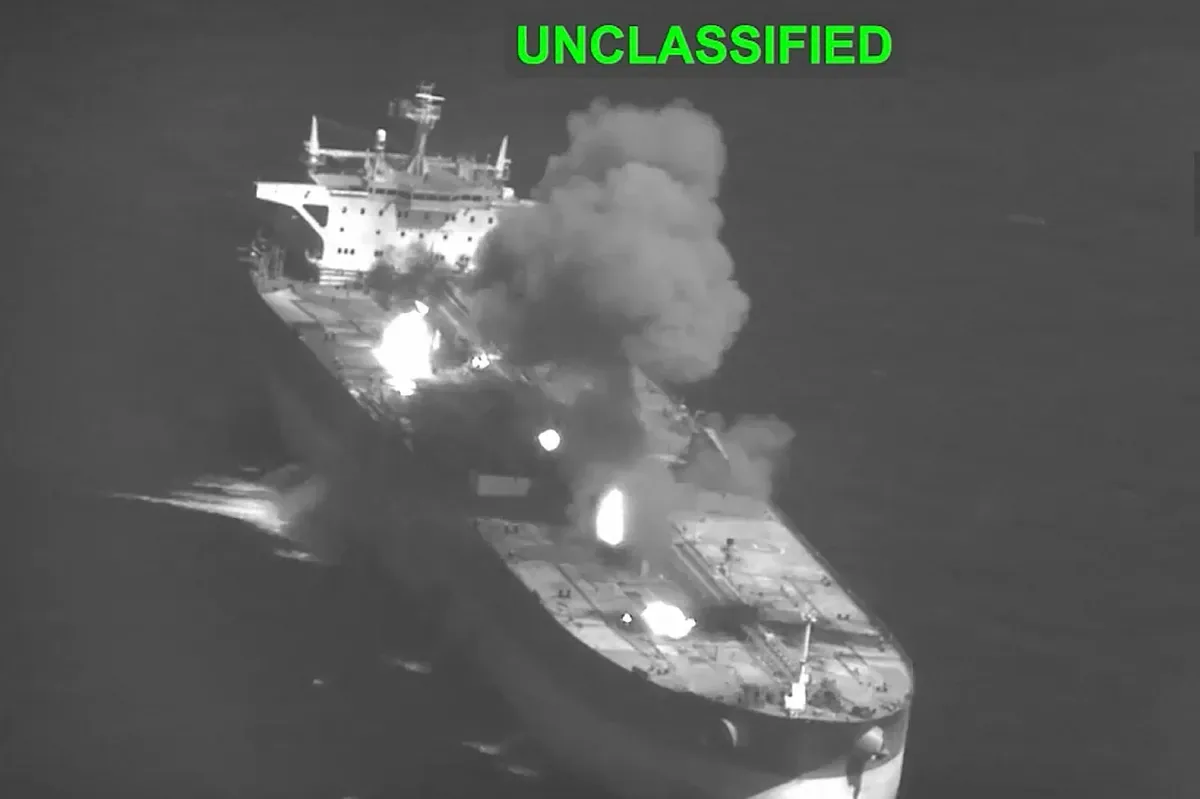
The United States attacked three Iranian oil tankers on Saturday after Iran launched ballistic missiles at two Navy warships, including an aircraft carrier, according to the US Central Command (Centcom), marking a significant escalation as the fight for control of the Strait of Hormuz intensifies.
Read more A Spaniard, kidnapped in Burkina Faso by an alleged terrorist group
“A US aircraft carrier and a guided missile destroyer successfully evaded multiple unprovoked Iranian attacks,” said Centcom, which oversees US forces in the Middle East.
The Islamic Revolutionary Guard Corps of Iran has launched ballistic missiles against US forces throughout the conflict, but the attempted attack on the warships was considered a major escalation, according to US officials.
“Let the message to the Islamic Revolutionary Guard Corps be clear: if you fire on two of our ships, we will impose an even greater economic cost on you by taking down three of yours,” said Admiral Brad Cooper, Centcom commander. “We will not hesitate to defend US forces and, if necessary, destroy Iran’s limited and vulnerable oil fleet.”
The United States began attacking Iranian oil tankers earlier this week as part of a new strategy to punish Tehran and reduce its ability to transport oil, according to US officials. US forces also attacked two tankers on Tuesday as part of a broader wave of attacks, according to a video released by Centcom.
Meanwhile, a fleet of US warships is imposing a blockade on Iranian ports. Up to this week, the US had diverted 87 commercial vessels, disabled three, and boarded two to ensure full compliance, Centcom reported.
Clashes had already intensified this week after the US announced it had removed naval mines from major shipping routes in the Strait of Hormuz, while the White House says the military is helping more ships transit the Persian Gulf loaded with crude. The US blockade remains in effect.
Iranian state media reported that an oil tanker was hit overnight near Kharg Island, where Iran stores and loads most of its crude exports.
The United States said it had disabled that tanker, as well as another near the Iranian oil terminal at Jask. Additionally, the US “completely destroyed” an unladen tanker in the Gulf of Oman, hitting it multiple times to render it inoperable after the crew was ordered to abandon ship, Centcom reported.
The latest wave of clashes in this waterway comes after the US and Iran exchanged heavy fire there earlier in the week, as both nations fight for control.
Iran began attacking ships in the corridor in the early days of the war and resumed after signing a preliminary agreement with the US in mid-June to open the strait, protesting US efforts to guide ships through it.
In recent days, Iran attacked two tankers carrying Saudi oil just minutes apart as they tried to cross the strait at midnight.
Both were navigating the corridor the US has established near the coast of Oman to break Iran’s control over the shipping lane.
Iran also attacked a Kuwaiti tanker a week earlier, one of more than a dozen it fired upon in August.
The United States says it is escorting several ships a day through the Strait to help ease pressure on the global oil supply. Ships usually cross at night with transponders off to make tracking difficult.
The military declared at the end of August that Navy SEALs, backed by other forces, had successfully cleared mines from the waterway, as part of an effort to get more ships past Iranian control.
The United States launched a wave of airstrikes along Iran’s Persian Gulf coast last week—the first in a month—demonstrating its determination to win the battle for control of Hormuz.
These included attacks on air defenses, radar sites, communications infrastructure, and maritime assets, the military reported.
The United States had avoided responding to Iranian attacks on ships throughout August, having set aside military action in favor of economic pressure to strangle Iran. But that restraint had worried Gulf allies, whose economies are being harmed by the fighting and attacks on their oil exports.
Iran’s control over the Strait of Hormuz, which before the war was the gateway for a fifth of the world’s oil, has been a major source of leverage for Tehran both in the war and in negotiations to end it.
Its own oil exports have been blocked for weeks by the US blockade, while Gulf oil exports get through, increasing pressure on the regime.