




Iran claims that US oil companies in the region could become its next military target, in the latest episode of escalating tensions that keep the Middle East on edge. “If they attack our assets, they will be attacked. We have already proven it. Ask the (military) bases that are no longer viable,” said the president of the Iranian Parliament and the country’s chief negotiator, Mohammad Bagher Qalibaf.
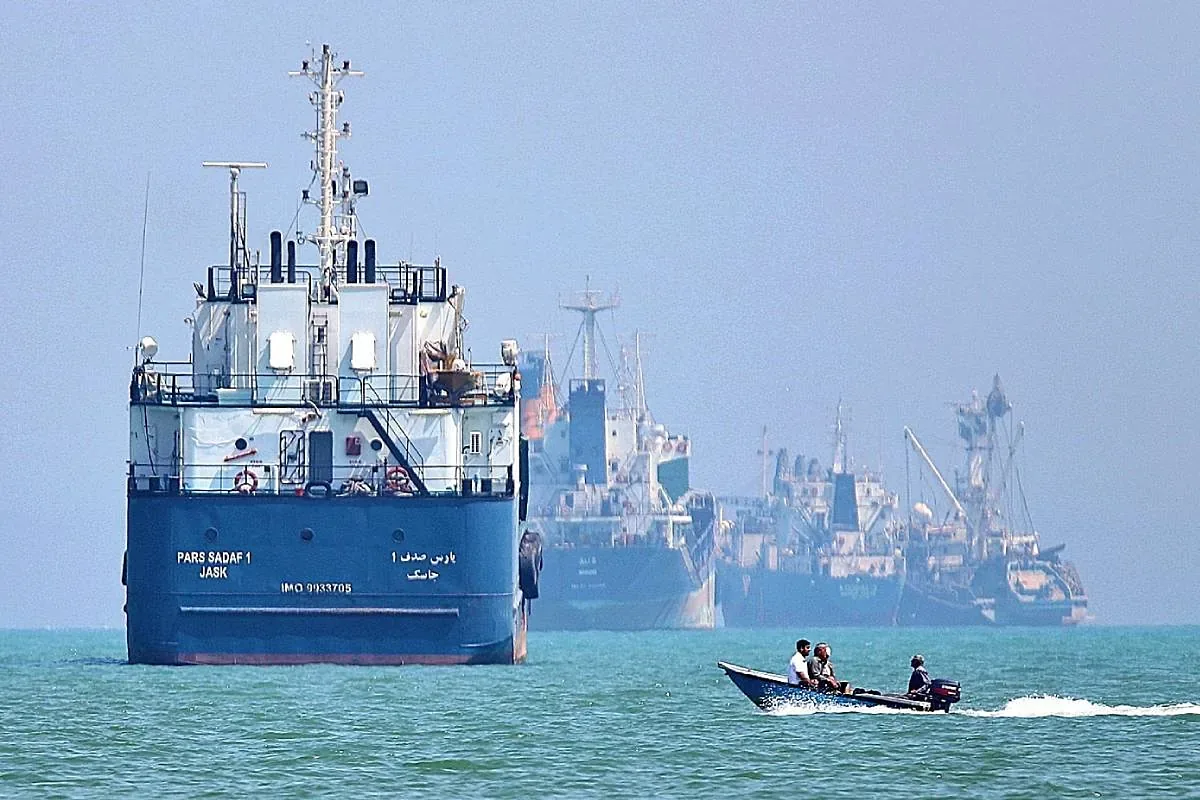
The statements by Qalibaf come after an especially violent weekend in the Strait of Hormuz, in which US forces attacked three Iranian oil tankers, including one off Jark Island, the nerve center of the country’s crude oil export. Washington claimed the offensive was in response to ongoing attacks by the Revolutionary Guard – the regime’s elite force – against ships transiting the strait’s waters, which have been blocked for months by the US and Iran. US Secretary of War, Pete Hegseth, warned on his social media that if Iran continues to attack vessels in the area, his country will destroy and sink their oil tankers. “It’s simple: the (US) oil and gas production chain is extensive, accessible, and vulnerable. US oil and gas companies in these waters share that vulnerability,” warned Qalibaf.
The ongoing clashes continue to affect maritime traffic in Hormuz, with about 10 cargo ships transiting these waters daily, the lowest number since May, according to a report by Kpler, a company that monitors maritime traffic. Several investigations indicate that in recent weeks, the US has managed to maintain the security of a maritime corridor in the southern strait, through which dozens of vessels have crossed without problems. After a pause in military actions during much of August, military clashes have resumed following the failure of the provisional ceasefire agreement reached in June, after which hardly any progress has been made on any of the war’s obstacles.
In this standoff over Hormuz, the Iranian security chief, Mohsen Rezaei, announced in a televised interview a new plan to expand the maritime area blocked by the regime. This new “restricted zone,” in Rezaei’s words, covers the entire Persian Gulf and will extend beyond the Strait of Hormuz, and any vessel entering the area could be subject to “interceptions, confiscations, or selective attacks.” Rezaei also claimed that his country has tested a “special missile” against US forces that “created hell for the US,” without providing further details.
Instability in Hormuz has forced oil-producing countries to seek alternatives for their exports. Iraq is transporting more than 100,000 barrels daily by road to Syria for subsequent shipment to the Mediterranean. The United Arab Emirates plans to double its pipeline capacity to Oman next year, while Saudi Arabia continues channeling much of its production through the Red Sea.
Read more Less alcohol, less cooking, and TikTok decides what we buy: this is how consumption has changed
The Iranian strategy seems to move in two simultaneous directions, according to experts like Mohammad Ali Shabani, editor-in-chief of the Arab media Amwaj. On one hand, Tehran keeps the diplomatic channel open and assures that negotiations remain its priority, as long as the terms agreed in the Memorandum of Understanding signed in June are maintained. Proof of this is the Qatari delegation that visited Tehran over the weekend, as part of regional efforts to achieve a de-escalation of the conflict. The regime is also in talks with Oman to establish a safe maritime corridor in the Strait of Hormuz, which will help recover traffic on this maritime route, although under a reality that did not exist before the war, under the tutelage of Tehran and Muscat.
At the same time, the regime is increasing pressure, showing its willingness to escalate reprisals at any moment. Security chief Rezaei said he had identified specific targets in Jordan and Erbil, but deliberately avoided attacking them, although he warned about the costs for neighboring countries of relying on US protection both for their security and for transit through the strait.
However, some voices are beginning to emerge in Iran opposing this indefinite escalation, especially now that Washington intends to economically strangle Tehran. The moderate former president, Hasan Rouhani, who governed between 2013 and 2021, has warned about the confusion between “resistance” and “endless war.” Rouhani has suggested holding a referendum to decide whether Iran should continue hostilities, questioning whether the Iranian people are truly willing to maintain a conflict indefinitely, in what seems to be an attempt to open an internal debate about the direction the country’s foreign policy is taking.
Read more The Sultan’s Word