









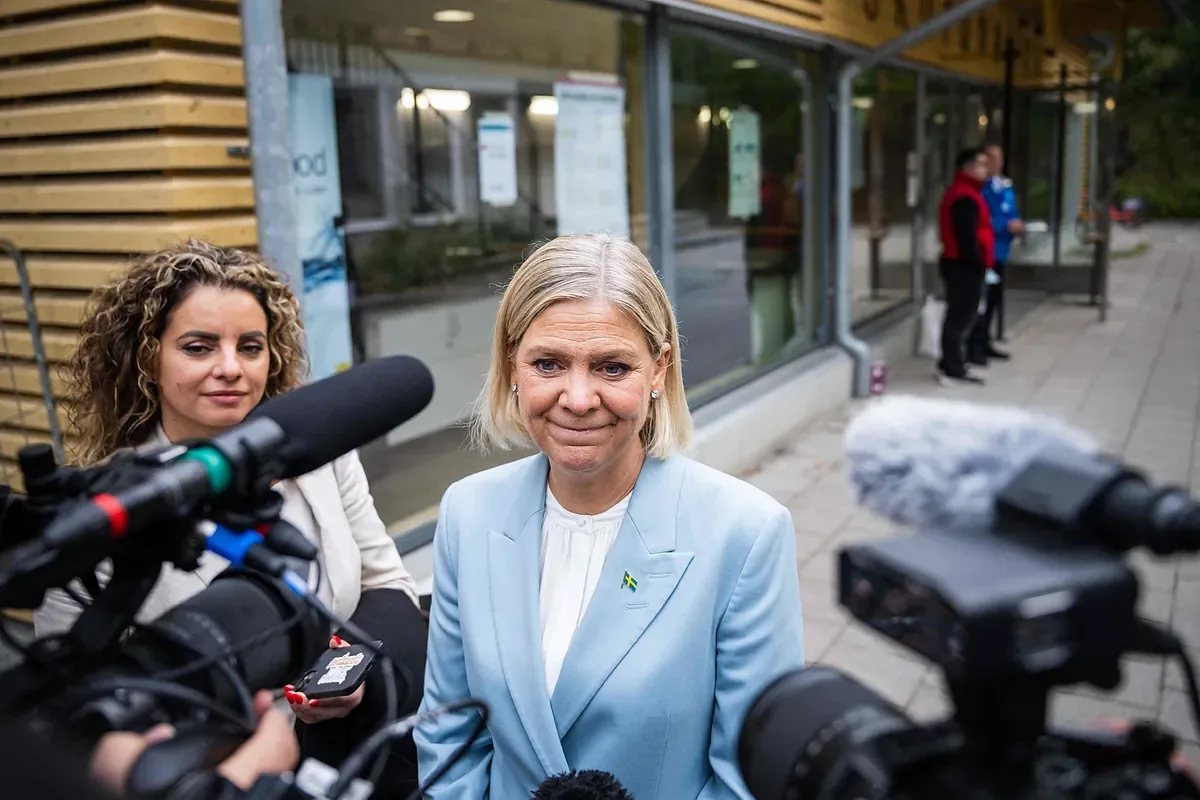
The rise of the far right is irreversible, but not the measures it leaves behind after its time in government. That is the lesson from the general elections in Sweden, where polls predicted on Sunday night that the Social Democrats will return to power after four years of conservative government supported by anti-immigration extremists whose program has even been imitated by part of the left.
Read more Alexander Zverev — Ben Shelton, the US Open final live
Sweden’s center-left opposition parties would collectively obtain 51.3% of the votes in the parliamentary elections, compared to 46.8% for the ruling right-wing bloc, according to the exit poll conducted by the public broadcaster SVT. This 4.5-point difference was influenced by the decline of the far-right Sweden Democrats, who dropped three points to 17.2%. The biggest increase went to the Greens, while the Liberals avoided disappearance by surpassing the 4% threshold with 5.5%: their parliamentary presence keeps the four parties of the conservative bloc alive, although the bloc appeared defeated in the poll, allowing the Social Democrats to return to power with these results. SVT’s forecast currently gives the opposition a one-seat advantage, which is incredibly close.
After getting many parties, including the left-wing coalition, to copy part of their restrictive program regarding the arrival of foreigners, the surprise of the night was that the extremist Sweden Democrats, a far-right party, would retreat for the first time since entering Parliament in 2010 and cease to be Sweden’s second-largest party. A dose of humility at a time when the far right is boasting in Europe.
The Social Democratic candidate, Magdalena Andersson, celebrated the victory as night fell, although she will now have to turn four parties into an operational majority. The Social Democrats would be joined by the Greens, the Liberal Centre, and the Left Party, with communist roots. There are deep differences among them on taxes and energy. The shared rejection of the far right offers a meeting point, but the common program remains pending negotiation: the Left demands ministries, and the fit with the more centrist parties is still unresolved. Over these years, even the Social Democratic Party has shifted toward tougher positions on immigration and security. Andersson advocates maintaining a restrictive migration policy and strengthening police efforts against criminal networks, although she rejects expulsions of young people who have grown up and integrated their lives in Sweden upon reaching adulthood. On crime, she combines harsher penalties and more resources for the police with investment in schools, social services, and prevention of youth recruitment by gangs.
Swedish Prime Minister Ulf Kristersson, who has governed for four years with the support of the Sweden Democrats, had indicated he would formally include the ultras in the government if his bloc won the general elections this Sunday, thus breaking an old taboo among Swedish parties. Kristersson lagged behind in the polls during the campaign despite improvements in the economy and his successes in public security. Many Swedes have expressed their mistrust of Kristersson’s insistence on imposing strict limits on immigration and considered his pre-election promise to bring the Sweden Democrats into government as going too far.
The Sweden Democrats have managed to spread their radical recipes to the rest of the parliamentary spectrum, despite acknowledging that their party was partly founded by neo-Nazis and white supremacists in the 1980s. Having become a force that mixes moderate economic proposals and even more ambitious ones than the rest in some areas of social protection, they claim to have eliminated the ultras from their ranks and have apologized for their past.
Before the polls closed, while people were voting, in the suburb of Spånga, with a strong immigrant presence, Frida tied her bicycle next to the commuter train station connecting to central Stockholm: “For me, these are important elections because many of my neighbors could lose their rights.” Mikael, who came from the north of the country, was optimistic: “Immigration has taken a back seat, now people vote thinking about the economy, and there things won’t change much.”
“The old image of Sweden as a Social Democratic country governed almost naturally by the Social Democrats belongs to the past. The party has been able to lead governments, but has always needed coalitions or agreements with other formations, and that dependence has forced its policies to be less clearly social democratic and has transformed the entire political system,” says Jonas Hinnfors, emeritus professor of Political Science at the University of Gothenburg.
Read more Alonso and Sainz, battle on and off the track: “He pushed me against the wall”