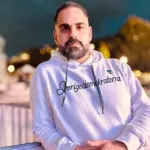







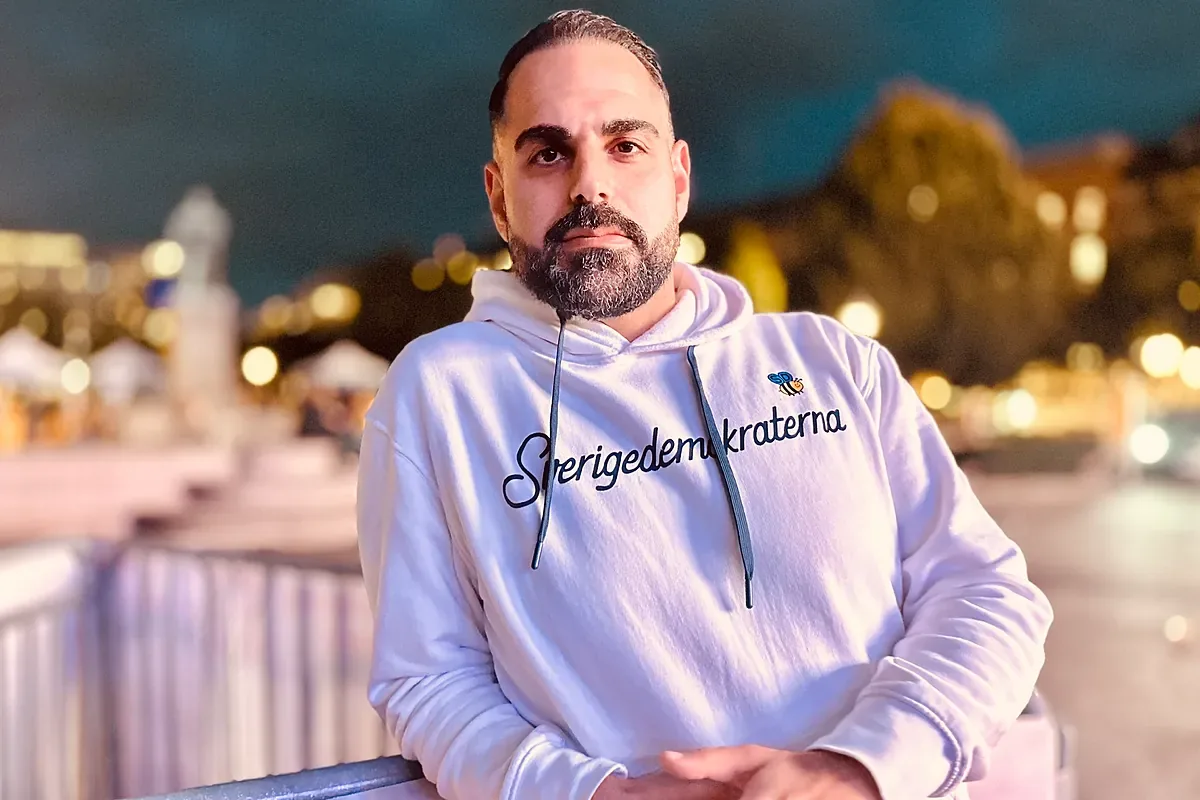
Son of Armenians born in Iran, Arin Karapet (Stockholm, 1988) defends from the ranks of Sweden Democrats, the far-right party that has supported the conservative government for these four years, a minimal migration policy. His biography might seem like an objection to the party’s discourse, but he uses it as an argument: the problem, he argues, lies in the volume of arrivals and in an integration model that demands too little from those who settle in the country. Karapet is a deputy and representative of a force that already considers its status as the second party in Sweden insufficient.
Read more The Swedish center-left opposition would win the general elections, according to exit polls
The possibility of entering the government, raised during the campaign, is part of a broader ambition. “Sweden Democrats is the second largest party in the country and our goal is to be the first. I trust that we will be the leading force in 2030. We want to make Sweden Sweden again and minimize the number of asylum seekers,” he explained minutes after the campaign closure on Saturday in central Stockholm, amid Viking rock performances and a show in which even their candidate Jimmie Åkesson played the keyboard to energize the audience.
The 2026 electoral program carries that idea of the country into all areas. In immigration, Sweden Democrats promises to maintain the lowest possible asylum level, restrict the arrival of foreign workers, condition benefits, and promote voluntary return.
As with the rest of his party colleagues, immigration is at the center of his concerns. Karapet describes a country transformed over the last decades and uses the word “ghetto”, common in Swedish political debate, to talk about neighborhoods where poverty, unemployment, and families of foreign origin concentrate: “Sweden has experimented with mass immigration for 30 or 40 years. I myself am the son of immigrants, but nowadays you find what in Swedish terms we would call a ghetto in practically every small city. When I was little, there were maybe three or four in the whole country. Now we want to reduce migration numbers, act tough against crime, and recover the economy.”
Therefore, in the security chapter, his party demands more police, longer sentences, extended detention for offenders considered dangerous, and the expulsion of all foreigners convicted of serious crimes. Their integration policy includes tougher requirements to obtain nationality, the withdrawal of citizenship from people born outside Sweden who commit certain crimes, the elimination of public education in mother tongues, and restrictions on the use of interpreters paid by the state.
A FAMILY STORY
The year 2015 is, for Karapet, the moment when the system reached its limit. Sweden then received one of the highest proportions of asylum seekers in Europe. Karapet points to that crisis as the origin of much of the current tensions: “In 2015 we received around 10,000 immigrants each week and now we are paying the price, and the vision of building a multicultural system also does not work, because a person becomes Swedish when they learn the language, pay their taxes, and respect Swedish culture. They can keep their own beliefs, but those beliefs must respect Swedish legislation.”
Read more Alexander Zverev — Ben Shelton, the US Open final live
His own family represents, in his view, the opposite path of his country’s recent course. His father came to Sweden to study. And his mother worked for a Swedish company. Both met in the Nordic country and built a family there. Karapet recalls a childhood with few resources, a mother demanding with his studies, and a welfare state that allowed him to progress. His parents’ odyssey contrasts with what he now sees from his seat: “My parents are Armenians born in Iran. My father came as a student and my mother worked for a Swedish company. They met here. They arrived with a goal and a plan about what the next step would be.” The rest is a story of hard work and meritocracy, because both “quickly learned the language, took care of me, and my mother was very strict with my studies.”
The family’s economic situation was far from comfortable. Karapet recalls that Sweden compensated for that precariousness through public services capable of providing education, healthcare, and opportunities regardless of the neighborhood or the parents’ income: “Our economic situation was not the best, but Sweden offers opportunities that other European countries do not provide… because here, regardless of where you live, the welfare state offers you healthcare, free dental care up to a certain age, and free education. We even grant aid to students so they can continue in school and university.”
In his speech, Karapet separates ethnic origin from national identity. A person’s appearance or surname matters less to him than their willingness to assume the country’s rules and customs. “Appearance, skin color, or surname do not matter. Anyone can become Swedish, but they have to adopt Swedish culture,” he argues. His idea of integration leaves room for family origins, although it demands a common public culture: “They have to learn the language, pay their taxes, and respect the laws. That is the model we defend.”
Karapet identifies Islamism and the aspirations to impose ‘sharia’ as one of the obstacles to integration, although he expressly distinguishes between that current and the whole of Muslims, because he is aware that “there is a current within a considerable minority of Muslims that wants sharia.” “I speak of a minority, not all Muslims”, he adds. To explain it, he again resorts to his personal experience and the Swedish secular tradition: “A secular Muslim person does not represent any problem for us. I am a secular Christian and I would not want someone talking to me about Jesus Christ 24 hours a day either.”
His conclusion, after an intense campaign in which immigration has been a card for almost all parties, combines secularism, cultural assimilation, and state authority. “In Sweden, religion belongs to the private sphere and the state is separated from it,” he argues. So religion can be preserved as part of individual life, as long as it remains outside institutions and subordinate to the law, because “each person can have their beliefs, but those beliefs must respect Swedish legislation, because to live together we need common rules.”