



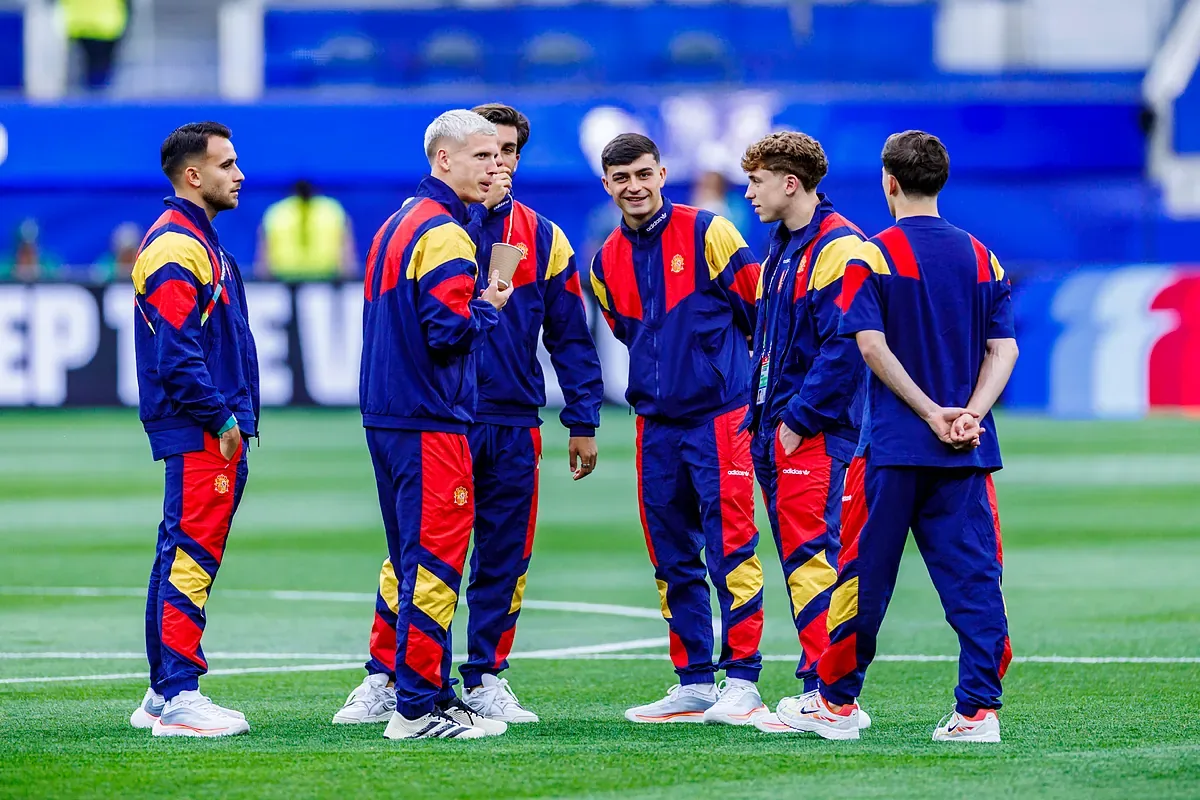
It has been 16 years since Spain lifted the World Cup in South Africa, after a poor start, with a team that went down in history for its tiki taka and which, at first glance, might seem to have little in common with the one that will fight tomorrow against Argentina for the second star. Football and Spanish society have changed in this decade and a half, accentuating the differences between the two teams, although similarities appear to confirm that the model that triumphed then remains valid.
If the Spain of Vicente Del Bosque reached the final without the historical burden of deep disappointments raised by the 2008 Euro Cup, the first title in more than 40 years, the one of Luis de la Fuente does so having achieved another 12 years later, with a more vertical style of football than that one and an irreverent generation.
The feeling is that this team led by the Generation Z is more precocious than that one, but the average age indicates there is only a one-year difference. If in 2010 the players called up by Del Bosque were 27.7 years old, those who will fight for the second star are 26.7. That feeling is caused by one player: Lamine Yamal. He is the big difference.
While 16 years ago there was no player under 20 in the squad – the youngest were Sergio Busquets and Javi Martínez, both 21 – now there are two who have barely passed the age of majority, Pau Cubarsí and Lamine. The one from Rocafonda has taken on a role that no one had back then.
Yamal is the star of a Spain that, without ceasing to be a collective, has him as its flag. He is the idol who draws ovations in every stadium and the advertising image that appears in every city, from Times Square to Kansas City, rubbing shoulders with icons like Messi, Mbappé, or Vinicius. That pole of attraction was not present in Del Bosque’s Spain, despite which, as continental champion, it was among the favorites. In 2026, the team has been, from the start, a strong candidate in all predictions.
Two years ago in Germany, a diverse, multiethnic, and even religious Spain was born, but with football origins that link it to the world champion. The epicenter is La Masía, Barça’s youth academy. In 2010, nine players were called by Del Bosque and all except Cesc (Arsenal) and Pepe Reina (Villarreal) still wore the blaugrana jersey. Today there are eight, although only six remain under Hansi Flick’s orders. Barça thus shows that it continues to be a great vacuum for all national talent, with players recruited from all the academies in the country, with Pedri or Gavi as standard-bearers as Andrés Iniesta once was.
No Real Madrid players
Real Madrid has lost much more presence. Sixteen years ago, Casillas, Sergio Ramos, and Xabi Alonso, as well as Arbeloa and Albiol, went to the World Cup as white players. This time, none were in the squad, although they signed Cucurella after the tournament started. Their academy also has no relevance: Marcos Llorente and Víctor Muñoz passed through La Fábrica.
There are still Canary Islands players, with Pedri and Yéremy Pino taking over from Silva and Pedro; youth players from Osasuna, Valencia, or Villarreal, and more Basques now than then. Xabi Alonso was the only one in 2010 and now there are Oyarzabal, Unai Simón, and Zubimendi. Andalusia remains with three: from Ramos, Navas, and Marchena, all trained at Sevilla, to Baena, Fabián, and Gavi who, curiously, are from the same town. While the PSG player was trained at Betis, Gavi left for Barcelona at 13 and Baena to Villarreal.
The great academies of historic First Division clubs still predominate. In 2010 only Villa was champion without going through the youth ranks of the big national clubs and this time it could be Porro, trained at Rayo Vallecano, or Marc Pubill, who had a brief stint with Espanyol’s youth to go from Manresa as a youth to Levante. A special mention deserves the case of David Raya, who left very young to Blackburn from Cornellá,
What makes today’s Spain more different is that those who will step onto the MetLife in New Jersey tomorrow have less finals experience. If then up to eight of the eleven players Del Bosque fielded in the final had won the Champions League at least once – with Real Madrid, Barça, and Rafa Benítez’s Liverpool – of those De la Fuente will start against Argentina only three have lifted the European Cup: Rodrigo Hernández and Aymeric Laporte, with Manchester City, and Fabián Ruiz, twice consecutively with PSG.
That said, in that Spain there was no Ballon d’Or, no matter how much it was demanded, and now De la Fuente can boast of having Rodrigo in 2024 and Lamine aiming for the coming years.
Read more From Connecticut to New York, Captain Rodri’s obsession: «He’s had that on his mind all year»