





The President of the Government, Pedro Sánchez, has denied having knowledge of the activity of the so-called PSOE sewers, promoted by his former lieutenant in the PSOE, Santos Cerdán, and which are being investigated by the Audiencia Nacional. “I never endorsed, nor did I ever have information or knowledge of something I would never have tolerated,” he said.
Read more The sewer list against the judges: Lesmes, Marchena or Llarena’s wife
The head of the Executive maintains confidence in the director of the Civil Guard, Mercedes González, who is a very close person to him, from his circle, despite the fact that it has been confirmed that the Executive lied by denying the meetings it did hold with Díez.
The report by the Central Operative Unit (UCO) of the Civil Guard included in the summary being investigated by the Audiencia Nacional judge Santiago Pedraz concludes that the PSOE’s sewer was “directed” by the party’s former Organization Secretary -Santos Cerdán- and by activist Leire Díez. “The former at a higher level,” the investigators specify, “and the latter, at an executive level, with other people having joined depending on the group’s needs.”
“All of them,” the UCO adds, “acted jointly” and “developed this activity in a coordinated manner, maintaining a unity of action and direction” with the aim of “protecting the interests at stake” that affected “certain members of the Government or its president.”
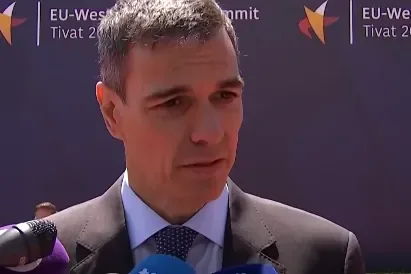
Sánchez wanted to stop before journalists upon his arrival in Tivat (Montenegro) to participate in the EU-Western Balkans Summit to send a message of distance and ignorance about this alleged plot. It is the first time he has spoken after becoming aware of the summary. A few days ago, the UCO’s entry into Ferraz caught him in Rome, in the middle of a meeting with the Pope to prepare his trip to Spain. Despite Cerdán’s involvement, that Díez had contacts with Cristina Narbona, president of the PSOE, and that it is now known that the plumber held meetings with Mercedes González, director of the Civil Guard, he denies having had any type of information or knowledge.
“I have never known nor have I ever been informed about the doings of Ms. Leire Díez, and if it hasn’t been done, it’s because I would never have tolerated it,” stated the President of the Government before opening the floor to press questions. He wanted to send and was looking for that message of distance and ignorance. “May citizens have no doubt about it.”
In the report prepared by the UCO, there are various allusions to the one, which the Civil Guard infers could refer to Sánchez. Díez specified to her interlocutors that this line of investigation linked to the fuel plot was very important for Santos Cerdán “by order of the one.” At another point, she writes this message: “Yesterday the one told S,” referring to Santos Cerdán, “to tell me that I am doing a great job and not to get discouraged.”
Sánchez has distanced himself and disassociated himself from these allusions. “Absolutely not,” he replied when asked if he gave any order or instruction to the members of the alleged plot. “The judge’s order must be respected. I am not going to enter into any assessment that the UCO may make. We must let Justice work. I never endorsed, nor did I ever have information or knowledge of something I would never have tolerated,” he repeated.
Regarding the objections and criticisms that despite what is known and the PSOE’s censure of Díez’s actions, the party has not taken any legal action against her, the President of the Government argues that his party’s legal services are analyzing all the information and documentation and that they will later decide the “next steps,” but he has not specified which ones. He does confess to feeling “outraged,” “disappointed,” and “concerned” by everything that has come to light. “My government is a clean government, my party is an integral party, and of course, the corruption is from a few.”
Sánchez maintains, at least for now, confidence in the director of the Civil Guard, Mercedes González. She and Marlaska have been called into question after being forced to admit that González met with Díez, something they had denied. The minister did so on repeated occasions. The head of the Benemérita was forced to admit it in an off-hours statement. She is a very close and trusted person to Sánchez for many years. “From the Government and from Interior , confidence in the professionalism and honesty of the director has been expressed, and therefore, I can only support those statements and convey that trust and support to the director, who is doing a very positive job.”
Marlaska, in the midst of the storm, also publicly maintained “confidence” in González this Friday, but introduced nuances, in the sense that he speaks from what he knows. A fact that increases the pressure and uncertainty about the continuity or not of the director of the Civil Guard. “As long as those meetings have been in the described form, and I have no reason to deny it, because I have no reason to doubt… Another question is whether that did not obey the reality or the truth of that statement.”
Marlaska leaves open the possibility that if there are new developments or the version changes regarding what is currently known, the opinion on González’s “honesty” and “professionalism,” and his defense of her, may vary. “I have no element that makes me glimpse that this is not true and that at no time has there been any relationship in her meetings with the facts object of that plot, which I repeat is truly of manifest seriousness.”


