




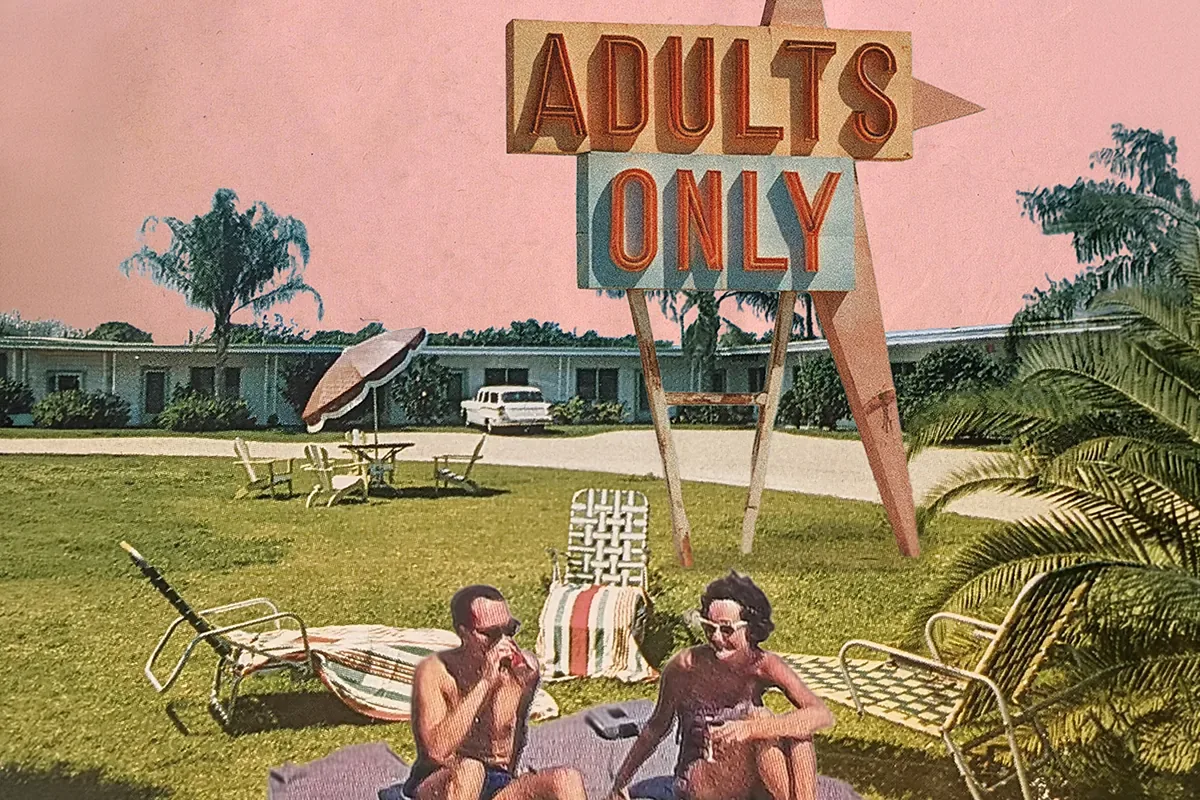
Esteban was surprised when he opened the long, cream-colored envelope. The last line of the invitation specifically detailed: «It will be an adults-only event». This meant he wouldn’t be able to enjoy that wedding in Madrid with his little ones. The moment he realized it, his joy was somewhat diminished. And tears appeared: those of the eldest child upon learning of his exclusion from the party.
Like him, many parents are concerned about how the adults only trend is expanding imperceptibly but unstoppably from the world of leisure (hotels, restaurants, bars, swimming pools, cruises…) to other spaces and services, such as train or plane travel. And even, much to Esteban’s chagrin – who is not actually called that – to the intimate sphere of family celebrations.
«In less than 10 years we will have child-free days in amusement parks», jokes (or not) Albert Vinyals, professor of Consumer Psychology at the Universitat Autònoma de Barcelona.
Why does it suddenly seem that children cause allergies, like cypresses or gluten? What interests lie behind the invisibilization of a part of the citizenry that still has no decision-making power, expresses itself with difficulty, and is alien to electoral processes? Can a country with a critical replacement rate, where there is no surplus of children, afford a child apartheid?
«Absolutely not», summarizes Alejandro Macarrón, director of the Demographic Renaissance Foundation. «More and more people see children only as a nuisance, who do not observe them with empathy. A society that values them so little is digging its own grave».
In Vinyals’ opinion, this segregationist phenomenon is explained by the confluence of two factors: the transition from a communal society model to a more individualistic one, and the obsession with immediate and limitless gratification. «A large part of our consumption decisions is based on the search for spaces of security and control. Adults only establishments would bea refuge from the unpredictable and the uncomfortable, while children would represent chaos, an interference that prevents enjoying the absolute hedonism offered by these establishments. Without children of one’s own or others, they are seen as the perfect vacation,» summarizes a professor who in his classes draws on Ulrich Beck’s essay Risk Society (Ed. Siglo XXI, 2006) as much as on the most enjoyable reels. «Places where you go with children are not the most Instagrammable,» Vinyals concludes.
Towards a child-free world: why there are more dogs than children in Spain
- Writing: RODRIGO TERRASA Madrid
- Writing: ILLUSTRATIONS: JOSETXU L. PIÑEIRO
The housing drama for broken families: “The breakup of a couple entails a distribution of miseries”
- Writing: JOSÉ MARÍA ROBLES Madrid
Summer vacations are an excellent testing ground, as the replacement of the school routine with all kinds of alternative plans allows mothers and fathers to check firsthand if we live on an adult-centric planet… or directly child-phobic. Last Thursday, at the season finale of La revuelta (TVE), actress Candela Peña took advantage of her presence on the show to thank her mother for preventing something that has been normalized for a while: domestic child exclusion. «She never sat me at the children’s table. She let me give my opinion, even if it was crap,» the actress confessed.
Delving into scatology, Peña called adults only hotels «fucking shit» and sent a message to parents like her: «Don’t be turds to the kids. Today’s adult is the wounded child you once were».
Sociologist Iván Rodríguez, who teaches at the University of Huelva, sees implications that go far beyond those related to the diversification of tourist offerings. «Unfortunately, what is driving this change is that children have become a very minority demographic group that many no longer easily tolerate. As we also have a society that tends to enclose itself in echo chambers where we avoid encountering people who differ from our tastes or life choices, all the elements appear for people to see a business niche in this. A booming business made possible by the fact that the moment to have children is increasingly delayed, so that we are not aware of their needs, or else a life as a couple without them is directly planned, and then it seems that other people’s children bother us,» argues the person who is also a member of the research committee on Childhood in the Spanish Federation of Sociology.
«The dangerous thing is that this trend is jumping from what may be more or less anecdotal – hotels, restaurants, etc. – to what should constitute a basic right. For example, housing. Many are already not rented to families with children,» Rodríguez warns about landlords who prefer not to have to repaint walls or refinish parquet floors more often than usual.
- What message does a society send that bans children from hotels and restaurants and is now starting to do so from housing and weddings?
- One of intolerance, clearly. It seems that what is normal for a child because it is part of their development – laughing or crying, struggling to sit at a table for two hours, or needing to run down a hallway – is no longer tolerable for adults. The difference is that this message implicitly carries the idea that with children, one can do what one would not dare to do with adults: total exclusion, which is nothing more than another form of discrimination. Can you imagine a hotel exclusively for men who think women talk too much? Or a supermarket only for young people because someone thinks the elderly are slower when shopping? It’s done with children because we don’t see them as people: for many, they are closer to being considered objects… or pets.
- Ugh.
- The wedding situation is even worse: here, discrimination against children isn’t even the basis of a business. It’s practiced by friends or family who either don’t want to put up with other people’s children or think it benefits them. I wonder what would happen if, when giving a monetary gift to the newlyweds at a child-free wedding, guests warned them that they had deducted the cost of paying whoever took care of their children during those hours.
The matter, as can be seen, is much more thorny than hiring a babysitter for an afternoon or including chicken nuggets in a wedding banquet. To understand how we got here, we have to travel to Jamaica. In April 1981, local businessman Butch Stewart, who until then had been dedicated to selling home appliances and air conditioners, bought two abandoned hotels in Montego Bay, in the northwest of the island. He decided to renovate one of them and turn it into accommodation exclusively for heterosexual couples. To do this, he designed romantic experiences within the facilities, filled the menu with gourmet dishes, and offered an open bar with premium drinks.
Thus, the adults only concept was officially born.

Four and a half decades later, thousands of hotels worldwide are geared towards this market segment. The visionary Stewart, the same man who soon after came up with the idea of building the first swim-up bar in the entire Caribbean, became a millionaire with the Sandals Resorts chain and encouraged others to follow his philosophy.
A Hosteltur report revealed in 2018 that Spain was the third world power in the adults-only niche, behind Japan and Brazil. Although the Spanish Confederation of Hotels and Tourist Accommodations (CEHAT) does not have a centralized registry, it is estimated that there are between 150 and 250 establishments with these characteristics in our country. They account for 5% of the total and are located mainly on the coasts and the two archipelagos. The Ostelea business school has confirmed that in the Balearic Islands alone, 100 complexes reserved for adults have been built. Or, in other words, not recommended for minors, since Article 14 of the Constitution states that «Spaniards are equal before the law, and no discrimination whatsoever may prevail by reason of birth, race, sex, religion, opinion or any other personal or social condition or circumstance».
«There isn’t an increase in adults-only hotels. What we see is that they are specializing more and more. Especially by season. A hotel caters to families during certain months, just as others cater to fair and congress participants or athletes», clarifies Ramón Estalella, secretary general of CEHAT. «Child-free weddings? I haven’t been to any. I love having the grandmother and the baby at weddings».
The specialization Estalella refers to is not made visible with a sign of a pacifier under a red ‘X’ at the reception desk. It is usually presented to the guest in the form of a subtle deterrent description. Whoever reads «atmosphere of exclusivity and tranquility» infers that this hotel does not have inflatable mattresses and swings, but rather a spa and jacuzzi. Just as it is deduced that a restaurant proudly promoting its wine tastings is not the most suitable for an infinite progeny like that of the series Los Serrano to dine. The conflict regarding children arises when imposition displaces freedom of choice.
In early 2023, content creator Verdeliss denounced on her social media the discrimination against a mother with four children who had been prohibited from traveling in an AVE silent car. You know, the one that doesn’t allow loud conversations or music without headphones and where executives and office workers usually travel with their laptops.
Estefanía Unzu, the influencer‘s real name, also a mother of a large family, recounted that she once boarded a silent car with one of her babies and the conductor forced her to leave, even though the little one was sleeping peacefully. She then argued that a child does not make more noise than an adult using electronic devices. And she criticized the «lack of humanity» and unfair restrictions suffered by families with small children in public spaces.
What’s happening with trains in Spain is already being seen on planes outside our country. In November 2023, just a few months after Verdeliss’s outburst, the Dutch-Turkish airline Corendon Airlines made history by being the first in Europe to operate with parameters similar to those of adults-only hospitality and catering. Founded by businessman Atilay Uslu, owner of a hotel chain oriented towards DINKY couples [an English acronym referring to couples with a comfortable financial situation and no offspring], the company turned the 10-hour flight between Amsterdam and Curaçao into a pilot test. How? By allowing passengers to pay between 45 and 100 euros extra to sit in the front section of the plane, isolated from the rest of the aircraft and reserved for those over 16 years old.
Three years later, the route operates with these same attractions, and Corendon plans to expand it to other destinations. At the antipodes of this commercial strategy was Mrs. Woo, a viral heroine in 2019. Aware that a transcontinental flight (Seoul-San Francisco) with a baby on board could be unbearable for a good part of the passengers, she distributed more than 200 gift bags to her fellow seatmates. It was an advance apology in case her child decided to cry loudly in a place from which there was no escape. In the little bags were candies and earplugs.

It is curious, paradoxically, to see how certain milestones are left in the rearview mirror as if they had never existed. The toy chain Imaginarium won the hearts of adults and children alike in the early 2000s simply by installing a horseshoe-shaped door at the entrance of its stores, sized for its best customers. And Sónar found it logical to create a space with creative activities aimed at the children of electronic music festival attendees. They called it Sónar Kids and it was a pioneer in the local circuit. In its first edition (2009), 5,300 people passed through it.
«We were seeing how children were participating more and more, in a very natural way, especially in the most interactive sections of the festival’s exhibition part,» explained Enric Palau, one of Sónar’s three founders, in a TED talk the year after the initiative was launched. «This, plus the fact that we personally have had children, part of our audience has grown older and also had them, and we have been having a lived experience with what we wanted to share with them, is what led us to think about an event format for children,» he added.
Today Imaginarium no longer exists (it closed in 2024), the three co-founders of Sónar disassociated themselves from the festival last year (they had sold their shares to a multinational in 2018), and the adults only trend blindly continues its path. However, with the opposition of some mothers in prime time. Like the aforementioned Candela Peña or Henar Álvarez. The comedian, also on TVE a few days ago, dedicated a monologue to the topic.
«We insist on pretending they don’t exist and not adapting the world to them», she attacked childphobia. «Restaurants you can’t enter with a stroller; metal slides, what do you do with those in summer, I ask you; squares where they can’t play ball; public places where you can’t breastfeed your child… And I say: ‘Excuse me, it’s a baby. If it were a 48-year-old man calling me mommy, I’d understand it’s not the place’… And then the ultimate absurdity is hotels where children can’t enter […] We would raise hell if the discrimination were based on gender, with other age groups, nationalities, skin color, body types… Look at the fuss over Bad Bunny’s little house! But because they are children… When I discuss this, people tell me: ‘But children are annoying, because they play, run, vomit…’. And I tell them: ‘Yes, and tourists too, and we roll out the red carpet for them’. And do you know the difference between children and tourists? Their presence doesn’t make your housing more expensive,» vented the host of ¡Al cielo con ella!
«We are not scandalized by the fact that there is no air conditioning in schools. The uproar there would be if it were an INEM office that lacked it», compares Professor Vinyals.
Thinking about what an (even more) insensitive world towards minors would be like does not require a great imaginative effort. The memory of the State of Alarm and the pandemic lockdown is relatively fresh, when the Government allowed dogs to go out before baby strollers. When public parks were cordoned off with warning tape, as if they were crime scenes, and families had to deal with the anxiety of their little ones at home.
«It was brutal. I had a three-year-old boy who was a whirlwind, and my wife was pregnant. Neither of us could go out. She kept pretending to go shopping because she needed to be able to walk,» Vinyals recalls. «I’ll tell you more: my group of friends is made up of super animal lovers. Well, the six or seven couples with children bought annual passes to the Barcelona zoo, which we would never have entered, because it was the only outdoor space where we could be with them».
Freedom in its most mocking sense is one of the arguments put forward by proponents of so-called childfree weddings. «At my wedding, I didn’t want children, and I found the hate hilarious», confessed Susana Molina (Susana Bicho), Big Brother winner and influencer. The Elpodcastdedruni account encouraged this week to take the criticism of Bicho’s decision «with humor and popcorn». «Organizing a personal event nowadays is facing a tribunal of outside opinions,» its creators justified. «When you break with a social tradition, people don’t get angry about your action, they get angry because you had the freedom to prioritize your desire over what others might say».
In a survey conducted by the wedding planning app Bridebook, 70% of participants stated that children should not attend these celebrations. The same survey indicates that child-free weddings are no longer seen as exceptional by millennials and Gen Z.
«It doesn’t surprise me because they are precisely the ones who have the fewest children. 40% of Spaniards of fertile age will not even have one,» demographer Macarrón bluntly states. «It makes perfect sense,» Vinyals analyzes. «These are the generations that have grown up with the logic of individualization and the death of rituals. The wedding has ceased to be a ritual and has become a product designed by a wedding planner, a high-end experiential event, a rich person’s whim that we introduce into our lives. And of course, you can miss out if you’re busy changing a diaper».