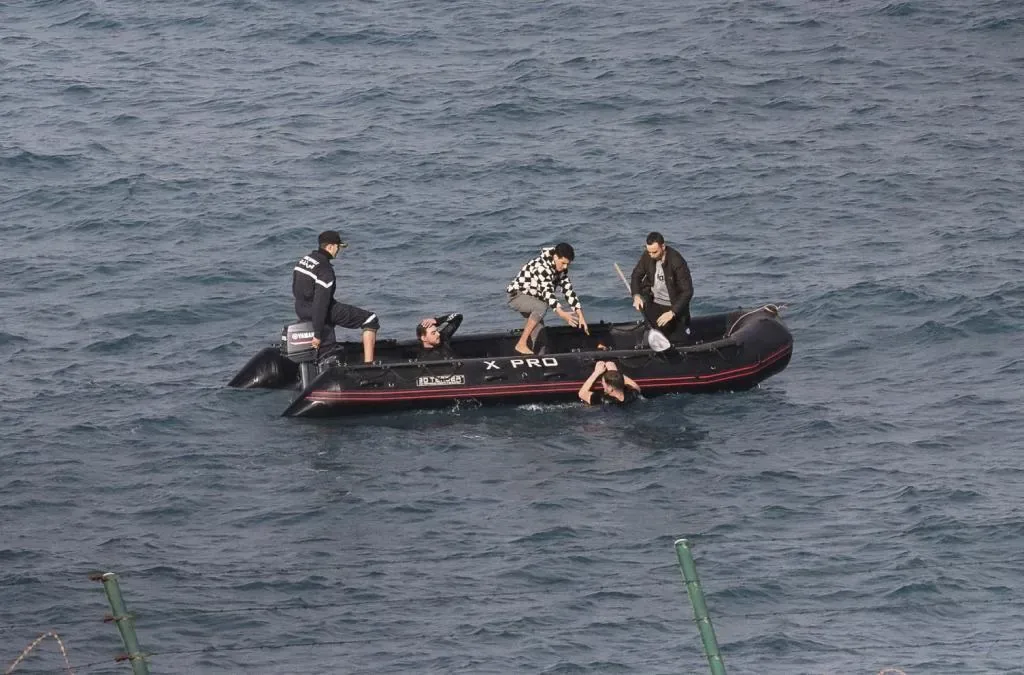







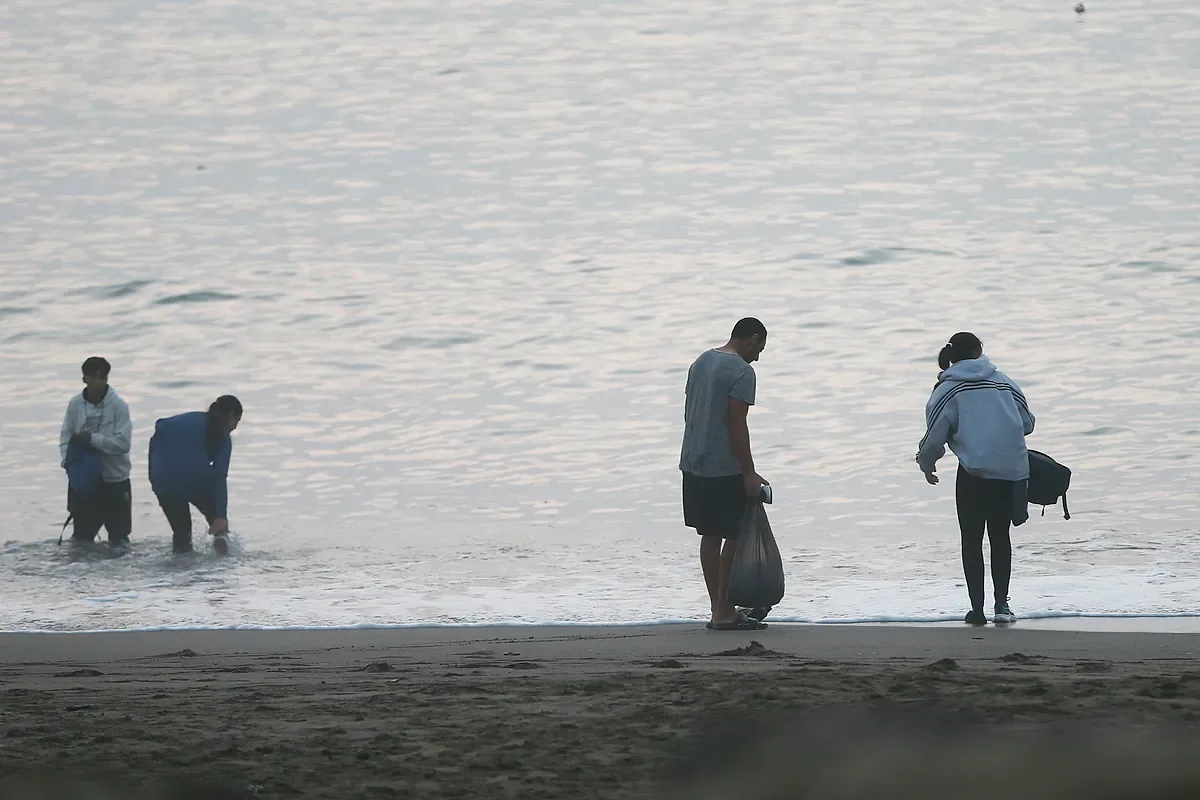
Those who live in Ceuta and are familiar with the migration phenomenon had sensed for days that this was going to happen. “But this time we caused it,” says an Army colonel on the ground, full of anger. According to him, after spending several mornings approaching the beach where they enter, “this Thursday there was only one Civil Guard patrol, and doing nothing,” he assures. He also explains that the migrants have a very organized modus operandi.
“They arrive wearing a wetsuit and take it off as soon as they touch land. Underneath, they have their mobile phone protected in a waterproof case,” he describes after seeing it himself over yesterday and today. According to him, the first thing migrants do upon arrival is turn on the device, start taking photos, and call others to come. “Come,” he explains they say, so that, immediately after, some pass it on to others and cause the ‘call effect’.
The police and Civil Guard unions warn of an “unsustainable” situation, in the words of Jupol. “The national police officers stationed in Ceuta continue working at the limit of their capacities, with an evident lack of personnel and material resources to face a situation of this magnitude,” the union states in a message published this Thursday on their social networks. From Jucil, the majority association of Civil Guards, they have also denounced “the lack of personnel and means”: “Why haven’t more human and material resources been deployed?”.
Both organizations demand from the Government “an immediate, firm, and forceful response to the very serious situation that Ceuta is experiencing,” in the words of Jupol. They request an “immediate reinforcement” of human and material resources. Government sources assure that the central Executive “is working with more resources, means, and personnel, which have been reinforced in the last week”.
For his part, David Gutiérrez, spokesperson for the Spanish Police Confederation, has reacted to this massive crossing of migrants by demanding “that the Government immediately activate all available resources of the National Police to stop the very serious assault that the Spanish border in Ceuta is suffering, where thousands of migrants are trying to enter our country illegally.” The national police officer has stated that they want “to help our colleagues” as well as calling for the immediate resignation of the Interior Minister, Fernando Grande-Marlaska, “for not heeding the reports that warned of this situation”.
According to EL MUNDO through the Spanish Troop and Navy Association, “several units in Ceuta have been put on alert in case they have to intervene in the mass events taking place.” According to the data collected, at least the Cavalry, Regulars, and the Legion units have been mobilized in case they need to assist the Civil Guard due to the lack of personnel.
Why the flood of arrivals?
The police and Civil Guard unions highlight various issues that may have triggered the flood of arrivals. “Morocco has taken advantage of a window of opportunity within its hybrid warfare strategy, using once again migratory pressure on Ceuta as a tool of political blackmail,” Jupol states in the message published on social networks.
The Unified Association of the Civil Guard (AUGC), for its part, attributes the massive arrival to a “call effect” derived from the recent Supreme Court ruling that prohibits rejection at the border—commonly known as hot returns—if the person has tried to enter Spain by swimming, as is happening now in Ceuta.
The Unified Police Union (SUP) has emphasized that this flood of arrivals occurs “days after the Supreme Court denied rejection at the border, complicating returns.” “We demand from the Government an immediate reinforcement of the National Police and Civil Guard staff at the border with Morocco,” adds the organization in a message on social networks.
The Government also refers to the Supreme Court ruling as the main cause of the flood of people who have already entered Ceuta and points to human trafficking networks as directly responsible. Likewise, Moroccan authorities are exempted from any kind of responsibility and, according to the Executive in a statement, “Grande-Marlaska thanks the efforts made in recent days by their security forces, which have prevented thousands of attempts of irregular migration”.
The Interior Minister has remained in permanent contact with his Moroccan counterpart, Abdelouafi Laftit, and, as a result, “both countries have agreed to strengthen coordination and efforts to address these flows and have committed to reviewing and implementing measures for the delivery, as soon as possible, of all persons who have entered Ceuta illegally”.
Humanitarian crisis
The flood of arrivals occurring in recent days also has a humanitarian aspect that keeps authorities and agents on alert. The Ceuta Medical Union warns that there are no means to meet the demand for intervention given the serious situation the autonomous city is going through.
The massive arrival of immigrants swimming in recent days adds to the serious structural deficiencies that the local health system has and which has further increased the healthcare pressure in the autonomous city, so the union has requested State intervention.
The union has pointed out that the situation could worsen with a hypothetical arrival of tens of thousands of people, which would be “completely unmanageable” for health, care, and emergency services that “are already at the limit of their capacity.” Ceuta doctors have recalled that each person who reaches the coast needs an immediate health assessment, in addition to many arriving with hypothermia, extreme exhaustion, traumatic injuries, or symptoms compatible with drowning.
At the same time, it has warned of the “collapse” of the Radiodiagnosis service, which must handle a high number of tests aimed at determining the age of immigrants through wrist X-rays and orthopantomographs, “diverting resources that should be destined for ordinary healthcare”.