









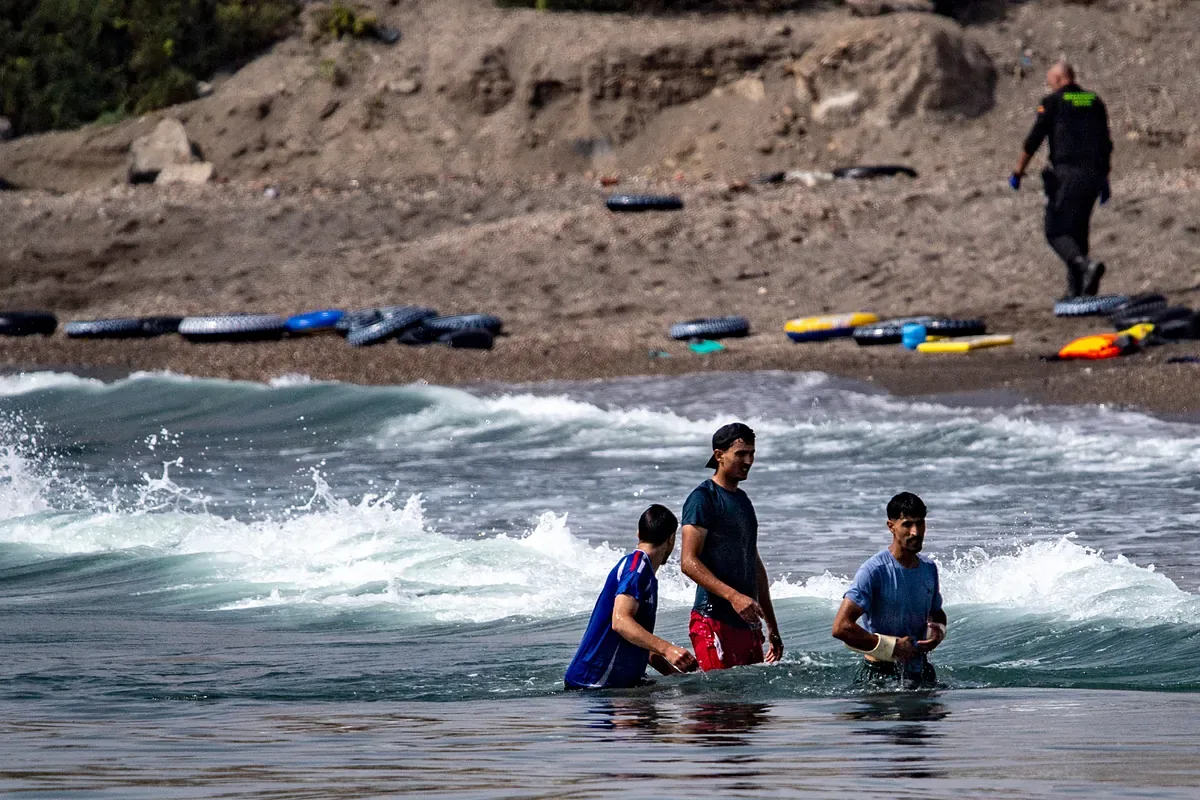
The Government exonerates Morocco from the avalanche of thousands of migrants taking place in Ceuta. In fact, the Ministry of the Interior highlights the “exemplary collaboration of Spain with Morocco in all areas, including migration matters.” The department led by Fernando Grande-Marlaska focuses on another circumstance: they consider that human trafficking networks are instrumentalizing a judicial ruling to promote the flow of undocumented migrants, mostly young people.
The Executive refers to the early July decision of the Supreme Court where it ratified that the law does not allow “hot returns” of migrants who try to enter Ceuta and Melilla by swimming. The Fifth Section of the Contentious-Administrative Chamber confirmed that the tenth additional provision of the Immigration Law does not allow applying border rejection to migrants intercepted at sea, who try to enter the cities of Ceuta and Melilla by swimming.
The court established this jurisprudential doctrine in a ruling examining the case of a migrant, of Algerian nationality, who appealed the administrative decision by which he was handed over to the Moroccan authorities after being intercepted at sea on November 14, 2024, when, along with two other people, he tried to enter Ceuta by swimming.
“The Government of Morocco is cooperating loyally and permanently with Spain and closely collaborating to address this situation,” government sources say. “The intervention of the Moroccan security forces is stopping the arrival of numerous people trying to access Ceuta from Moroccan territory.”
The Interior Ministry explains that our country and Morocco have agreed to strengthen coordination and efforts to face these flows and have committed to reviewing and implementing measures for the delivery, as soon as possible, of all people who have entered Ceuta illegally.
The Interior Minister has remained in permanent contact with his Moroccan counterpart, Abdelouafi Laftit. For his part, Pedro Sánchez has gotten in touch