








The narrow road leading to the gate of the Ceuta immigrant reception center is a hive of people coming and going, with no apparent destination. Many of them rest lying on the asphalt shoulder or lying on red blankets with Red Cross insignia. Others doze sheltered from the heavy sun of these days under makeshift tents made with sheets, cardboard, and tree branches.
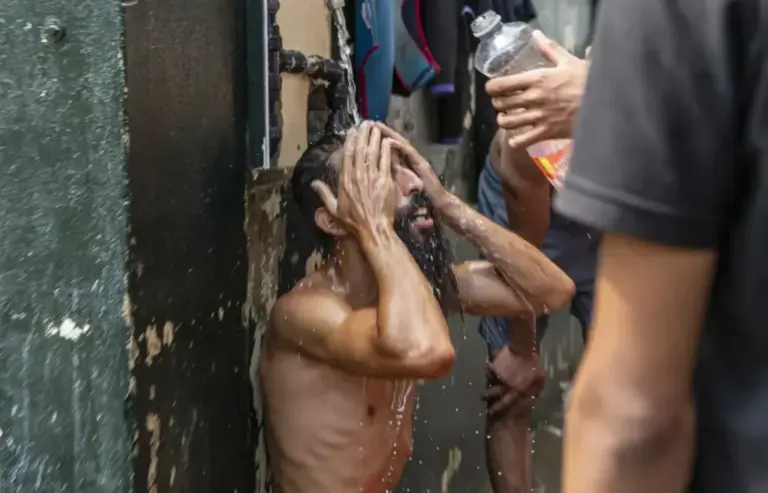
In front of the entrance to the compound, about thirty men wait in line to wash themselves kneeling under a faucet in the middle of the street. Mohamed, a 23-year-old Moroccan, says he entered Ceuta by swimming last Friday. He comes from Nador, the Moroccan city bordering Melilla, the other Spanish autonomous city located in North Africa.
Before throwing himself into the sea, he traveled by bus for 12 hours to Castillejos, the Moroccan town on the other side of the Ceuta fence. Mohamed is one of about 1,000 people who have been waiting for days to enter the overcrowded Temporary Stay Center for Immigrants (CETI) in this city.
“I left at three in the morning from Castillejos beach. At five, I arrived at Tarajal beach. I did it alone, swimming without fins, without a wetsuit, without a float. I almost froze. It was very, very cold,” says the newcomer in fluent Spanish because he has lived three years in Barcelona.
Fifteen days ago, Mohamed returned to Morocco to visit his family. But he wanted to return to Spain as soon as possible. Since he does not have his administrative status regularized in this country, he has re-entered irregularly through the maritime border of his country. “There is only poverty in Morocco. The reality there is very bad. There is a lot of hunger,” he assures.
–Did you see many people waiting to cross, as you did?– asks the reporter.
–I can’t tell you how many, but there are people from all parts of Morocco. Casablanca, Nador, Rabat. 2,000, 3,000 people… I would say more than 3,000 people are waiting on the beaches of Morocco to swim across.
–Is there currently a police presence in the area?
–There are gendarmes from my country with dogs, with batons, on the beach and nearby. But there are too many people; it’s not possible to control everyone. They are kids, youngsters who group together very quickly. Some don’t even know how to swim.
Ceuta is experiencing a migration crisis increasingly reminiscent of May 2021, when around 14,000 people crossed on foot and by sea from Morocco in just four days.
Now, with the border sealed because access to the autonomous city is only possible by visa or by illegally jumping the perimeter fence, most arrivals are happening by swimming. Many of those who succeed are minors. They are referred to emergency reception centers set up in the warehouses of Tarajal, the industrial park next to the border.
Adults end up in the CETI, with an official capacity of 512 reception places. Last Tuesday, there were already 694 people inside its overcrowded facilities. However, between 800 and a thousand more wait outside, although there are no official figures since the flow of arrivals is constant.
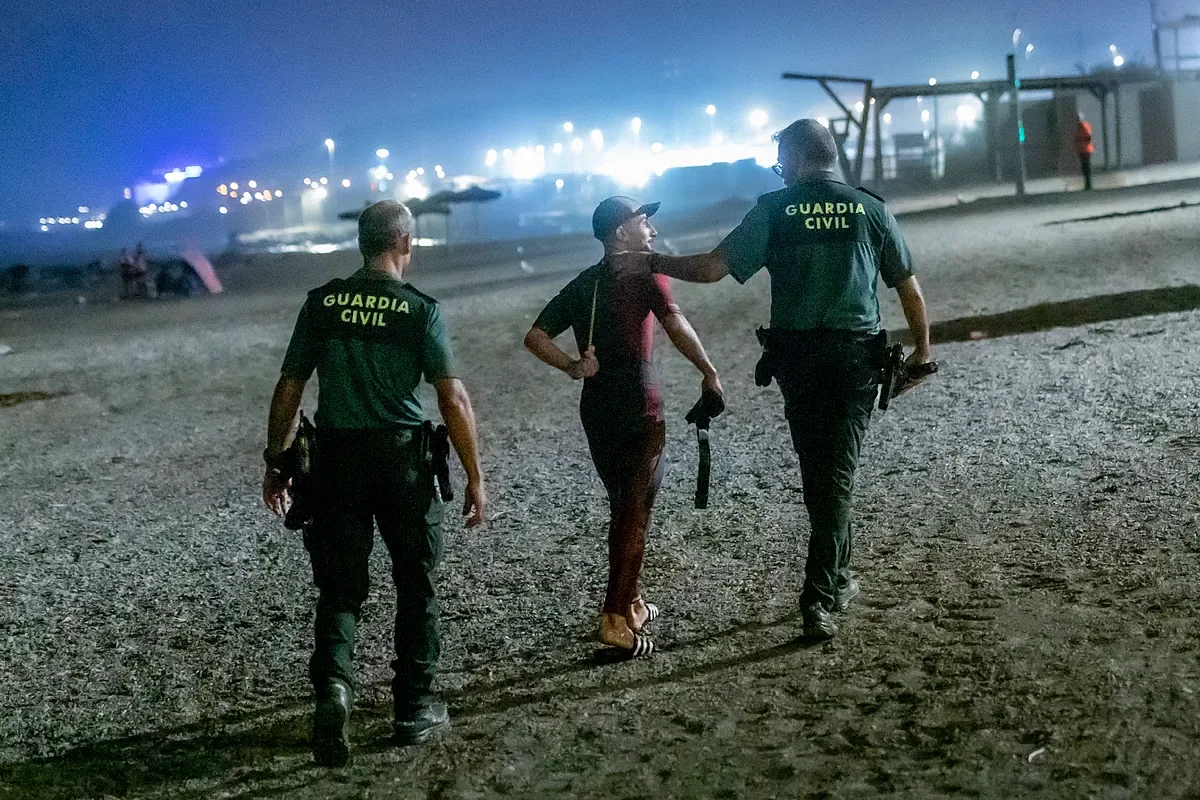
A recent Supreme Court ruling has confirmed that Spain cannot carry out ‘hot returns’ by sea of immigrants to Morocco. “It is inevitable to think that there is a ‘pull effect’ for that reason,” comments a civil guard while helping a young man out of a rocky area near the border.
“The CETI is a pressure cooker. Hundreds keep arriving every day,” adds the agent in conversation with the journalist. “Morocco is not cooperating. If they wanted, this wouldn’t happen. We know there are thousands more people there. Either this is stopped now or the situation will be as serious as five years ago.”
The arrival of swimmers from Morocco seems unstoppable. Although the boats of the Civil Guard and the Royal Moroccan Navy have a constant and active presence, day and night, in the waters that mark the maritime border between the two countries, dozens of floats adrift from those who have already managed to touch land can be seen from the coast closest to the neighboring country.
If any immigrant is spotted in those waters, the Civil Guard marks their location to their Moroccan counterparts to pick them up, although if the situation is really extreme, they are rescued by Spanish police forces. The president of Ceuta, Juan Vivas, appeared before the press yesterday. He described the migration situation as “serious” since all the city’s reception services are overwhelmed.
“We are living an extremely complicated situation,” said Juan Vivas. According to him, 1,500 immigrants have arrived by sea in recent days, and both the CETI and the minors’ reception centers are saturated. “There is no room for anyone else and more than 200 people enter daily.” Many of them, as witnessed by this newspaper, wander the streets of the autonomous city.
“Where is the CETI?” several young Moroccans, from a group of 16 people, asked yesterday at ten in the morning near the port of Ceuta. Apparently, all are adults. Four of them still wear wetsuits. Others simply wear swim shorts and show their bare torsos. One has left his fins lying in the middle of the sidewalk, about fifty meters from where they allow themselves to be photographed for EL MUNDO.
“It took us five hours to swim from a beach in Castillejos [the Moroccan town on the other side of the border]. We were very cold, but it was worth it. Almost all of us are from Tetouan, Tangier…,” explains, in precarious Spanish, one of the irregular immigrants in this group who has just crossed the maritime border between Ceuta and Morocco by swimming.
The young man clarifies that they did not manage to reach any Ceuta beach, but on the way, they were rescued by a Maritime Rescue boat, which works tirelessly. La Salvamar Atria, based in Ceuta, has not stopped rescuing immigrants since the early hours of last Tuesday, when the current wave of immigrants by sea, which started about 10 days ago, intensified.
“Now they have told us to go to the CETI. How do we get there?” insists the young immigrant in his question.
“We want to eat and rest, brother,” says another Moroccan from this group. He holds a packet of cookies which he begins to share among his travel companions.
Very close by, next to the taxi stand at the port, a Red Cross nurse treats the wounds of a man who, according to him, was beaten by a Moroccan gendarme the previous night before managing to throw himself into the sea from a beach in Castillejos.